Taco Bell is converting its annual National Taco Day into a seven-country event on October 6, partnering with language-learning platform Duolingo to launch what the brand is calling Global Taco Day — complete with a limited-edition co-branded sauce, multi-market in-store activations, and a loyalty-linked subscription giveaway.
The move is a useful case study in how large QSR operators are structuring brand collaborations: layered incentives across a single day, tied directly to a loyalty program, with market-specific execution rather than a one-size-fits-all push.
The Activation Stack
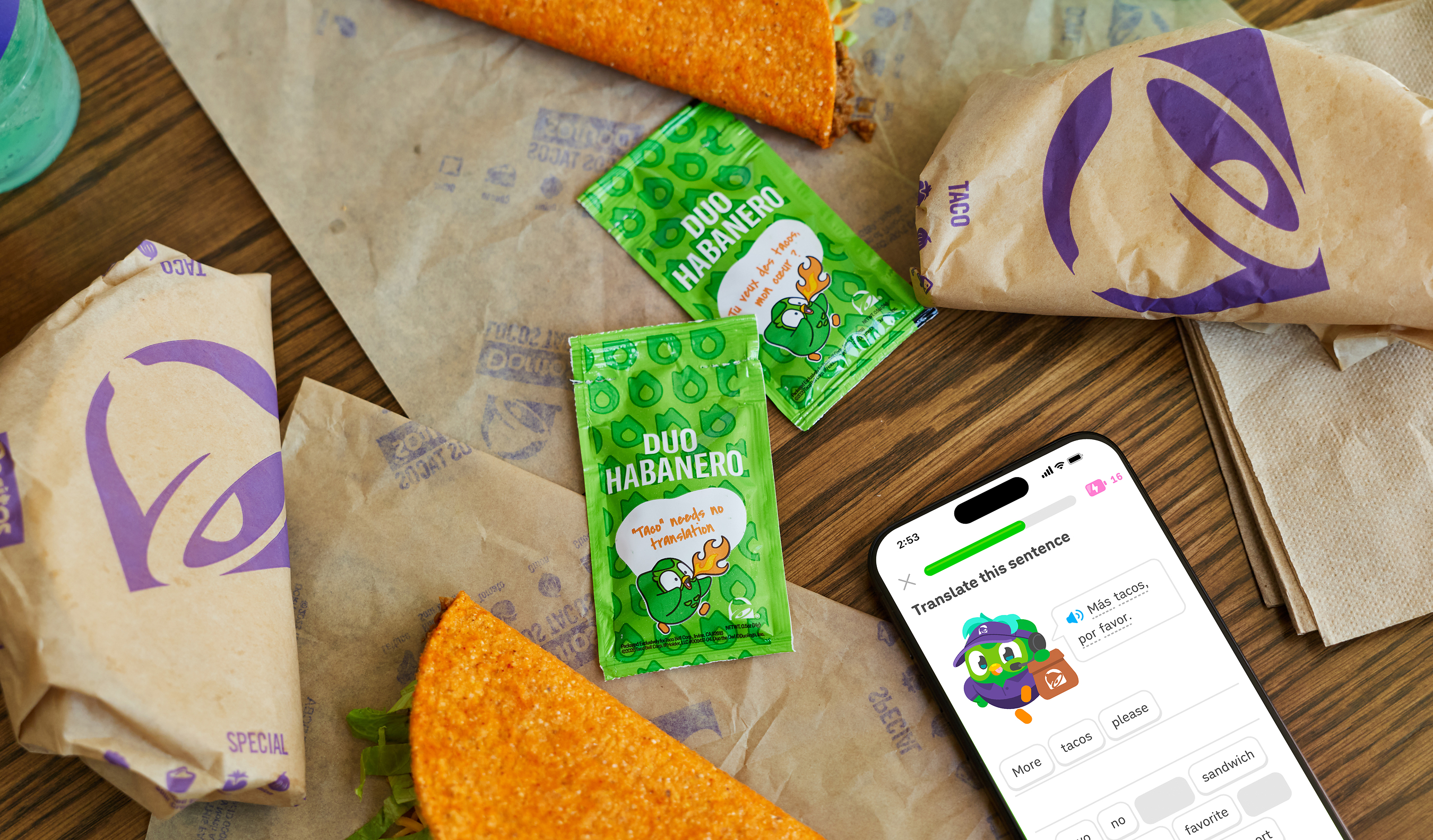
Taco Bell anchors the campaign around Duo Habanero Sauce, a limited-time sauce developed exclusively for the collaboration. The packet design carries taco-themed sayings in nine languages — English, Spanish, French, Hindi, Portuguese, German, Korean, Mandarin, and Japanese — with international markets receiving assortments localized to native and popular Duolingo study languages. In the U.S., one packet is free with any Doritos Locos Taco purchase; additional packets are priced at $0.20 each. The physical product becomes a brand touchpoint across every table, tray, and to-go bag that moves through a participating restaurant — a low-cost media placement that scales with transaction volume.
Beyond the sauce, Taco Bell Rewards members can unlock one free month of Super Duolingo between October 1 and October 6, with codes redeemable through November 15. That subscription bridge is the more strategically significant element: it ties Taco Bell's loyalty database directly into Duolingo's subscriber funnel, giving both brands a reason to share audience data and re-engagement mechanics. For operators benchmarking loyalty program design, the structure is worth noting — the offer is exclusive to Rewards members, time-boxed, and delivered through the app, all of which drive downloads and re-engagement without discounting core menu items.
What This Signals for Operators
The campaign's international scope — simultaneous activations in New York City, Mumbai, Toronto, and Shanghai — points to a growing expectation that major QSR brands will coordinate global moments rather than export domestic campaigns on a lag. For franchisees and regional operators in those markets, that means local execution requirements (staffing, inventory, promotional compliance) are increasingly driven by headquarters-level brand calendars tied to social media timing.
The Duolingo partnership also reflects a broader pattern in QSR brand-launch strategy: attaching a food brand to a non-food platform with a large, engaged mobile user base. Duolingo reports it is the top-grossing education app on both major app stores globally, giving Taco Bell access to a daily-habit user base that skews younger and internationally diverse — precisely the demographic profile QSR operators are competing for in international markets.
For vendors and agencies evaluating similar co-brand structures, the Taco Bell–Duolingo model bundles four revenue-driving mechanics into one activation window: a new SKU (the sauce), a subscription incentive (Super Duolingo), a collectible product (1,000 limited-edition plushies distributed globally via Tuesday Drops and local market events), and a physical in-store event tied to a specific address and time window. Each layer is designed to generate social content without requiring a paid media budget for every market. That's a replicable framework operators of any scale can adapt — even if the IP partnership requires more modest licensing than a brand of Duolingo's size.
Taco Bell's history with this holiday reinforces the compounding value of owning a calendar moment: the brand has methodically expanded National Taco Day each year since 2022, from a subscription pass to a legal challenge over "Taco Tuesday" to lobbying the National Day Calendar to move the date to a Tuesday. Going global is the next logical extension of that long-term brand-calendar investment, and it's one more data point for operators considering how annual occasions can anchor multi-year growth marketing plans rather than one-off promotions.
Written by Michael Politz, Author of Guide to Restaurant Success: The Proven Process for Starting Any Restaurant Business From Scratch to Success (ISBN: 978-1-119-66896-1), Founder of Food & Beverage Magazine, the leading online magazine and resource in the industry. Designer of the Bluetooth logo and recognized in Entrepreneur Magazine's "Top 40 Under 40" for founding American Wholesale Floral, Politz is also the Co-founder of the Proof Awards and the CPG Awards and a partner in numerous consumer brands across the food and beverage sector.