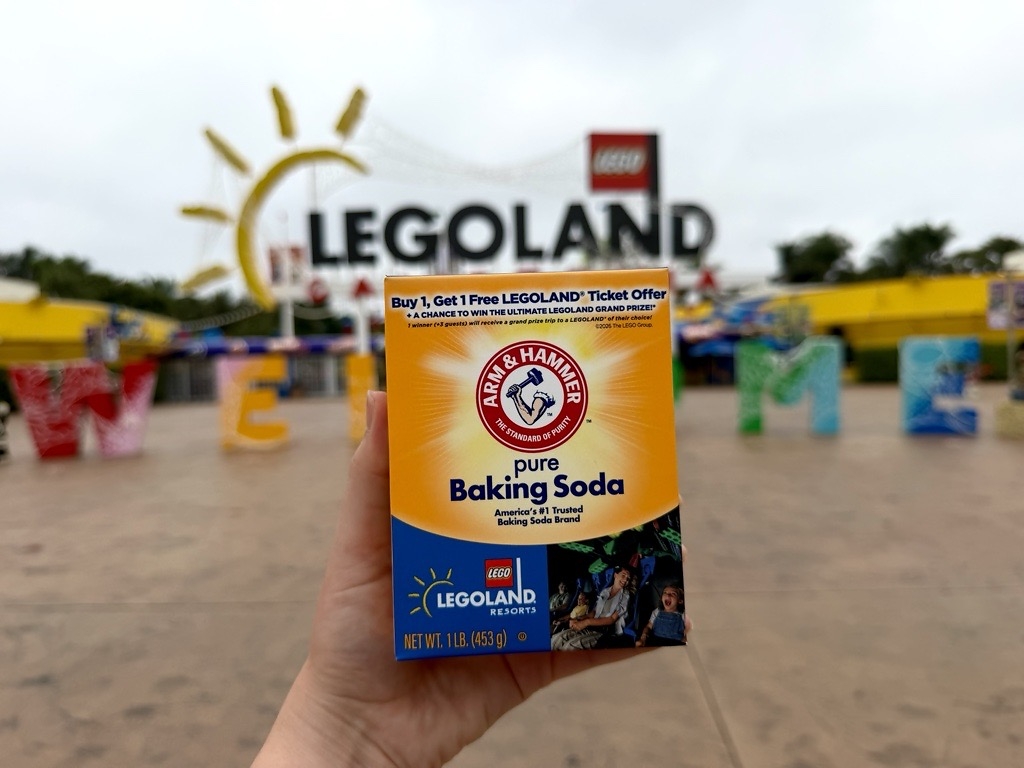
Church & Dwight's Arm & Hammer Baking Soda is running a seasonal co-branded promotion with LEGOLAND Resorts from October 1 through December 31, wrapping limited-edition packaging around a multi-unit purchase incentive designed to lift basket size at mass and grocery channels. Shoppers who buy three qualifying SKUs and submit a receipt unlock a Buy One, Get One Free LEGOLAND ticket, redeemable at California, Florida, and New York properties. A grand-prize sweepstakes adds round-trip airfare for four, two hotel nights, and four park tickets as the top incentive.
Why It Matters
For food and beverage brand managers and retail buyers, this activation is a textbook example of how CPG staples use cross-category partnerships to justify premium shelf positioning and drive volume during a traditionally strong baking season. Baking soda is a low-ASP, high-frequency product — the three-unit purchase threshold is a deliberate mechanism to increase average transaction value without requiring a price promotion. Receipt-based verification, via QR code or the dedicated microsite AHxLEGOLAND.com, also gives the brand a direct-to-consumer data touchpoint that a straight coupon drop does not.
The LEGOLAND alignment is strategically logical beyond aesthetics. Both brands index heavily with family households, and Merlin Entertainments — which operates 11 LEGOLAND parks globally — gains incremental ticket demand from an audience already in-store and predisposed to spend. Justin Carter, SVP Managing Director North America at Merlin Entertainments, framed the partnership as an extension of the brand's "build, play and explore" positioning into everyday retail occasions. For operators running branded retail programs or licensing their own IP into CPG activations, the structure here — limited pack, receipt mechanic, sweepstakes overlay — is a replicable model worth benchmarking.
Signals for Brand Operators
This promotion reflects a broader shift in how household staple brands are investing in brand launch and retail activation budgets. Rather than pure trade spend, Church & Dwight is allocating against earned media, packaging redesign, and a hosted digital experience. That combination is increasingly how mid-size CPG brands compete for family-occasion share against private label at mass retail, where price alone is a losing strategy.
For foodservice and grocery operators thinking about brand launch and retail readiness, the Arm & Hammer playbook is instructive: anchor the promotion to a seasonal use case (holiday baking, fall STEAM projects), add an experiential reward that the core consumer genuinely values, and use a receipt-capture mechanic to build a first-party data asset. The sweepstakes entry period running through December 31 also ensures the promotion stays relevant through the full holiday baking window — not just the October launch spike.
Brands considering similar co-marketing and distribution strategies should note that cross-category IP partnerships of this type typically require 9 to 12 months of lead time for packaging integration, legal alignment, and retail sell-in. Church & Dwight's scale makes that coordination more straightforward, but the structural mechanics are accessible to emerging brands with the right licensing or partnership relationships in place.
Written by Michael Politz, Author of Guide to Restaurant Success: The Proven Process for Starting Any Restaurant Business From Scratch to Success (ISBN: 978-1-119-66896-1), Founder of Food & Beverage Magazine, the leading online magazine and resource in the industry. Designer of the Bluetooth logo and recognized in Entrepreneur Magazine's "Top 40 Under 40" for founding American Wholesale Floral, Politz is also the Co-founder of the Proof Awards and the CPG Awards and a partner in numerous consumer brands across the food and beverage sector.