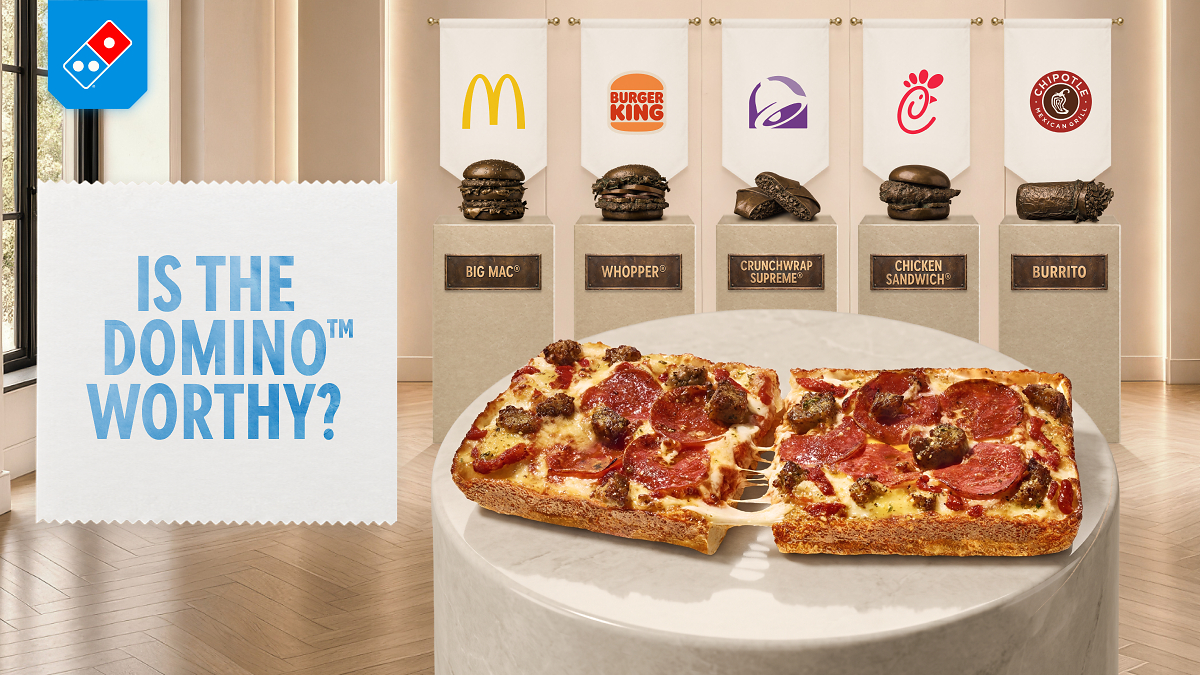
Domino's Pizza is launching what it calls the most significant new product in the chain's recent history: the Domino, a Detroit-style pizza built for a single diner, shaped like the brand's logo tile, and backed by a sampling campaign the company says is worth up to $1 million in free product.
The product arrives as single-serve and individual-portion formats have accelerated across QSR and fast-casual — a response to the growth of solo dining occasions, third-party delivery for one, and the persistent consumer desire for full topping control without negotiation. According to Kate Trumbull, Domino's executive vice president and chief marketing officer, "It solves a problem traditional pizza never could: everyone gets the toppings they love, without having to compromise."
The Product Details
The Domino is handmade on a buttery-flavored pan dough encrusted with real Parmesan cheese, baked in a rectangular pan to produce a crispy Detroit-style crust. It layers two types of cheese, a customer-selected sauce, up to three toppings, and finishes with Domino's signature garlic seasoning — cut into two slices and designed as a complete individual meal. Domino's internal testing rated it among the highest-performing products in the company's history, a claim operators should note given the chain's scale: more than 22,500 stores across 90-plus markets and over $20.6 billion in global retail sales in the trailing four quarters ended June 2026.
The Campaign Mechanic
The activation strategy is worth a close look from any operator or brand marketer planning a product launch or sampling campaign. To receive a free Domino, customers must purchase a named competitive product — a McDonald's Big Mac, Burger King Whopper, Taco Bell Crunchwrap Supreme, Chick-fil-A Chicken Sandwich, or Chipotle Burrito — then upload that receipt to IsTheDominoWorthy.com to receive a redemption code. The mechanic runs through September 30, 2026, with codes available on a first-come, first-served basis. At least 105,375 offer codes are confirmed available.
This cross-brand receipt mechanic is a high-visibility tactic that converts competitive purchase data into first-party trial — giving Domino's a read on which competitor's customers are most likely to switch occasions, while generating earned media through the provocation of naming rivals directly. For brand and menu teams at regional chains or emerging concepts, the structure is instructive: it ties sampling to a behavioral trigger (a competitor transaction) rather than a passive coupon drop, which tends to produce higher-intent trial audiences.
What This Signals for Operators
Domino's executing this at national scale with a $1 million sampling commitment reinforces a broader shift in QSR launch strategy: product debuts now require a media moment and a participation mechanic, not just a limited-time-offer price point. With more than 85% of U.S. retail sales flowing through digital channels in 2025, Domino's is also positioning the Domino as a digital-native SKU — an app- and web-first ordering item optimized for individual delivery occasions.
For independent operators and regional pizza concepts, the individual-portion format is the more durable signal. Consumer data across foodservice has consistently pointed toward smaller-party dining and the growth of "meal for one" as a planned occasion rather than a fallback. Any operator still relying exclusively on shared-format menu architecture — full pies, shareable apps — should assess whether a single-serve tier belongs in next year's menu development calendar.
For suppliers and packaging vendors serving the pizza segment, the Detroit-style rectangular pan format at individual scale represents a procurement and equipment consideration worth tracking as the format gains mainstream visibility through Domino's distribution footprint.
See related coverage on single-serve menu strategy and QSR innovation and brand launch mechanics for foodservice operators.
Written by Michael Politz, Author of Guide to Restaurant Success: The Proven Process for Starting Any Restaurant Business From Scratch to Success (ISBN: 978-1-119-66896-1), Founder of Food & Beverage Magazine, the leading online magazine and resource in the industry. Designer of the Bluetooth logo and recognized in Entrepreneur Magazine's "Top 40 Under 40" for founding American Wholesale Floral, Politz is also the Co-founder of the Proof Awards and the CPG Awards and a partner in numerous consumer brands across the food and beverage sector.