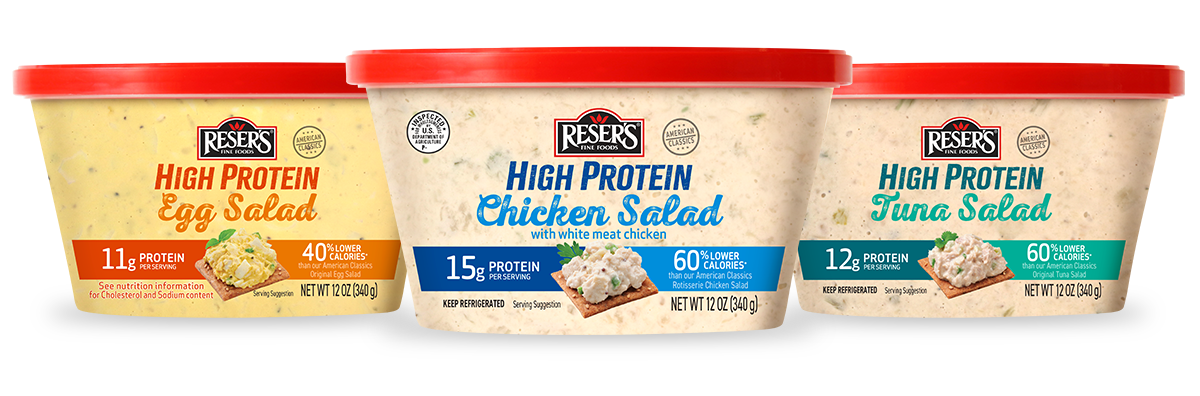
A Reser's Fine Foods survey of 1,000 U.S. consumers aged 16–29 found that 50.0% of Gen Z are eating more protein today than two years ago — and 95.0% say they want more variety in how they get it. The family-owned refrigerated prepared foods manufacturer is answering that demand with a new High Protein Deli Salads line: Chicken Salad (15g protein per serving), Tuna Salad (12g), and Egg Salad (11g), all now in the deli section at major grocery retailers nationwide.
The product formulation leans on a cottage-cheese-based dressing — a functionally interesting move that Megan Torres, senior brand strategy manager for Reser's, says delivers 25.0% more protein and 40.0–60.0% fewer calories compared to Reser's traditional deli salads. That's a notable reformulation strategy: rather than adding protein isolates or powders, the brand repositioned a familiar dairy ingredient as the functional hero. For deli buyers and category managers, the cottage cheese base also works within existing refrigerated supply chains without introducing novel ingredients that complicate procurement.
What the Survey Signals
The Gen Z data carries purchasing intelligence worth tracking. Three out of four respondents identify as "Team Protein" over team carbs. Nearly 70.0% report feeling better after increasing protein intake. And 87.0% say they want high-protein versions of foods they already know — not new formats or unfamiliar SKUs. That last number is significant for operators and retail buyers evaluating which functional food bets are realistic: the appetite is for familiar formats with upgraded nutrition profiles, not category disruption.
For foodservice operators — particularly those running deli, grab-and-go, or catering programs — this data reinforces what menu trend trackers have flagged for the past 18 months: protein density is now a menu attribute, not just a fitness-channel talking point. The 63.0% of Gen Z consumers who say they're tired of eating the same proteins and want more options is a direct brief for deli operators looking to differentiate ready-to-eat programs. Traditional chicken-breast and hard-boiled-egg options are no longer sufficient as a protein strategy.
Retail Readiness and Operator Implications
Reser's operates 14 facilities across the U.S. and Mexico and employs more than 5,000 people, giving it the distribution infrastructure to execute a national deli launch without leaning on a co-manufacturer. The new SKUs join an existing portfolio that includes Deviled Egg Potato Salad, Macaroni Salad, and Cole Slaw — meaning retail buyers can rationalize placement as a line extension rather than a new brand relationship. That lowers the barrier to shelf entry considerably.
For operators managing deli case resets or evaluating refrigerated prepared food suppliers, the Reser's move is a useful benchmark: the protein-forward deli salad segment is now getting formulation investment from established players, not just challenger brands. Suppliers pitching protein-forward SKUs into foodservice channels should expect buyers to reference this launch as proof that the category has retail legs. And for brands earlier in the product launch and retail readiness process, Reser's survey methodology — commissioning consumer research to anchor a product story — is a replicable strategy for building buyer-deck credibility with category data rather than brand claims alone.
Written by Michael Politz, Author of Guide to Restaurant Success: The Proven Process for Starting Any Restaurant Business From Scratch to Success (ISBN: 978-1-119-66896-1), Founder of Food & Beverage Magazine, the leading online magazine and resource in the industry. Designer of the Bluetooth logo and recognized in Entrepreneur Magazine's "Top 40 Under 40" for founding American Wholesale Floral, Politz is also the Co-founder of the Proof Awards and the CPG Awards and a partner in numerous consumer brands across the food and beverage sector.