A new professional toolkit designed to move fermented foods from nutrition journals into hospital cafeterias, teaching kitchens, and foodservice menus arrived this week — and the partnership behind it signals how ingredient suppliers are increasingly investing in practitioner-level education to drive category adoption.
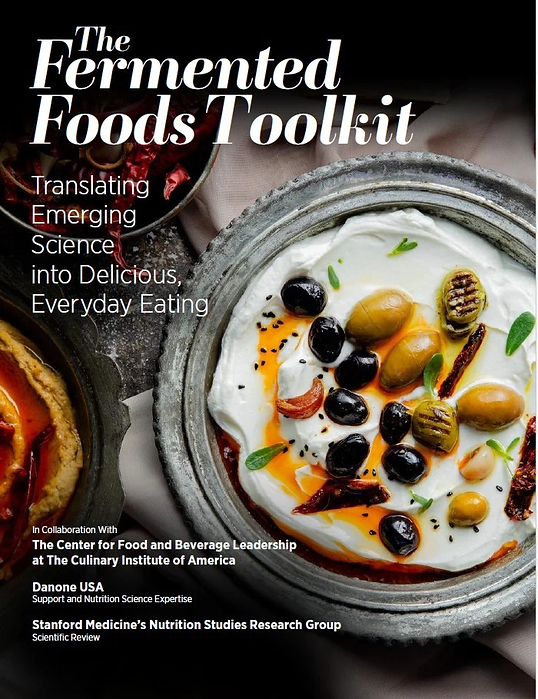
Danone USA contributed nutrition science expertise to The Fermented Foods Toolkit: Translating Emerging Science into Delicious, Everyday Eating, developed by The Center for Food and Beverage Leadership at The Culinary Institute of America. Researchers from Stanford Medicine's Nutrition Studies Research Group provided scientific review. The free downloadable resource is part of Danone's two-year commitment as a founding exhibitor of the Food is Life, Food is Health Summit, a joint initiative between the CIA and Stanford Medicine.
What the Toolkit Contains
The publication is structured for real-world professional use across three distinct settings: clinical patient consultations, foodservice menu development, and community nutrition programming. It includes visual learning tools that address common consumer-facing myths — including why pickled foods are not automatically fermented — as well as flavor-forward recipes featuring yogurt, kimchi, sauerkraut, and miso in applications like grain bowls, dressings, and sauces. A dedicated section provides culturally adaptive guidance for diverse patient and guest populations across varying budgets.
"We heard from professionals that the challenge is not simply finding nutrition information," said Kristen Rasmussen, MS, RDN, Program Director of Food is Life, Food is Health and Assistant Director of Health & Sustainability Programs at the Culinary Institute of America. "They asked for clear evidence summaries, approachable recipes, flexible meal ideas, and visual tools that can work during a patient visit, in a teaching kitchen, or in foodservice."
The toolkit also addresses the FDA's first qualified health claim for yogurt — granted following a petition from Danone — linking regular yogurt consumption to reduced risk of type 2 diabetes. Pairing that regulatory milestone with culinary application guidance is a deliberate strategy to move the claim out of marketing copy and into menu engineering conversations.
Intelligence for Operators and Buyers
For foodservice operators, the practical signal here is that fermented foods are moving past trend status and into clinical credibility. As healthcare systems expand their food-as-medicine programming and hospital foodservice accounts grow as a procurement channel, having menu items that align with practitioner-recommended dietary patterns is increasingly a competitive differentiator — not just a wellness marketing angle.
Suppliers in the fermented-food and probiotic-ingredient space will note Danone's approach: co-developing practitioner tools rather than relying on consumer advertising alone. This puts branded science education into the hands of registered dietitians and executive chefs simultaneously, compressing the path from evidence to plate. For operators evaluating menu and beverage trends driven by health-forward purchasing, this category is now backed by an FDA-recognized claim and a CIA-stamped culinary framework.
Buyers and category managers sourcing fermented ingredients — miso, kimchi, kefir, yogurt — for healthcare dining, university foodservice, or fast-casual menus should monitor how this toolkit gets adopted in clinical settings, since practitioner recommendations have historically accelerated institutional procurement shifts. As covered in our look at ingredient positioning and brand launch strategy, the brands that invest in professional education at this stage tend to capture institutional shelf space before the trend fully commoditizes.
What This Signals
Danone's two-year commitment to the Food is Life, Food is Health platform is a longer-cycle brand strategy — one designed to build durable practitioner trust rather than generate short-term trial. For competing suppliers and operators watching category spend, the takeaway is straightforward: fermented foods are no longer a niche menu add-on. They are entering the clinical nutrition mainstream, and the foodservice operators best positioned to benefit are those who build sourcing relationships and menu frameworks now.
Written by Michael Politz, Author of Guide to Restaurant Success: The Proven Process for Starting Any Restaurant Business From Scratch to Success (ISBN: 978-1-119-66896-1), Founder of Food & Beverage Magazine, the leading online magazine and resource in the industry. Designer of the Bluetooth logo and recognized in Entrepreneur Magazine's "Top 40 Under 40" for founding American Wholesale Floral, Politz is also the Co-founder of the Proof Awards and the CPG Awards and a partner in numerous consumer brands across the food and beverage sector.