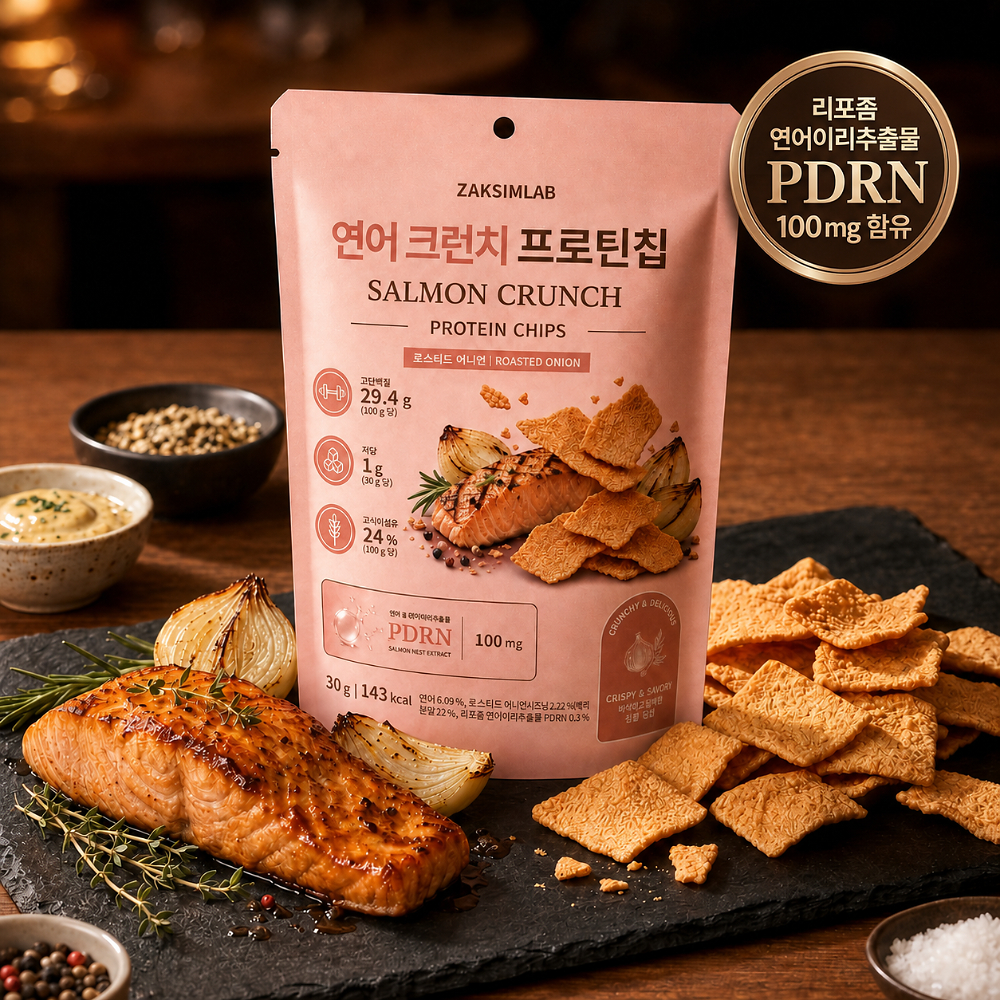
South Korean food brand ZAKSIMLAB launched Salmon Crunch Protein Chips in September and is now actively pitching a bundled retail and menu concept — pairing the chips with its existing powdered kombucha line — directly to cafe operators and distributors across the domestic market. The move is less a product launch and more a channel-entry strategy: ZAKSIMLAB is using the snack as a vehicle to deepen its footprint in the cafe retail segment.
The chips are built on Alaska pollock surimi and salmon, pressed with rice flour from Korean-grown rice and finished in brown rice oil. The result is a thin, crispy, roasted-onion-flavored snack that skews toward the savory-protein positioning gaining traction in Asian convenience and cafe retail. The format is deliberate — single-serve and shelf-stable, which fits naturally alongside a powdered kombucha stick pack at a cafe counter or in a grab-and-go display.
The Cafe Channel Play
ZAKSIMLAB debuted both products together at the 2026 Cafe & Bakery Fair Season 2, held October 29 through November 1 at KINTEX in Goyang, Gyeonggi Province. The booth ran kombucha tastings and chip sampling simultaneously, while brand representatives walked cafe owners and distributor buyers through two distinct use cases: kombucha as a customizable beverage base for drink menus, and salmon chips as an in-store retail SKU. That dual pitch — beverage menu ingredient and retail impulse item — is a smart compression of the sales conversation for small-format cafe operators who need products to serve double duty.
The kombucha line currently spans 12 flavors, including lemon, flat peach, and plum, all in powdered single-serve stick packs designed to dissolve in still or sparkling water. For cafe operators, that format lowers the barrier to menu experimentation: no cold chain, no special equipment, and flexible flavor rotation without inventory risk. Pairing it with a shelf-stable snack SKU gives distributors a natural bundle to place.
Pairing Campaign and What It Signals
Beyond trade distribution, ZAKSIMLAB is preparing a consumer-facing pairing campaign targeting Millennial and Gen Z adults. The campaign frames salmon chips alongside kombucha-based highballs as part of what the brand describes as a gathering culture that accommodates varying drinking preferences — including non-alcoholic choices. That framing is worth noting for operators: it positions kombucha not as a wellness afterthought but as a social beverage with parity alongside alcohol, a narrative that has gained significant traction in the low- and no-alcohol category globally.
For cafe and specialty retail operators evaluating their snack and beverage adjacencies, ZAKSIMLAB's bundled approach reflects a broader shift in how emerging Asian food brands are entering wholesale channels — leading with a pairing story rather than a standalone SKU pitch. It reduces buyer friction and gives floor staff a simple selling script. Operators sourcing for beverage program expansion or evaluating emerging snack brands for retail adjacency should watch how this co-merchandising model performs in the Korean cafe market, where it may surface as a template for other functional snack and drink pairings moving into Western distribution.
Written by Michael Politz, Author of Guide to Restaurant Success: The Proven Process for Starting Any Restaurant Business From Scratch to Success (ISBN: 978-1-119-66896-1), Founder of Food & Beverage Magazine, the leading online magazine and resource in the industry. Designer of the Bluetooth logo and recognized in Entrepreneur Magazine's "Top 40 Under 40" for founding American Wholesale Floral, Politz is also the Co-founder of the Proof Awards and the CPG Awards and a partner in numerous consumer brands across the food and beverage sector.