The Move
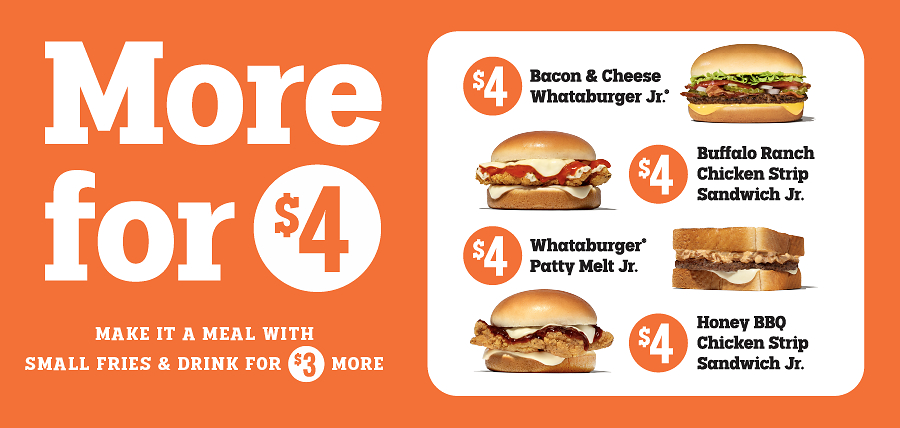
Whataburger launched More for $4 on August 18, establishing a permanent value tier across its 1,200-plus locations in 17 states. The platform offers four Jr.-format items — Bacon & Cheese Whataburger Jr., Whataburger Patty Melt Jr., Honey BBQ Chicken Strip Sandwich Jr., and Buffalo Ranch Chicken Strip Sandwich Jr. — each priced at $4. Guests can add a small fries and drink for $3 more, creating a full meal entry point at $7. The offer is available 24/7 across drive-thru, digital, and in-app ordering channels.
What makes this more than a promotional play is the architecture: this is a named platform, not a limited-time offer. Whataburger is positioning More for $4 as an everyday value destination rather than a discounting event, a distinction that carries real operational weight. Jessica Reicher, Chief Operating Officer, framed it plainly: the goal is to give guests more choice and made-to-order quality at a price that fits their daily lives.
Why Operators Should Watch This
The broader QSR industry has spent the past 18 months reacting to consumer pushback on menu inflation. Traffic data across the fast-food segment has shown that value perception — not just absolute price — is the lever that moves frequency. Operators who structured value around temporary discounts found themselves in a promotional treadmill; those building named, standing tiers are seeing more durable returns on traffic and app engagement.
Whataburger's decision to anchor the platform to Jr.-format items is deliberate margin management. Smaller-format proteins at a fixed $4 retail price allow the chain to maintain quality signaling — made-to-order, customizable — without cannibalizing full-size SKUs. The $3 meal upgrade is also a clean upsell mechanic that keeps average check defensible. For multi-unit operators and franchisees watching this, the lesson is that a structured value entry point with a visible upgrade path outperforms an undifferentiated discount on a flagship item.
Simultaneously, Whataburger is standardizing its Jr. Whatameal lineup — all All-Time Favorite and limited-time Jr. Whatameals now include a small fries and small drink — which simplifies crew execution and reduces order complexity at the POS. That kind of menu rationalization alongside a value launch is a signal that this is a system-wide operational initiative, not just a marketing campaign.
Signals for the Market
For vendors, agencies, and tech providers in the hospitality stack, this launch has a few readable implications. First, the heavy lift on digital — app download incentives, online ordering integration, loyalty point accrual — suggests Whataburger is using the value platform as a first-party data acquisition tool. Guests who download the app to access offers generate customer profiles that feed CRM, retargeting, and geo-fenced media strategies. Value and growth marketing are increasingly the same budget line.
Second, the Jr.-format play has procurement ripple effects. Suppliers serving regional QSR chains and emerging fast-casual brands should note how Whataburger structures its value SKUs around existing core proteins in smaller portions, rather than introducing new ingredients. That approach compresses SKU count and protects supply chain predictability — a model worth benchmarking for operators managing food cost volatility heading into 2027.
For operators evaluating their own menu pricing strategy or exploring how digital channels can support a value-focused brand launch, Whataburger's More for $4 is a clean case study in platform thinking over promotional thinking.
Written by Michael Politz, Author of Guide to Restaurant Success: The Proven Process for Starting Any Restaurant Business From Scratch to Success (ISBN: 978-1-119-66896-1), Founder of Food & Beverage Magazine, the leading online magazine and resource in the industry. Designer of the Bluetooth logo and recognized in Entrepreneur Magazine's "Top 40 Under 40" for founding American Wholesale Floral, Politz is also the Co-founder of the Proof Awards and the CPG Awards and a partner in numerous consumer brands across the food and beverage sector.