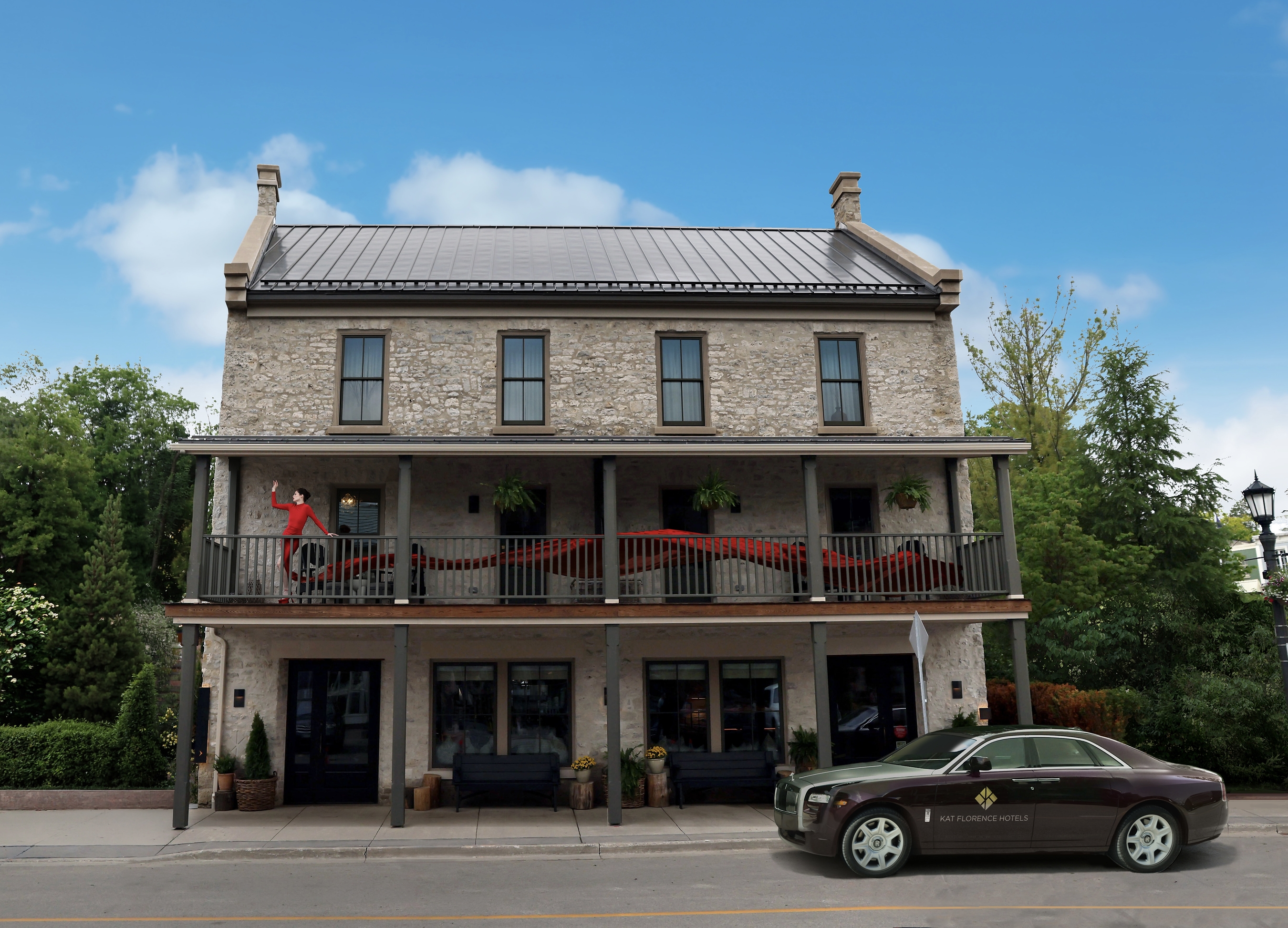
Effective September 1, Kat Florence Hotel in Elora, Ontario is rolling out its most substantive programming expansion since opening — one that repositions the intimate limestone retreat as a fully bundled ultra-luxury proposition rather than a traditional room-rate property. The package adds a 100-acre private nature reserve, a restored 1870s heritage manor with its own celebrity resident chef, nightly tasting dinners led by a rotating fleet of internationally credentialed culinary talent, and a living gallery of seven-figure gemstones embedded in the hotel's original walls.
The Culinary Stack
The dining programme is where operators and hospitality buyers will find the most transferable intelligence. Every guest stay at Kat Florence Hotel already included a multi-course tasting dinner; the September expansion deepens the roster with the addition of Chef Neill Anthony, a private chef to royals and celebrities whose client list includes King Charles, the Prince and Princess of Wales, Elton John, and Paul McCartney. Anthony's CV runs through Gordon Ramsay, Marcus Wareing, and Alyn Williams, and he has served as an on-tour private chef for Middle Eastern royal families. He joins a fleet that includes Chef Anthony Bish — known from MasterChef and Iron Chef appearances — and Chef Marc Collyer, formerly of the twice Michelin-starred The Manor House in the UK. The model is deliberately unpredictable: guests are not told in advance which chef will be cooking that evening, creating a built-in experiential variable that supports repeat stays and word-of-mouth. For operators benchmarking inclusive-dining models, the structure is worth studying: rather than an à la carte upsell, culinary talent is woven into the base rate as a non-negotiable pillar of value.
The Manor and the Reserve
The Imperial Jade Manor — a limestone Italianate Revival residence originally built in the 1870s and later repurposed as a girls' school — now operates as a private-booking estate within the hotel's orbit. Its dedicated resident chef is Chef Dale Mackay, Canada's first Top Chef winner, formerly the youngest-ever Relais & Châteaux Grand Chef designee, and a veteran of Gordon Ramsay's kitchens in New York and Japan as well as Daniel Boulud's Dinex Group. The manor's amenities include a six-figure custom stone hot bath and a 60-foot swimming pool — details that matter less to the foodservice operator than the underlying model: a single-estate culinary residency built around one named chef rather than a rotational programme.
The Kat Florence Reserve, the 100-acre private wilderness sanctuary accessible only by invitation and guided one couple or suite at a time, extends the property's land footprint into protected Elora Gorge terrain. The conservation mandate — Kat Florence purchased the land specifically to prevent corporate development — doubles as a brand differentiator in an era when land stewardship and regenerative hospitality are increasingly visible in luxury travel positioning.
The expansion also introduces a Library on the River reading and working space, complimentary Sundowners styled after Southern African safari lodges, and a rotating display of museum-grade gemstones — including a 424.8-carat Royal Velvet Blue Tanzanite and a 52.48-carat flawless Jeremejevite set in D-flawless diamonds — installed directly into the hotel's 1848 limestone walls.
What Operators Should Track
The Kat Florence model is a case study in all-inclusive value stacking at the ultra-luxury tier. The property is not competing on room count or distribution scale; it is competing on the density of credential and rarity per guest night. For boutique hotel operators, food-and-beverage directors, and culinary consultants, the relevant question is whether a chef-residency model — where a named, credentialed chef is tied to a specific property or estate — commands meaningfully higher ADR than a rotational or contract-catering approach. The Kat Florence expansion suggests the answer is yes, at least at the top end of the market. For suppliers and vendors serving the luxury hospitality segment, the signal is that provenance, exclusivity, and named talent are being bundled into the base product rather than sold as add-ons — a structural shift that has implications for menu and beverage trend planning and brand launch positioning in the Canadian hospitality market.
Written by Michael Politz, Author of Guide to Restaurant Success: The Proven Process for Starting Any Restaurant Business From Scratch to Success (ISBN: 978-1-119-66896-1), Founder of Food & Beverage Magazine, the leading online magazine and resource in the industry. Designer of the Bluetooth logo and recognized in Entrepreneur Magazine's "Top 40 Under 40" for founding American Wholesale Floral, Politz is also the Co-founder of the Proof Awards and the CPG Awards and a partner in numerous consumer brands across the food and beverage sector.