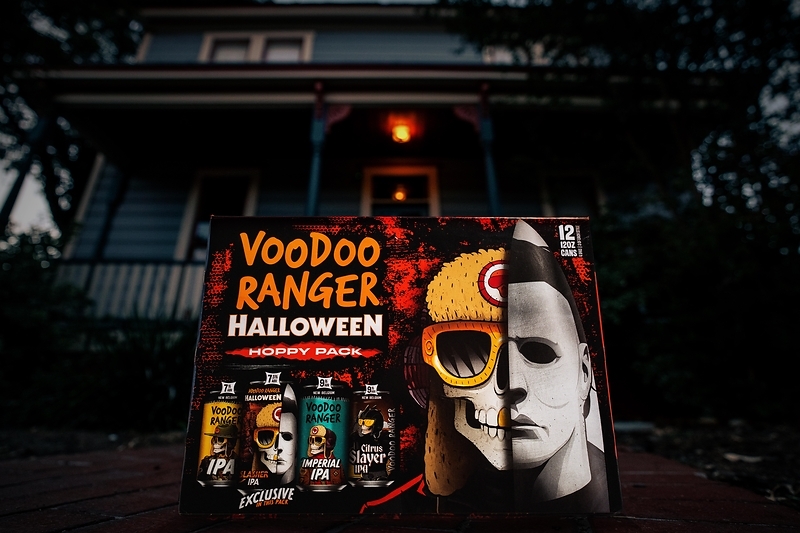
New Belgium Brewing's Voodoo Ranger is running one of the more structurally interesting Halloween activations in craft beer this season: a nationwide search for people legally named Michael Myers, rewarding verified winners with cash equivalent to a year's supply of Voodoo Ranger beer. The stunt, called Slasher Manhunt, is built around a partnership with Halloween: The Game and anchored by a limited-edition collaboration SKU, Slasher IPA, available exclusively in a Hoppy Pack variety format. The entry window closes October 7, 2026, the same night a live event — branded 'Party Without Fear' — takes place at Ray's on the Lower East Side in New York City.
Why the SKU Structure Matters
The Slasher IPA isn't just a branding vehicle — it's a sell-through mechanism. By limiting availability to the Hoppy Pack and tying the SKU to an active cultural moment, Voodoo Ranger creates urgency at retail without requiring a permanent line extension. According to NIQ all-outlet data through September 5, 2026, the collab Hoppy Pack is the fastest-selling Hoppy Pack Voodoo Ranger has released this year. For operators and buyers evaluating limited-edition craft placements, that velocity figure is the number worth tracking. When the Hoppy Pack sells through, Slasher IPA is gone — a scarcity signal that keeps distributor relationships clean and avoids inventory drag.
The IP partnership with Halloween: The Game (developed by IllFonic and published by Gun Interactive) layers in a cross-category reach play. Gaming audiences skew 21–35 and over-index on craft beer consumption, making the collab a reasonably efficient audience extension for a brand already positioned as America's number-one IPA. Kiron Chakraborty, Marketing Director of Voodoo Ranger, framed the campaign simply: "We're rewarding real Michael Myerses with a year's supply of Voodoo Ranger because Halloween deserves to be celebrated, not endured."
What Operators and Buyers Should Take From This
For on-premise operators, the Voodoo Ranger activation is a useful case study in how suppliers are increasingly doing the promotional heavy lifting around limited SKUs. The live event component — ID verification, game demos, exclusive giveaways at a named venue — gives bar and restaurant partners a ready-made programming hook without requiring them to build a concept from scratch. That's a template worth flagging as brewers compete for tap handles and back-bar real estate heading into the holiday quarter.
For retail buyers and distributors, the campaign illustrates a broader shift in how craft brands are managing SKU proliferation. Rather than launching a permanent Halloween seasonal that competes with existing portfolio lines, Voodoo Ranger contains the release inside a variety pack with a hard end date. It drives trial, generates social content, and exits cleanly. Brands executing limited drops with media-backed launch packages are consistently outperforming evergreen extensions on velocity metrics in the current off-premise environment.
The name-based eligibility mechanic — open only to people who can legally prove their name is Michael Myers — is deliberately narrow, but its PR surface area is wide. Earned media coverage of a stunt like this costs a fraction of a paid programmatic campaign, yet the impression volume and brand-search lift can rival paid channels for a week or more around a cultural moment. Beverage brands building seasonal growth programs are increasingly designing stunts with this earned-to-paid ratio in mind.
Written by Michael Politz, Author of Guide to Restaurant Success: The Proven Process for Starting Any Restaurant Business From Scratch to Success (ISBN: 978-1-119-66896-1), Founder of Food & Beverage Magazine, the leading online magazine and resource in the industry. Designer of the Bluetooth logo and recognized in Entrepreneur Magazine's "Top 40 Under 40" for founding American Wholesale Floral, Politz is also the Co-founder of the Proof Awards and the CPG Awards and a partner in numerous consumer brands across the food and beverage sector.