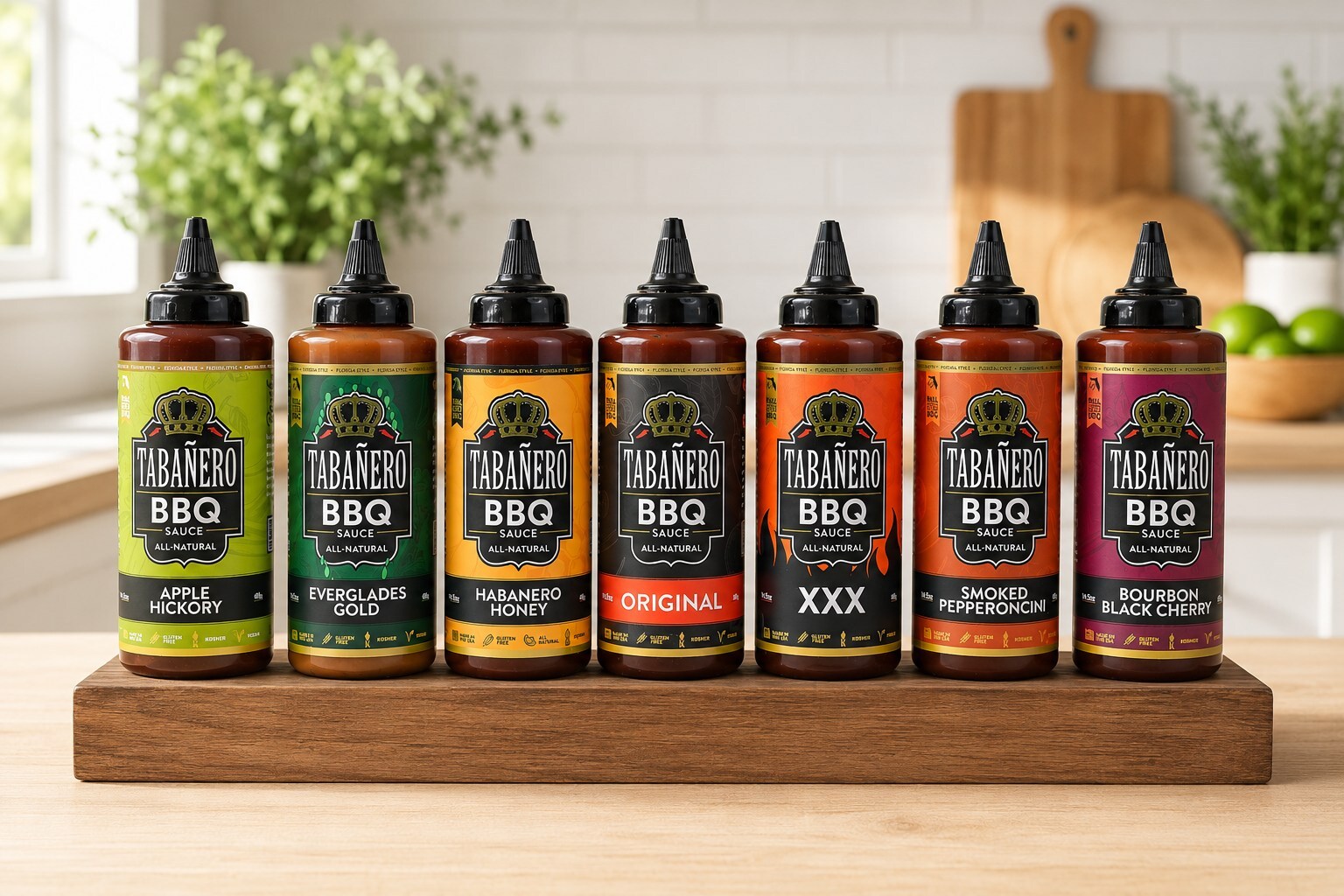
Tabañero Holdings, the Delray Beach-based condiment brand that built its name on premium hot sauces, is moving into the barbecue sauce category with a seven-SKU lineup that leans hard on clean-label credentials. The collection draws on Florida's Southern, Caribbean, and Latin American culinary influences and is formulated to deliver roughly half the sugar and calories of the category's dominant national brands. For operators and buyers, the launch is less about a new condiment and more about a positioning thesis: that better-for-you can coexist with bold flavor at the retail shelf, without the premium-price penalty that typically comes with 'clean' products.
The barbecue sauce category is crowded but increasingly vulnerable to disruption. Legacy brands like KC Masterpiece and Sweet Baby Ray's hold substantial market share, but their nutrition panels — often 15–17 grams of sugar per two-tablespoon serving — have become a liability as retail buyers respond to GLP-1 adoption trends, clean-label mandates from regional grocery chains, and a broader consumer shift toward ingredient transparency. Tabañero's move mirrors what brands like Primal Kitchen did in the dressing and mayo aisle: attack a dominant, low-innovation category on the axis of health without surrendering on taste. That playbook has proven repeatable for brands with genuine culinary credibility.
For food brands evaluating retail expansion, the intelligence here is in the sourcing story. Locally sourced Florida produce is not just a marketing line — it is a buyer conversation point for regional grocery chains and specialty retailers who are actively building local-brand sections into their planograms. Brands entering retail today without a provenance narrative or a differentiated nutrition story are fighting for shelf space on price alone, which is a difficult position for an emerging brand to sustain. Tabañero's dual-angle pitch — clean ingredients plus regional identity — gives broker reps and category managers something concrete to present at the buy. That kind of retail-readiness thinking, from formulation through to the buyer deck, is what separates a successful launch from a slow-turn delisting within 18 months. Operators sourcing house-made or branded condiments for restaurant use should also note the lower sugar profile as a menu-claim asset, particularly for health-forward concepts or dietary-accommodation menus.
The launch also signals that Tabañero is building a platform brand rather than a single-product business. Moving from hot sauce into barbecue is a deliberate category adjacency — same usage occasion, same retail section, same consumer — which reduces the cost of shelf acquisition and supports incremental velocity across both lines. Brands that can demonstrate multi-SKU velocity from a single buyer relationship are materially more attractive to distributors and brokers navigating tighter warehouse slot economics. For suppliers and co-manufacturers watching this space, demand for clean-label barbecue formulations with reduced sugar is a real R&D signal worth tracking. For retail-ready brand launch strategy, see how operators are structuring buyer decks and distribution introductions to support exactly this kind of category expansion. And if you are benchmarking launch media for a condiment brand, the programmatic and geo-fencing playbook used by emerging food brands is worth a read before you finalize your launch spend.
Written by Michael Politz, Author of Guide to Restaurant Success: The Proven Process for Starting Any Restaurant Business From Scratch to Success (ISBN: 978-1-119-66896-1), Founder of Food & Beverage Magazine, the leading online magazine and resource in the industry. Designer of the Bluetooth logo and recognized in Entrepreneur Magazine's "Top 40 Under 40" for founding American Wholesale Floral, Politz is also the Co-founder of the Proof Awards and the CPG Awards and a partner in numerous consumer brands across the food and beverage sector.