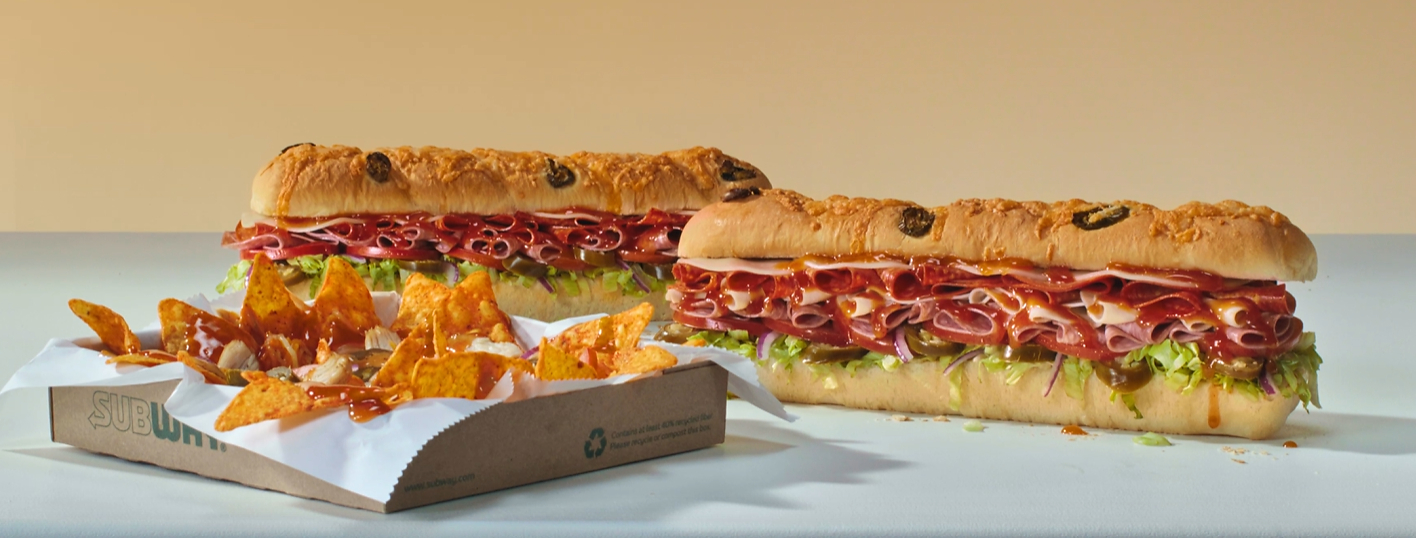
Subway is expanding its Hot Honey platform into a full limited-time collection built around a CPG co-brand, launching the Hot Honey Signature Swicy Collection on Aug. 20 and running it through Oct. 26. The centerpiece is Doritos® Hot Honey Nachos — a fixed-build snack item starting at $4.99 — flanked by two new subs: the Hot Honey Italian and the Hot Honey Turkey Italiano. For QSR operators and foodservice marketers watching how top chains monetize flavor trends, this rollout is a practical case study in margin-aware LTO construction.
The Format Logic
The nacho build is deliberately constrained. Guests choose from three pre-set configurations — Chicken, Steak, or Cheese — rather than a fully customizable format. That decision isn't accidental. Fixed builds reduce ticket-time variance, simplify crew training, and protect food cost consistency across thousands of franchise locations. The $4.99 price point on Chicken and Cheese builds gives franchisees a defensible value anchor without discounting core sub margins. Steak carries an upcharge, preserving protein-tier pricing discipline. Operators running their own LTO programs should note that the fixed-build model is increasingly common at scale: it balances marketing novelty with operational reality.
Co-Brand as Marketing Infrastructure
The Doritos partnership — a PepsiCo brand already present in Subway's beverage and snack supply chain — does more than add crunch. It transfers brand equity and social reach from one of the most recognizable chip SKUs in foodservice into Subway's limited-time narrative. This is the same playbook major QSR chains have used with licensed flavors and CPG crossovers to generate earned media without buying all of it outright. For suppliers and brand managers pitching co-development concepts to restaurant groups, the Subway-Doritos structure is a useful benchmark: the chip brand brings flavor credibility and consumer recognition, while Subway provides the distribution footprint and app-driven promotional channel.
The "swicy" (sweet-heat) flavor trend has sustained enough menu velocity over the past 18 months to move from trend report to LTO standard across QSR, fast-casual, and convenience. Subway's decision to bring Hot Honey back a second year — and build a broader collection around it — reflects the kind of data-driven LTO iteration that operators at every scale should be tracking. As Jeff Klein, Chief Marketing Officer at Subway, noted, the goal was to deliver something beyond a simple repeat: "We partnered with Doritos® to give them something completely unexpected."
The collection also includes the addition of Propel® Kiwi Strawberry to the beverage lineup — a zero-sugar, electrolyte-enhanced option — rounding out the PepsiCo integration across both food and drink categories for the promotional window.
What Operators Should Take Away
For independent and multi-unit operators evaluating their own LTO strategy, the Subway playbook here maps directly onto the brand launch and menu trend decisions smaller operators face when deciding how to ride a flavor wave without overcommitting on inventory. The fixed-build structure, CPG co-brand, loyalty app integration via Sub Club, and defined promotional window (nine weeks) are all levers worth modeling against your own calendar. Separately, the swicy trend's durability in foodservice suggests operators who haven't yet built a hot honey or chili-honey application into their menu development pipeline are running behind the curve.
Written by Michael Politz, Author of Guide to Restaurant Success: The Proven Process for Starting Any Restaurant Business From Scratch to Success (ISBN: 978-1-119-66896-1), Founder of Food & Beverage Magazine, the leading online magazine and resource in the industry. Designer of the Bluetooth logo and recognized in Entrepreneur Magazine's "Top 40 Under 40" for founding American Wholesale Floral, Politz is also the Co-founder of the Proof Awards and the CPG Awards and a partner in numerous consumer brands across the food and beverage sector.