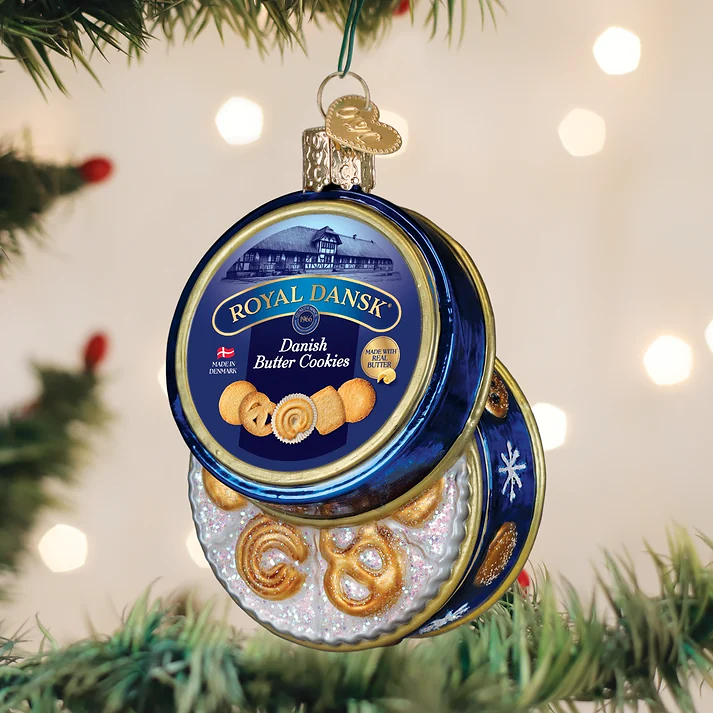
The Royal Dansk® blue tin — a fixture in holiday gifting for six decades — has crossed into licensed collectibles territory. Old World Christmas, a Spokane-based maker of hand-crafted glass ornaments, has partnered with Royal Dansk to reproduce the iconic Danish Butter Cookies tin as a mouth-blown, hand-painted glass ornament retailing at $27.99. The piece is available now at OldWorldChristmas.com and Amazon ahead of the 2026 holiday season.
The Brand Licensing Play
For food and beverage operators, this partnership is worth reading as more than a novelty item. Heritage consumer brands are increasingly licensing their most recognizable packaging — not their product — to extend emotional equity into categories that stay in the home year-round. The Royal Dansk tin already lives a second life in millions of households as a sewing box or keepsake container. Converting that unprompted consumer behavior into a deliberate product strategy is a legitimate brand-extension move. Old World Christmas, which has built a catalog of more than 2,000 proprietary designs since 1979, brings the manufacturing and retail relationships; Royal Dansk brings 60 years of recognition. Neither company had to build the other's core competency.
Neal Applefeld, President and CEO of Old World Christmas, framed the collaboration plainly: "The Royal Dansk tin is already in millions of homes. We just made a version you can hang on the tree." Kris Nance, Brand Manager at Royal Dansk, noted that the ornament reflects the stories consumers already attach to the tin — families sharing cookies and then repurposing the container long after the product is gone.
What Operators and Brand Managers Should Track
The timing anchors to two retail moments: the broader 2026 holiday gifting season and National Cookie Day on December 4. That dual hook is a straightforward content and sampling-campaign framework any food brand can borrow — pairing a product launch with an established food holiday reduces the creative lift required to build a campaign narrative.
More strategically, Royal Dansk and Old World Christmas have confirmed plans to expand the collaboration beyond this first ornament. That signals a structured licensing roadmap, not a one-season stunt. For suppliers and brand managers watching the snack and confectionery space, it raises a practical question: which of your brand's physical assets — packaging, vessels, branded hardware — carries enough consumer recognition to support a licensed product line? Packaging that consumers voluntarily repurpose is the clearest signal that the asset has standalone equity worth monetizing.
Food and beverage brands considering similar moves should evaluate retail channel fit early. OldWorldChristmas.com and Amazon serve a gifting-oriented consumer; hospitality gift shops, hotel retail, and specialty food retailers represent adjacent distribution that a brand-licensing play like this could reach with minimal incremental investment. The $27.99 price point also positions the ornament as a stocking stuffer and hostess gift — two high-velocity gifting occasions for the on-premise hospitality channel.
For operators building holiday gifting and seasonal merchandise programs, this collaboration illustrates how a recognizable food brand can generate incremental revenue and extend brand impressions into spaces a cookie tin alone cannot reach. It's a model worth benchmarking against your own seasonal brand assets before the 2027 planning cycle opens.
Written by Michael Politz, Author of Guide to Restaurant Success: The Proven Process for Starting Any Restaurant Business From Scratch to Success (ISBN: 978-1-119-66896-1), Founder of Food & Beverage Magazine, the leading online magazine and resource in the industry. Designer of the Bluetooth logo and recognized in Entrepreneur Magazine's "Top 40 Under 40" for founding American Wholesale Floral, Politz is also the Co-founder of the Proof Awards and the CPG Awards and a partner in numerous consumer brands across the food and beverage sector.