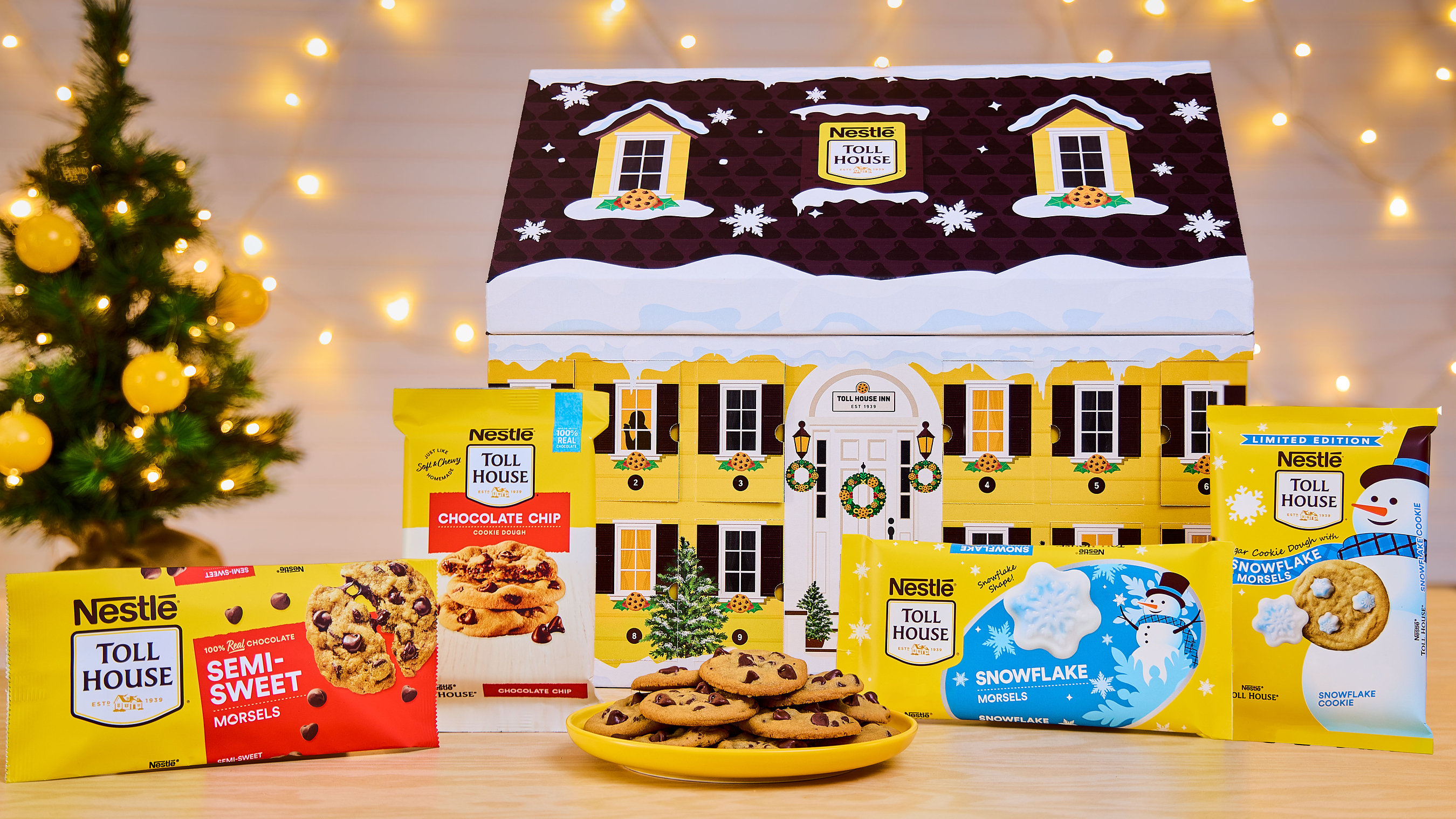
Nestlé Toll House is stepping outside traditional retail with a direct-to-consumer advent calendar priced at $29.99 — a timed-drop format more common to streetwear and specialty beverage brands than legacy baking SKUs. The 12 Days of Nestlé Toll House Advent Calendar goes live in three separate drops on October 9, November 6, and December 4, each at 2pm ET, while supplies last. For operators and food-brand strategists tracking how heritage CPG labels are evolving their go-to-market playbooks, this is worth a closer read.
The Product Architecture
The calendar is built around 12 numbered doors — the box itself shaped after the original Toll House Inn — and contains a mix of refrigerated cookie doughs and morsels spanning everyday staples and two new holiday SKUs. The new additions are Snowflake Morsels, a shaped morsel format joining the brand's existing playful lineup, and Snowflake Cookie Dough, a sugar cookie base embedded with the same snowflake-shaped morsels. The remaining ten slots cover established seasonal and year-round products including Peppermint Cocoa Cookie Dough, Santa's Cookie Dough, Semi-Sweet Chocolate Morsels, Dark Chocolate Morsels, and Butterscotch Morsels, among others. Framing new product introductions inside a bundled, gifted format reduces the shelf-placement risk that a standalone SKU launch would carry.
What the Drop Model Signals
The mechanics here are deliberate. Rather than placing a holiday bundle in mass retail where it competes on shelf positioning and promotional pricing, Nestlé Toll House is running this exclusively through a Shopify-hosted DTC storefront. Three staggered drops create urgency, extend the brand's earned media window across October, November, and December, and generate first-party purchase data that a retail sell-through never would. Melanie Knoke, Senior Marketing Manager at Nestlé Toll House, framed it around tradition-building and memory-making — but the underlying architecture is a controlled DTC test with built-in scarcity mechanics.
For foodservice and CPG operators, the playbook is replicable at smaller scale. A limited-run seasonal bundle sold direct — through a brand's own Shopify or similar storefront — sidesteps retailer margin requirements, builds an owned email list, and creates shareable unboxing moments that function as organic content. The challenge for most mid-size food brands is logistics: refrigerated or temperature-sensitive products narrow the DTC window considerably, which makes Toll House's willingness to ship a refrigerated-dough bundle a meaningful proof-of-concept.
Brand launch teams advising food clients on holiday retail readiness should note the timing strategy: the October 9 first drop lands well before most brick-and-mortar holiday sets are even finalized, capturing early-season intent buyers and generating press coverage that extends into peak gifting weeks. Operators building out DTC channel strategy for seasonal SKUs can benchmark against this structure — three drops, fixed price point, exclusive URL, scarcity messaging — as a low-risk framework to pressure-test direct demand before committing to a broader retail program.
Takeaway for Operators
The advent calendar format itself is gaining traction across food and beverage categories — spirits, hot sauce, specialty chocolate, and now baking — as a high-perceived-value gifting vehicle that moves multiple SKUs in a single transaction. At $29.99, Toll House is pricing into the accessible gifting tier, which positions this as a basket-builder rather than a premium splurge. Whether the drops sell through quickly will tell the brand — and the industry — something meaningful about consumer appetite for DTC baking bundles at that price point.
Written by Michael Politz, Author of Guide to Restaurant Success: The Proven Process for Starting Any Restaurant Business From Scratch to Success (ISBN: 978-1-119-66896-1), Founder of Food & Beverage Magazine, the leading online magazine and resource in the industry. Designer of the Bluetooth logo and recognized in Entrepreneur Magazine's "Top 40 Under 40" for founding American Wholesale Floral, Politz is also the Co-founder of the Proof Awards and the CPG Awards and a partner in numerous consumer brands across the food and beverage sector.