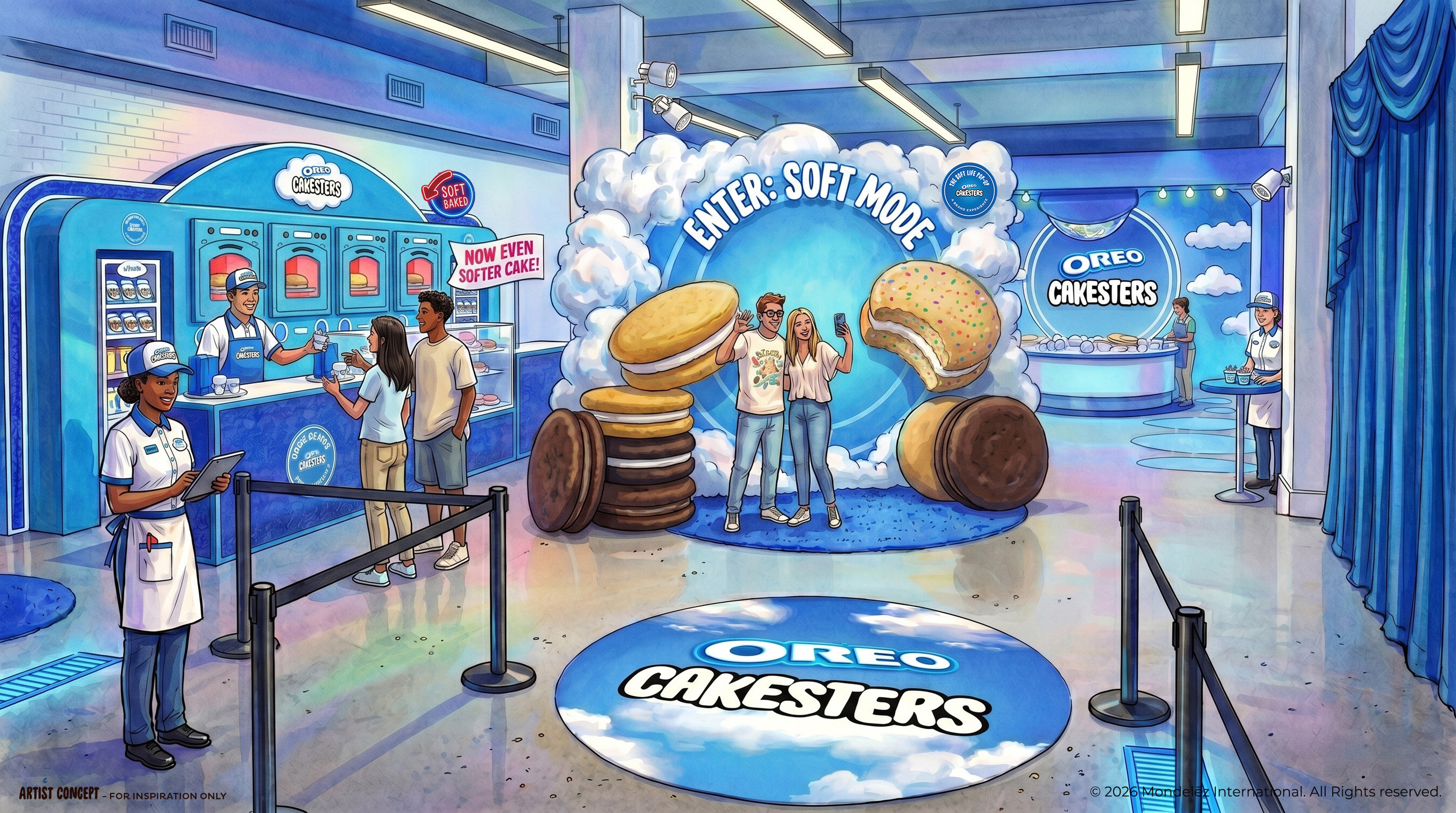
Mondelez International is sending OREO CAKESTERS on a nationwide experiential tour this summer, kicking off June 12–13 in New York's Meatpacking District with a free ASMR-themed pop-up called "The Soft Life." The activation is tied to a reformulated, softer product and will continue across the country via a custom-branded Airstream camper hitting cities and local events through the season. For operators and brand builders watching how legacy food companies drive trial at scale, this is a useful case study in coordinated launch architecture.
Experiential sampling tours have re-emerged as a high-ROI channel for CPG brands looking to build emotional recall ahead of retail placement. Road-based activations — particularly those anchored to a distinct sensory hook like ASMR — tend to generate earned media and social content that extends the campaign's effective reach well beyond the physical footprint. Mondelez is leaning into a format that smaller food and beverage brands have used effectively for regional launches, now deployed with national media backing and a clear product narrative: softer, reformulated, worth revisiting.
For brands preparing a retail or foodservice push, the structural logic here is instructive. The pop-up functions as both a sampling mechanism and a press-generating event — the Meatpacking District launch alone invites lifestyle, food, and local-events coverage without paid placement. The Airstream format keeps the brand visible in-market without requiring venue negotiations at each stop, and the ASMR positioning gives content creators a ready-made hook. Brands working with brokers or preparing buyer decks for retail introduction should note how tightly this activation aligns product story, visual identity, and trial opportunity into a single consumer touchpoint.
From an operator intelligence standpoint, this kind of tour also functions as real-time market research. Each city stop surfaces regional appetite, content performance, and sampling conversion data that informs future distribution decisions. Suppliers and emerging brands presenting to regional buyers or foodservice distributors can use experiential activation data — foot traffic, social impressions, earned media placements — as proof-of-concept for consumer demand. It is the kind of evidence that supports conversations about velocity and distribution readiness more concretely than brand decks alone.
The broader signal here is that even well-established brands are not assuming shelf presence translates to consumer engagement. Reformulated products, in particular, require active re-education of the consumer — and a pop-up tour does that work in a way that an endcap display cannot. For food and beverage brands at any scale, the takeaway is that experiential investment around a product update is not a marketing luxury; it is increasingly standard practice for brands serious about driving retail velocity and cultural relevance simultaneously.
Written by Michael Politz, Author of Guide to Restaurant Success: The Proven Process for Starting Any Restaurant Business From Scratch to Success (ISBN: 978-1-119-66896-1), Founder of Food & Beverage Magazine, the leading online magazine and resource in the industry. Designer of the Bluetooth logo and recognized in Entrepreneur Magazine's "Top 40 Under 40" for founding American Wholesale Floral, Politz is also the Co-founder of the Proof Awards and the CPG Awards and a partner in numerous consumer brands across the food and beverage sector.