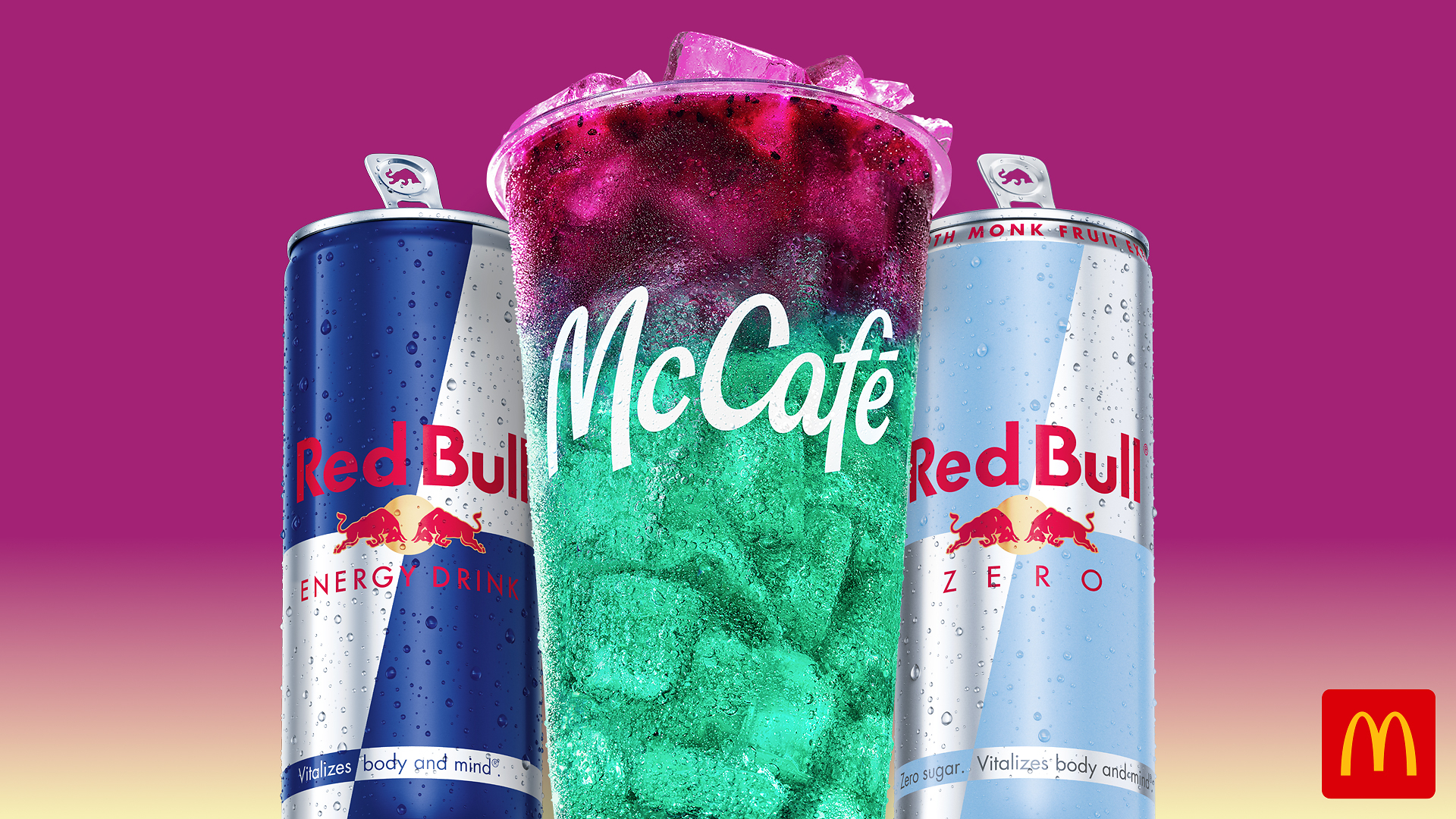
McDonald's USA is stepping into the energy drink category for the first time, launching the Red Bull Dragonberry Energizer at participating U.S. restaurants starting August 17. The drink combines Red Bull's base with blue raspberry syrup and freeze-dried dragonfruit inclusions, and comes with a reduced-sugar option using Red Bull Zero as the base. Participating locations will also sell an 8.4 oz Red Bull can outright — a direct signal that McDonald's is positioning its beverage program to compete with convenience-store and specialty coffee dayparts, not just traditional QSR drink menus.
Why Operators Should Care
This launch is not an isolated menu add — it is the latest move in a deliberate beverage platform build. McDonald's has steadily expanded its crafted-soda and Refresher lineup, and the Red Bull partnership gives that platform a co-branded energy anchor with mass consumer recognition. Alyssa Buetikofer, Chief Marketing and Customer Experience Officer of McDonald's USA, noted the chain already tested the Red Bull Dragonberry Energizer in U.S. markets and saw strong consumer response before committing to a national rollout. That test-then-scale methodology is worth noting for any operator considering beverage program investment: consumer validation before broad distribution reduces waste and sharpens launch messaging.
For franchisees — who own and operate approximately 95.0% of McDonald's roughly 13,500 U.S. locations — the practical question is ticket lift. Energy drinks carry premium price positioning relative to fountain soda. A co-branded, customizable energy format with a recognizable label creates both an upsell opportunity and an afternoon/evening traffic driver, two dayparts where traditional QSR volumes have historically been softer.
The Broader Beverage Shift
The energy drink category has grown steadily at retail and foodservice alike, and QSR operators are increasingly treating beverage customization as a revenue and loyalty lever rather than a commodity add-on. McDonald's expanded its core drink lineup simultaneously with this launch, adding Vanilla Swirl crafted sodas built on Coca-Cola, Diet Coke, and Coke Zero Sugar bases, along with reduced-sugar crafted sodas featuring Diet Dr Pepper, Dr Pepper Zero Sugar, and Sprite Zero Sugar. That breadth signals a deliberate attempt to cover the full spectrum from indulgent to better-for-you in a single program — a strategy operators across segments are watching closely as consumer demand for beverage variety continues to outpace food customization growth.
For suppliers and beverage vendors, the McDonald's-Red Bull partnership illustrates how established energy brands are seeking foodservice distribution to complement retail shelf presence. Operators evaluating their own beverage programs — whether in fast casual, hotel food and beverage, or convenience foodservice — should treat this as a benchmark moment: branded energy partnerships are now viable at QSR scale, which typically sets the floor for where category adoption is headed. Coverage of the broader non-alcoholic beverage trend in hospitality is worth reviewing alongside this development, as are the menu and beverage trends shaping what guests expect at the point of service.
Operators running loyalty programs should also pay attention to how McDonald's bundles this launch inside its app ecosystem — beverage customization is a natural fit for digital ordering and growth marketing engagement, particularly for repeat afternoon traffic.
Written by Michael Politz, Author of Guide to Restaurant Success: The Proven Process for Starting Any Restaurant Business From Scratch to Success (ISBN: 978-1-119-66896-1), Founder of Food & Beverage Magazine, the leading online magazine and resource in the industry. Designer of the Bluetooth logo and recognized in Entrepreneur Magazine's "Top 40 Under 40" for founding American Wholesale Floral, Politz is also the Co-founder of the Proof Awards and the CPG Awards and a partner in numerous consumer brands across the food and beverage sector.