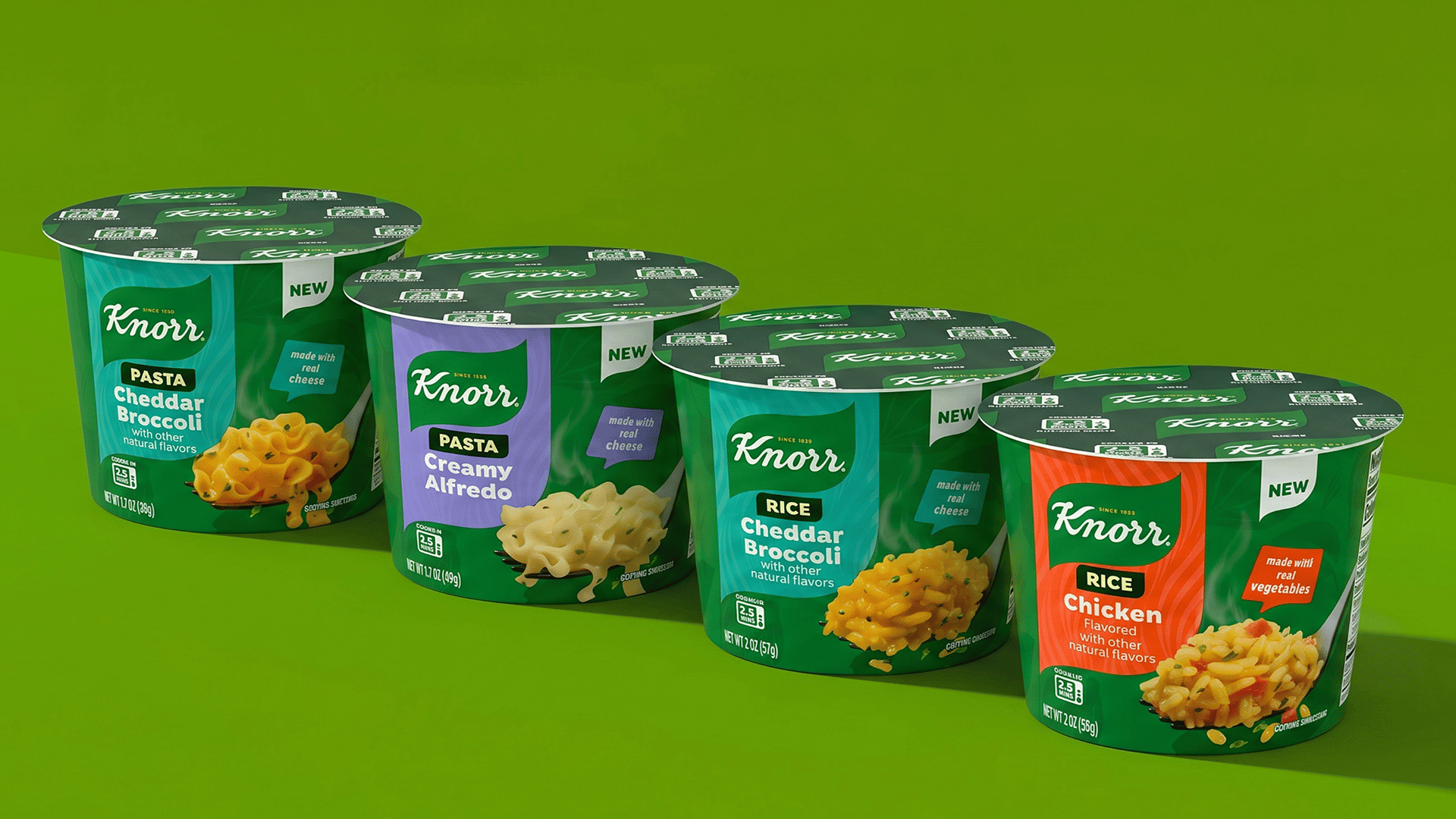
Single-serve convenience just got a major brand-name entry. Knorr has launched Knorr Cups — eight microwave-ready pasta and rice SKUs priced at $1.47 per cup and $11.76 for an eight-pack — now available at Walmart, Amazon, and retailers nationwide. For foodservice operators, c-store buyers, and grocery category managers watching the snackification trend, this launch is a data point worth tracking.
The Format Signal
The single-serve, add-water-and-microwave format isn't new, but Knorr's entry carries distribution weight that most emerging brands lack. The cups cook in two and a half minutes with a three-minute rest — no pot, no boiling water. Flavors span four pasta varieties (Cheddar Broccoli, Chicken, Creamy Alfredo, Creamy Garlic) and four rice varieties (Cheddar Broccoli, Chicken, Spanish Style, Chicken Broccoli). At that price point and with Walmart as a lead retailer, Knorr is positioning squarely against the cup noodle and instant mac segments while trading on brand equity built through its Rice and Pasta Sides line.
The consumer data behind the launch is instructive for operators building menus or grab-and-go programs. According to a Harris Poll cited by Knorr, more than half of Gen Z Americans carry a side hustle. Separately, 71.0% of Gen Z and millennials now prefer multiple small meals throughout the day over three structured meals, per research cited from Taste Technology. And 81.0% of consumers report snacking as a way to carve out quiet time. These aren't marginal behaviors — they represent a structural shift in how a significant consumer cohort relates to eating occasions.
Activation and Retail Readiness
To support the launch, Knorr staged a one-day pop-up event — the Flash Cupping Studio — at 178 Bleecker Street in New York, offering complimentary cupping therapy sessions timed to match the product's cook time. The stunt is a textbook experiential sampling tactic: create a sensory memory tied to the product's key differentiator (speed), generate earned media in a high-foot-traffic market, and photograph it for social amplification. Melanie Cappella, Knorr's Chief Growth Officer, framed the event as proof that "even a short break can go a long way" — language that maps directly to the brand's positioning around reclaimed time.
For buyers and category managers evaluating shelf placement, the pop-up signals Knorr intends to invest in market-level activation beyond a standard trade promotion. That matters when a brand is asking for premium shelf real estate in a crowded single-serve segment.
What Operators Should Watch
The broader implication here isn't about Knorr specifically — it's about where big CPG is placing its product development bets. A global brand backed by Unilever, which reported sales of €60.8 billion in 2024, is funneling R&D into sub-three-minute, single-serve ambient formats. That tells you the snackification and speed-of-service trend has crossed from foodservice innovation into mainstream retail product strategy.
For operators running grab-and-go programs in hotels, airports, or campus dining, the competitive set just widened. Branded, flavor-credible ambient cups at $1.47 set a consumer price anchor that any hot-case or made-to-order program has to work around. Conversely, for brand launch teams preparing retail buyer decks, Knorr's move demonstrates that convenience-format storytelling now requires behavioral data — snacking frequency, meal occasion fragmentation, wellness adjacency — not just product specs.
Written by Michael Politz, Author of Guide to Restaurant Success: The Proven Process for Starting Any Restaurant Business From Scratch to Success (ISBN: 978-1-119-66896-1), Founder of Food & Beverage Magazine, the leading online magazine and resource in the industry. Designer of the Bluetooth logo and recognized in Entrepreneur Magazine's "Top 40 Under 40" for founding American Wholesale Floral, Politz is also the Co-founder of the Proof Awards and the CPG Awards and a partner in numerous consumer brands across the food and beverage sector.