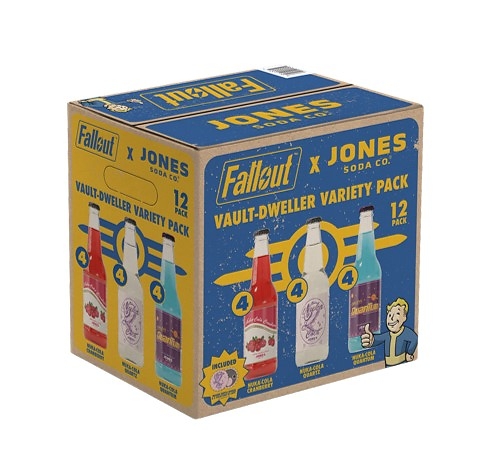
Jones Soda Co. is shipping its fourth Fallout-branded club exclusive ahead of October 23's Fallout Day, and this drop is the most ambitious yet: two Nuka-Cola flavors — Quartz and Cranberry — that have never existed outside the game's fiction are entering the physical beverage aisle for the first time alongside the returning Nuka-Cola Quantum.
The Jones x Fallout "Vault-Dweller Variety" 12-Pack is available exclusively at participating club retail locations across the United States and Canada. Each pack contains four glass bottles of each of the three flavors, plus a custom Quartz-themed bottle opener, collectible caps, and a display-ready collector bag — the kind of treasure-hunt merchandising that club-format shoppers respond to and that standard grocery sets can't easily replicate.
Why Club Channel Wins Here
The club channel has become a deliberate strategic lever for craft and specialty beverage brands. The format rewards scarcity, oversized packaging, and giftable presentation — all three of which Jones leans into heavily here. For operators and brand launch strategists watching the NAB space, this is a textbook example of how a mid-sized craft soda company extracts outsized earned media and social proof from a licensing partnership by controlling the distribution aperture. A club-exclusive drop creates urgency, limits price comparison, and positions the SKU as a collectible rather than a commodity.
This is Jones Soda's fourth Fallout release with Bethesda Softworks, which signals the program has cleared internal performance hurdles on both sides. Repeat IP drops at club are uncommon — most licensed beverage collaborations fade after one or two cycles. The fact that Jones and Bethesda are iterating flavor complexity (moving from a single returning SKU to two world-first flavors) suggests sell-through data has supported expansion rather than contraction.
What This Signals for Brand Launch
For beverage brands eyeing entertainment IP partnerships, the Jones-Fallout model offers a replicable playbook: anchor the launch to a cultural calendar moment (Fallout Day, October 23), build in physical collectible value beyond the liquid itself, and restrict distribution to a channel whose members self-select for discovery shopping. The glass bottle format and custom accessories push average unit retail well above standard can multipacks, improving margin optics without requiring a premium-tier retail placement.
Brands and agencies working on limited-edition release strategy should note the timing mechanics: product begins shipping in late September, giving club locations roughly four weeks of floor time before the holiday event date. That window is long enough to build word-of-mouth and short enough to sustain scarcity framing.
Scott Harvey, Chief Executive Officer of Jones Soda Co., framed the collection as experiential rather than transactional: "For the first time, fans can taste Nuka-Cola Quartz and Nuka-Cola Cranberry... in a collectible package designed exclusively for club members."
For operators and buyers tracking the intersection of entertainment licensing and specialty beverage retail, the Jones-Fallout cadence is worth benchmarking. IP-anchored limited releases are compressing from annual novelties into a repeatable revenue channel — and the club format is emerging as the preferred launch vehicle for brands that want controlled scarcity without the markdown risk of broad retail placement.
Written by Michael Politz, Author of Guide to Restaurant Success: The Proven Process for Starting Any Restaurant Business From Scratch to Success (ISBN: 978-1-119-66896-1), Founder of Food & Beverage Magazine, the leading online magazine and resource in the industry. Designer of the Bluetooth logo and recognized in Entrepreneur Magazine's "Top 40 Under 40" for founding American Wholesale Floral, Politz is also the Co-founder of the Proof Awards and the CPG Awards and a partner in numerous consumer brands across the food and beverage sector.