JINRO has crossed 500 million cumulative views on its debut global campaign in under two months — a benchmark that places the South Korean soju brand squarely in the conversation about how imported beverage labels can build mainstream awareness in Western markets without a traditional distributor-led rollout.
The JINRO campaign, titled "My Favorite JINRO," launched in early July with global ambassador V of BTS as its anchor talent. The main commercial video alone logged more than 300 million views; campaign-related content across all social channels generated roughly 10 million engagements — likes, comments, and shares combined. JINRO's global social following grew by approximately 200,000 accounts from the pre-teaser baseline, a clean signal that the brand is acquiring net-new audiences rather than just activating existing fans.
The OOH Footprint
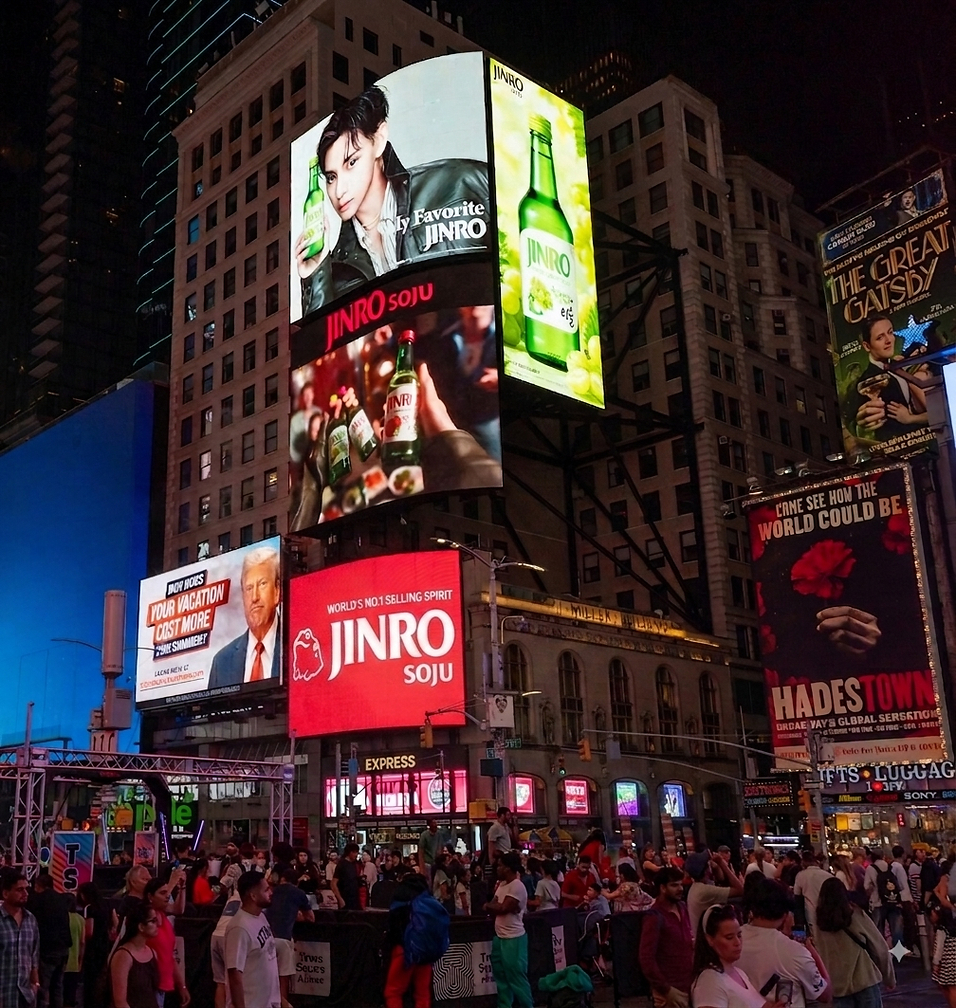
What makes this campaign operationally interesting for beverage operators and brand marketers is the deliberate offline amplification layer. HiteJinro, JINRO's parent, has placed outdoor campaign creative in Times Square in New York, Toronto, Beijing, Shanghai, Tokyo, Ho Chi Minh City, Manila, and Sydney — coordinating a simultaneous multi-market OOH buy across radically different regulatory and media environments. Times Square placement began in late July and has generated organic social lift on its own: local visitors film and share the billboard, extending paid media reach at zero incremental cost. That flywheel — paid OOH driving earned social — is a repeatable playbook that on-premise and retail beverage brands of any size can study.
Jung-ho Hwang, Head of Overseas Business at HiteJinro, noted that the campaign expanded global consumer interest in JINRO and increased direct touchpoints. The brand intends to continue marketing activity designed to broaden JINRO's mainstream appeal beyond its established Korean-diaspora base.
What This Signals for Operators
For foodservice buyers and beverage program directors, the campaign's performance data is worth benchmarking against your own spirits category velocity. Soju has been gaining menu placement in non-Korean restaurants for several years — particularly in Japanese izakayas, pan-Asian concepts, and cocktail-forward bars — and a global brand campaign of this scale accelerates consumer pull-through. When a customer has seen 300 million views' worth of JINRO content, your staff spends less time explaining the category and more time closing the upsell.
The campaign also illustrates a broader trend in imported beverage marketing: talent-anchored global launches that bypass legacy media entirely in favor of social-first, OOH-amplified distribution. Brands entering the U.S. market through this model are compressing the traditional awareness-to-trial timeline. Operators who track brand launch and distribution trends will recognize this as the same pattern used by premium Asian spirits and RTD brands over the past two years.
For agencies and suppliers pitching beverage accounts, the JINRO case also demonstrates that international OOH buys are increasingly coordinated through centralized brand teams rather than local distributors — a procurement shift worth noting when positioning geo-fenced digital or programmatic out-of-home capabilities to beverage clients.
Written by Michael Politz, Author of Guide to Restaurant Success: The Proven Process for Starting Any Restaurant Business From Scratch to Success (ISBN: 978-1-119-66896-1), Founder of Food & Beverage Magazine, the leading online magazine and resource in the industry. Designer of the Bluetooth logo and recognized in Entrepreneur Magazine's "Top 40 Under 40" for founding American Wholesale Floral, Politz is also the Co-founder of the Proof Awards and the CPG Awards and a partner in numerous consumer brands across the food and beverage sector.