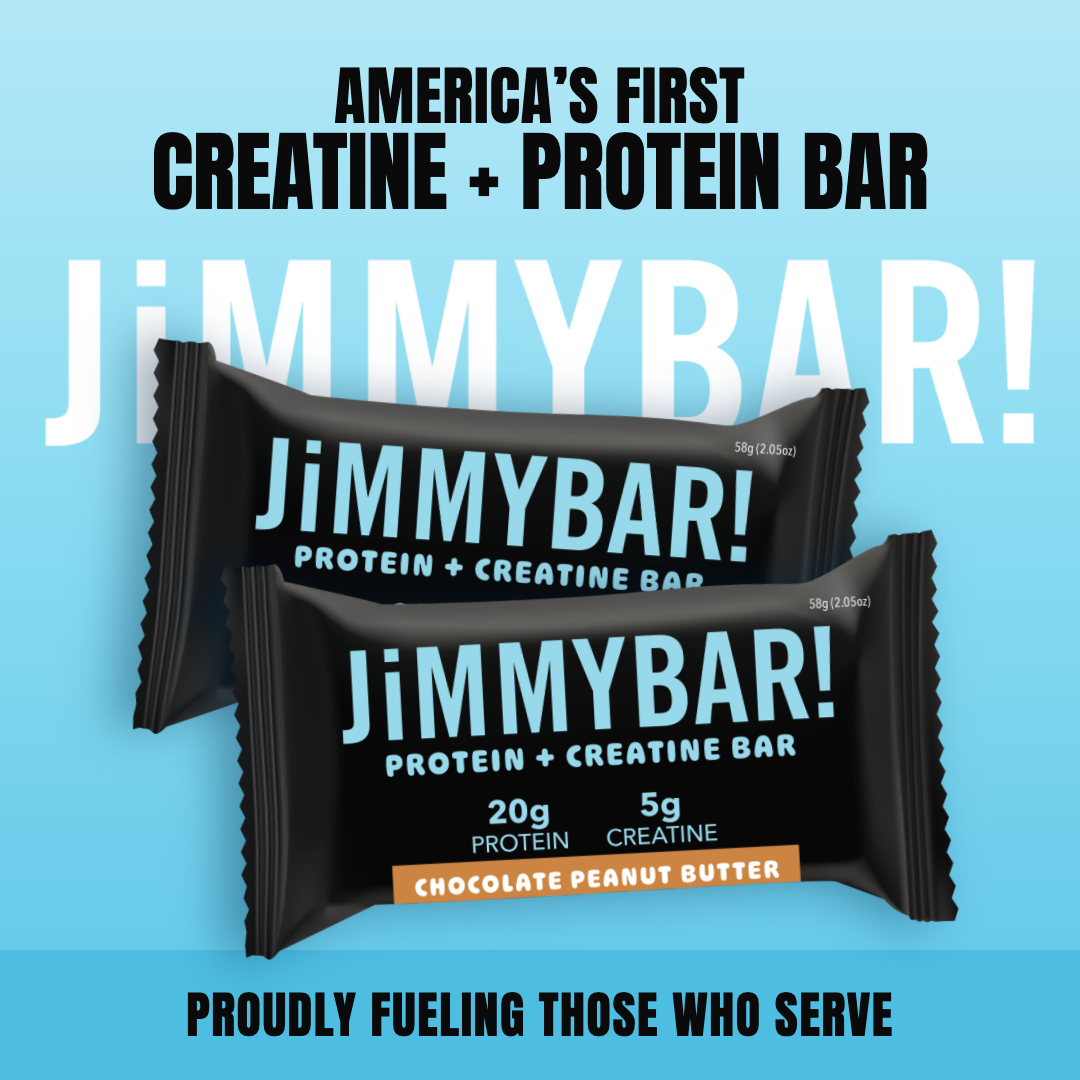
A family-owned protein bar company from suburban Chicago has quietly built one of the more unusual distribution footprints in the functional-food category: JiMMYBAR! Functional Protein now stocks shelves in 166 military exchange stores across 11 countries and territories, including locations at Ramstein Air Base in Germany and installations throughout Japan, South Korea, Italy, Poland, Kosovo, Bulgaria, and the United Kingdom.
The latest activation adds Navy Exchange (NEXCOM) to an existing presence in the Army & Air Force Exchange Service (AAFES) and Marine Corps Exchange (MCX) — completing a tri-service military retail sweep that most emerging brands never attempt. Of the 166 total doors, 105 are domestic or U.S. territory locations; 44 are international.
Why Military Retail Matters
Military exchanges are a structurally distinct retail channel that brand builders often underestimate. They operate outside conventional retail timelines, carry a captive, fitness-oriented consumer base, and — critically — a placement in NEXCOM or AAFES functions as proof-of-concept for procurement officers evaluating shelf-stable, performance-oriented SKUs. For a brand already in Target, Sam's Club, Costco, GNC LiveWell, H-E-B, Hy-Vee, and Wawa, adding military distribution signals that JiMMYBAR! is pursuing a layered retail strategy rather than chasing a single anchor account.
The product itself plays well in a performance-channel context. Each bar delivers 20 grams of protein alongside a full 5-gram serving of creatine monohydrate — a combination the brand claims as the first of its kind in bar format. With creatine supplementation continuing to trend up among both fitness consumers and mainstream health shoppers, the format offers a convenience-first entry point for a supplement that has historically required mixing powders.
What This Signals for Operators and Buyers
For foodservice and retail operators tracking the functional-nutrition space, this distribution move is worth filing under two separate intelligence threads.
First, the channel diversification model: JiMMYBAR! has built domestic retail breadth (mass, club, convenience, specialty) and layered international access on top via a government retail channel rather than through traditional export brokerage. That's a replicable playbook for any emerging brand with strong unit economics and a differentiated format.
Second, the in-store activation component: Navy Exchange endcap placements during November suggest the brand is investing in trade marketing dollars alongside the distribution win — a discipline that separates brands that hold shelf space from those that lose it at the next reset. Buyers across functional-beverage and snack categories have noted that endcap performance data increasingly influences reorder decisions within 90 days of placement.
Jim Simon, CEO and Co-Founder of JiMMYBAR!, framed the milestone in straightforward terms: the brand manufactures in Elk Grove Village, Illinois, and ships finished product to bases halfway around the world — a supply chain accomplishment that also reinforces the "American-made" positioning the brand carries into every retail conversation.
For operators and procurement managers tracking how emerging brands build distribution leverage, JiMMYBAR!'s military channel expansion is a case study in using non-traditional retail access to validate scale before pushing deeper into conventional grocery.
Written by Michael Politz, Author of Guide to Restaurant Success: The Proven Process for Starting Any Restaurant Business From Scratch to Success (ISBN: 978-1-119-66896-1), Founder of Food & Beverage Magazine, the leading online magazine and resource in the industry. Designer of the Bluetooth logo and recognized in Entrepreneur Magazine's "Top 40 Under 40" for founding American Wholesale Floral, Politz is also the Co-founder of the Proof Awards and the CPG Awards and a partner in numerous consumer brands across the food and beverage sector.