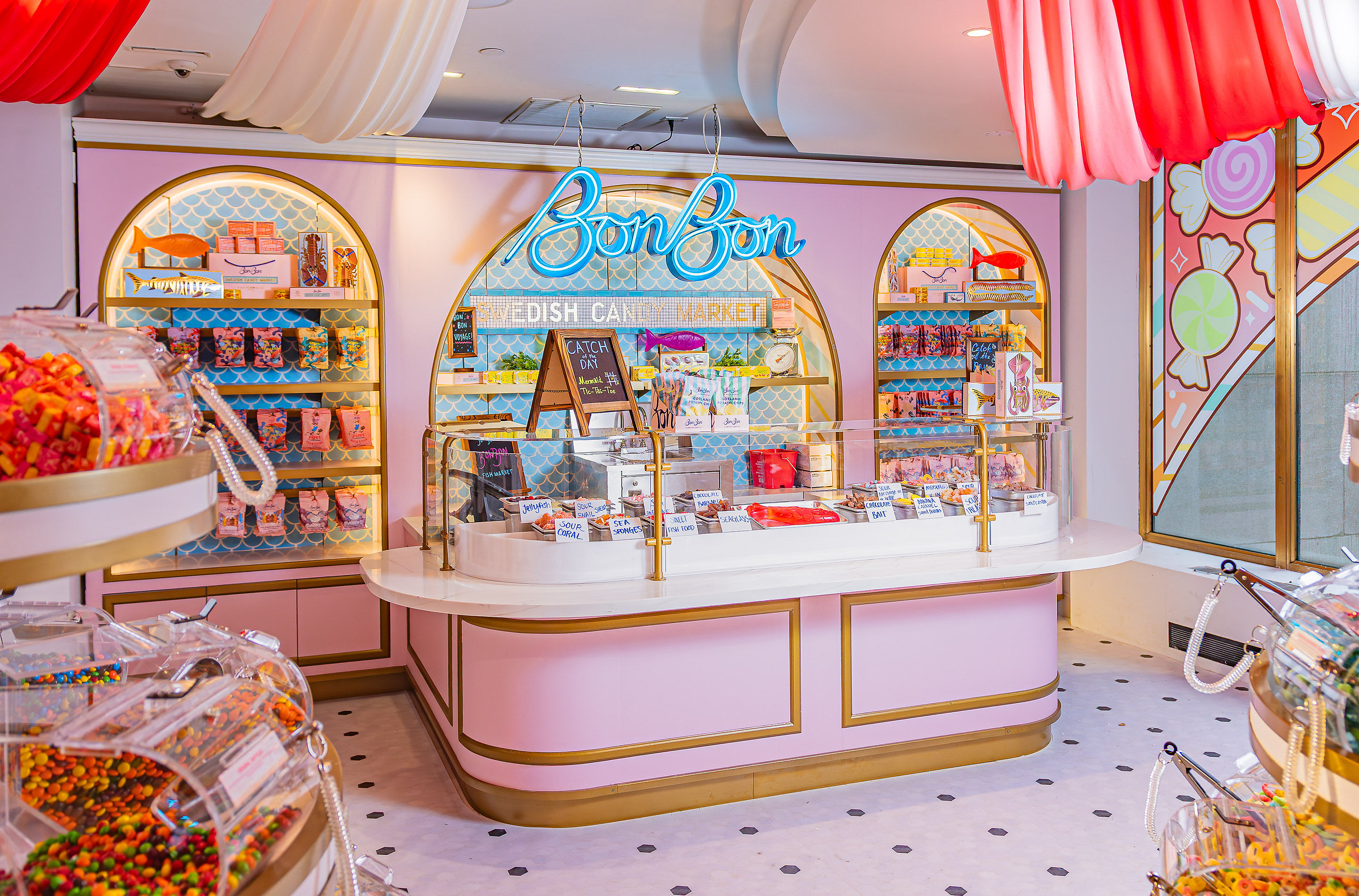
BonBon Swedish Candy Co. has opened a permanent Fish Counter inside the FAO Schwarz flagship at 30 Rockefeller Plaza, stacking a working-actor service model on top of imported Scandinavian sweets sold by the pound. The launch marks the brand's eighth physical location and its highest-profile experiential bet since it placed product in more than 1,900 Target stores nationwide.
The Retail Concept
The Fish Counter format is a direct lift from traditional fishmongers' counters — product displayed in bulk, ordered by weight, packaged to order. Here, that structure runs on theater: trained actors rotate through the floor as candy connoisseurs, scooping product, narrating selections, and packaging purchases in branded containers. The counter also carries exclusive holiday bundles, advent calendars, and gift towers timed to the holiday traffic surge at Rockefeller Center. A grab-and-go section captures shoppers who want speed over spectacle.
The concept is rooted in the Swedish confectionery ritual lördagsgodis — literally "Saturday candy" — a cultural practice BonBon has been building American consumer awareness around since its 2018 Lower East Side debut. That origin story has real retail weight now: the brand has grown from a single Manhattan shop to a nationally distributed confectionery label with an e-commerce channel and a Target shelf presence that most specialty food founders spend years chasing.
Why Operators Should Watch This
For food and beverage operators considering their own experiential retail or pop-up strategies, the BonBon model offers a replicable framework: take a culturally specific consumption ritual, add a theatrical service layer, and anchor the launch in a high-foot-traffic venue with built-in tourist and family demographics. FAO Schwarz at 30 Rock draws visitors who are already primed to spend on gifting and novelty — exactly the buyer profile that justifies premium packaging, exclusive SKUs, and higher average ticket.
The actor-as-staff model also addresses a persistent hospitality challenge: how to create dwell time and social-media content without discounting. Live performance drives organic content creation, extends time on floor, and elevates perceived value — all without touching margin. That is a staffing and training investment, but one with measurable returns in gifting categories where impulse and presentation drive purchase decisions.
Specialty confectionery is moving toward destination retail faster than most food segments. Brands that have cracked mass distribution — Target, Whole Foods, regional grocers — are increasingly using flagship experiential locations to defend brand equity and generate the kind of content that keeps algorithm-driven discovery channels fed. BonBon's FAO Schwarz counter fits that playbook precisely. Operators in adjacent brand-launch situations, particularly those in gifting, snack, or beverage categories with strong cultural backstory, should study how the brand is using a single high-visibility location to anchor national storytelling.
For vendors and agencies working with specialty food brands, the Fish Counter launch also signals growing demand for experiential retail design, theatrical hospitality training, and holiday-specific SKU development — all services that will be in sharper focus as Q4 gifting competition intensifies.
Takeaways for Operators
- BonBon now operates eight retail locations plus distribution in more than 1,900 Target stores — a dual-channel scale that most specialty brands have not achieved.
- The actor-staffed service model creates dwell time and organic social content without discounting, a margin-friendly alternative to promotional pricing.
- Holiday-exclusive SKUs (advent calendars, gift towers) layered on top of a by-the-pound core menu extend average ticket during the highest-traffic retail window of the year.
- Rockefeller Center foot traffic skews heavily toward tourists and gift-buyers — a demographic that rewards presentation and story over price sensitivity.
- Specialty food brands with a cultural origin story and existing mass-retail distribution are well-positioned to replicate this experiential anchor-store model in other high-footfall venues.
Written by Michael Politz, Author of Guide to Restaurant Success: The Proven Process for Starting Any Restaurant Business From Scratch to Success (ISBN: 978-1-119-66896-1), Founder of Food & Beverage Magazine, the leading online magazine and resource in the industry. Designer of the Bluetooth logo and recognized in Entrepreneur Magazine's "Top 40 Under 40" for founding American Wholesale Floral, Politz is also the Co-founder of the Proof Awards and the CPG Awards and a partner in numerous consumer brands across the food and beverage sector.