Restaurant back-of-house software provider Decision Logic has released two new products — Vitals and ShiftFlow — designed to close the gap between when something goes wrong on the floor and when a manager actually finds out about it. The launch targets a persistent pain point in multi-unit operations: shift-level data that arrives too late to act on.
What the Products Do
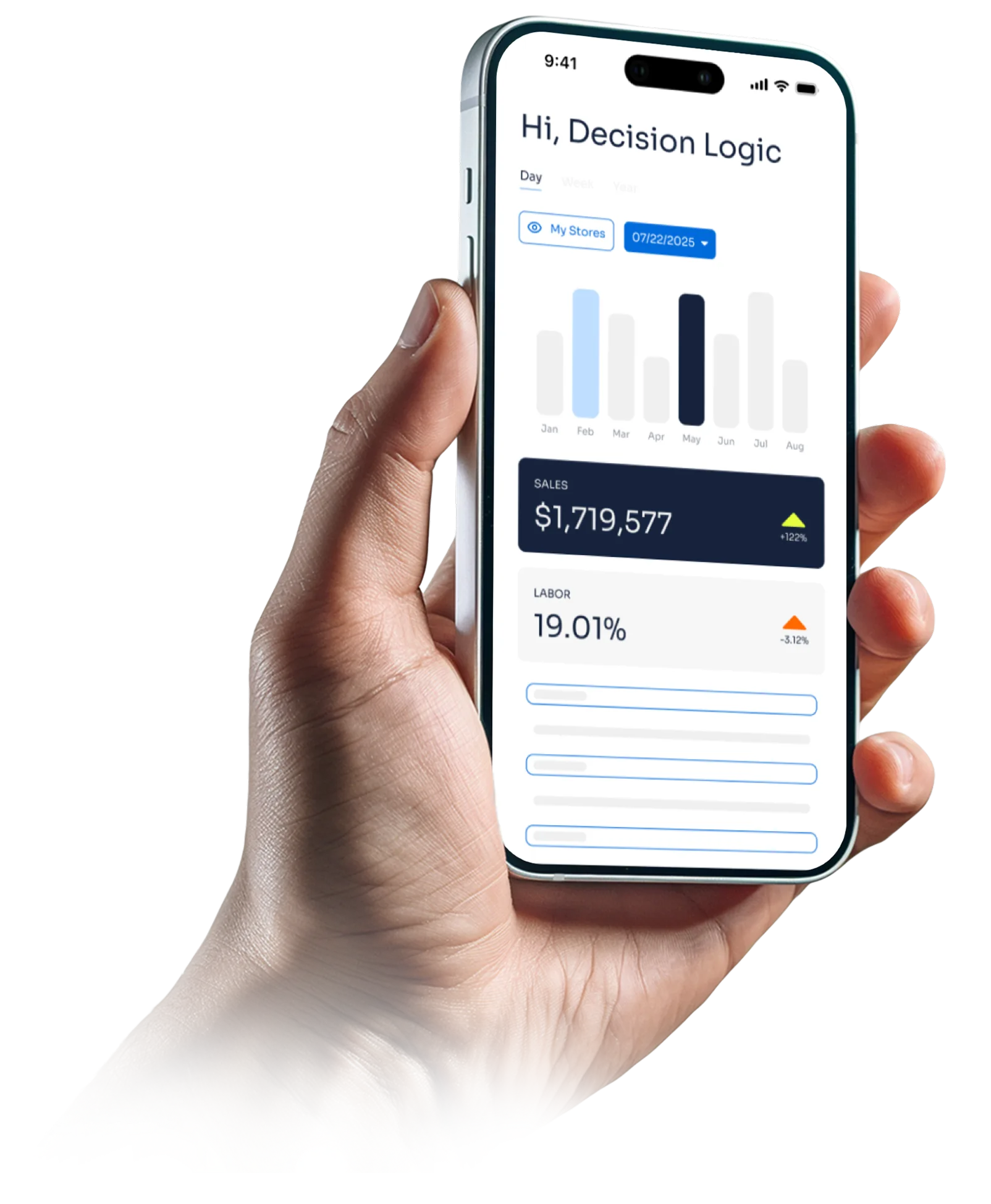
Vitals delivers 34 near-real-time metrics across four operational categories — 14 performance indicators, 11 labor metrics, five productivity signals, and four adjustment-risk flags covering voids and discounts. The intent is to function as an early-warning system: if labor is drifting over schedule or a line check is overdue during a peak period, a manager sees it on the floor rather than reading about it in an end-of-day report. ShiftFlow handles the execution side, consolidating tasks from existing schedules, above-store directives, and in-the-moment manager needs into a single mobile workflow that supports nine task types at launch, including scheduled orders, inventories, line checks, maintenance, and closing activities.
"Vitals answers, 'How are we doing?' ShiftFlow answers, 'What needs to happen next?'" said Keegan Conrey, CEO of Decision Logic. "Put those together and you give managers a much better chance to change the outcome of a shift instead of explaining the outcome after it's over."
The Turnover Angle
The design rationale for ShiftFlow is rooted in a hard labor reality: Decision Logic cites a 28.0% annual manager turnover rate in restaurants. When an experienced GM leaves, institutional knowledge about shift sequencing — what gets checked when, who handles what, and in what order — often walks out with them. ShiftFlow is built to codify that process so a new manager can execute consistently from day one, without relying on tribal knowledge or a senior operator being physically present. For above-store leaders managing multiple locations, that creates a verifiable consistency layer across the portfolio.
This positions ShiftFlow as much a training and retention tool as a task manager — a distinction worth noting for operators evaluating hospitality tech procurement this budget cycle. The product launches without a POS dependency, lowering the integration barrier for multi-unit brands running mixed technology stacks. Vitals will launch with Toast and Qu integrations, with additional POS connections planned.
Operator Takeaways for Tech Buyers
The broader signal here is that the back-of-house software category is moving away from reporting as a backward-looking function and toward real-time operational visibility. Vendors including Food & Beverage Magazine network partners have tracked this shift across inventory, labor, and food-cost platforms over the past 18 months. Decision Logic's existing platform already covers inventory management, food cost variance (actual vs. theoretical), labor optimization, manager logs, and consolidated sales analytics — Vitals and ShiftFlow extend that stack into live shift intelligence.
For operators evaluating AI-assisted restaurant operations tools, it is worth distinguishing products that surface alerts from those that structure response workflows. Decision Logic is attempting to do both in a single mobile-first interface, which reduces context-switching for floor managers who should not be anchored to a back-office terminal. Beta customers are already live. Both products are being demonstrated at FSTEC 2026, and demos are available at decisionlogic.io/demo.
Takeaways for operators and buyers:
Written by Michael Politz, Author of Guide to Restaurant Success: The Proven Process for Starting Any Restaurant Business From Scratch to Success (ISBN: 978-1-119-66896-1), Founder of Food & Beverage Magazine, the leading online magazine and resource in the industry. Designer of the Bluetooth logo and recognized in Entrepreneur Magazine's "Top 40 Under 40" for founding American Wholesale Floral, Politz is also the Co-founder of the Proof Awards and the CPG Awards and a partner in numerous consumer brands across the food and beverage sector.