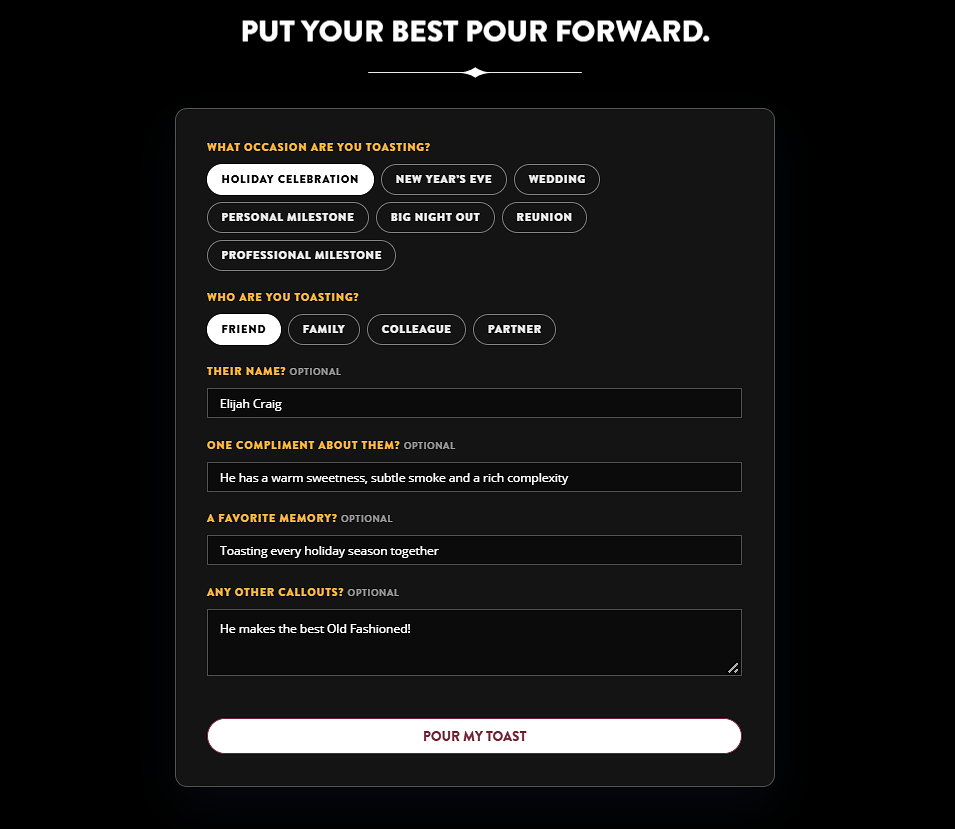
Elijah Craig has launched a free digital tool — the Perfect Pour, Perfect Toast Generator — that uses an AI-curated content library to produce customized, shareable toasts for holidays, birthdays, promotions, and other milestones. The move is a direct-to-consumer engagement play timed to the highest-gifting quarter for premium bourbon, and it signals how spirits brands are beginning to operationalize AI for experiential marketing rather than pure e-commerce.
Users enter a few details — the occasion, the honoree's name, a favorite memory — and the generator returns a personalized toast in seconds. A "Pour This Toast Again" function refreshes the output, letting users iterate until the language feels right. Critically, Elijah Craig states the tool neither collects nor retains any personal data entered, a privacy posture that reduces friction and addresses a growing consumer hesitation around AI-powered brand tools.
The Operator Angle
For on-premise operators — bar managers, event directors, hotel F&B teams — this kind of brand activation is worth cataloguing. Premium spirits suppliers are increasingly building digital touchpoints designed to deepen consumer affinity before the bottle ever hits a back bar. When a brand like Elijah Craig, produced by Heaven Hill Distillery and holder of Whisky Advocate's 2025 Whisky of the Year for its inaugural Barrel Proof Rye, runs a campaign this visible, it creates downstream pull that affects velocity at the glass and on the retail shelf. Understanding what your suppliers are spending marketing dollars on helps operators anticipate which SKUs carry consumer momentum heading into Q1.
The tool is explicitly anchored to Elijah Craig Toasted Barrel Bourbon — a finished expression aged in a second, custom toasted oak barrel that the brand describes as carrying notes of milk chocolate and baking spices. Tying an AI engagement mechanic to a specific SKU, rather than the brand family broadly, is a deliberate product-marketing choice. It concentrates holiday attention on a mid-tier expression that sits in an increasingly competitive finishing-barrel segment alongside entries from multiple major distillers.
AI as Brand Infrastructure
What's notable for operators and brand managers tracking AI tools in hospitality is the low-lift architecture here. This is not a chatbot, a loyalty integration, or a complex personalization engine — it is a constrained, single-purpose AI tool with a clear consumer job-to-be-done. That simplicity is a feature. Max Stefka, Associate Vice President at Elijah Craig Bourbon, framed the intent plainly: the goal is to let people "live in these moments, not fear them" — referencing research citing public speaking as a top American fear.
For beverage brands considering similar activations, the template is replicable: identify a friction point in the consumption occasion, build a lightweight AI tool that removes it, tie the tool to a specific product, and distribute via mobile and desktop with zero data-collection overhead. The cost of entry for this category of tool has dropped substantially, making it accessible beyond large spirits conglomerates.
Operators building out brand launch or seasonal campaign strategies for private-label or emerging beverage lines should note how effectively this mechanic extends a brand's presence into the gifting and celebration occasion without requiring a paid media budget at the point of use.
Written by Michael Politz, Author of Guide to Restaurant Success: The Proven Process for Starting Any Restaurant Business From Scratch to Success (ISBN: 978-1-119-66896-1), Founder of Food & Beverage Magazine, the leading online magazine and resource in the industry. Designer of the Bluetooth logo and recognized in Entrepreneur Magazine's "Top 40 Under 40" for founding American Wholesale Floral, Politz is also the Co-founder of the Proof Awards and the CPG Awards and a partner in numerous consumer brands across the food and beverage sector.