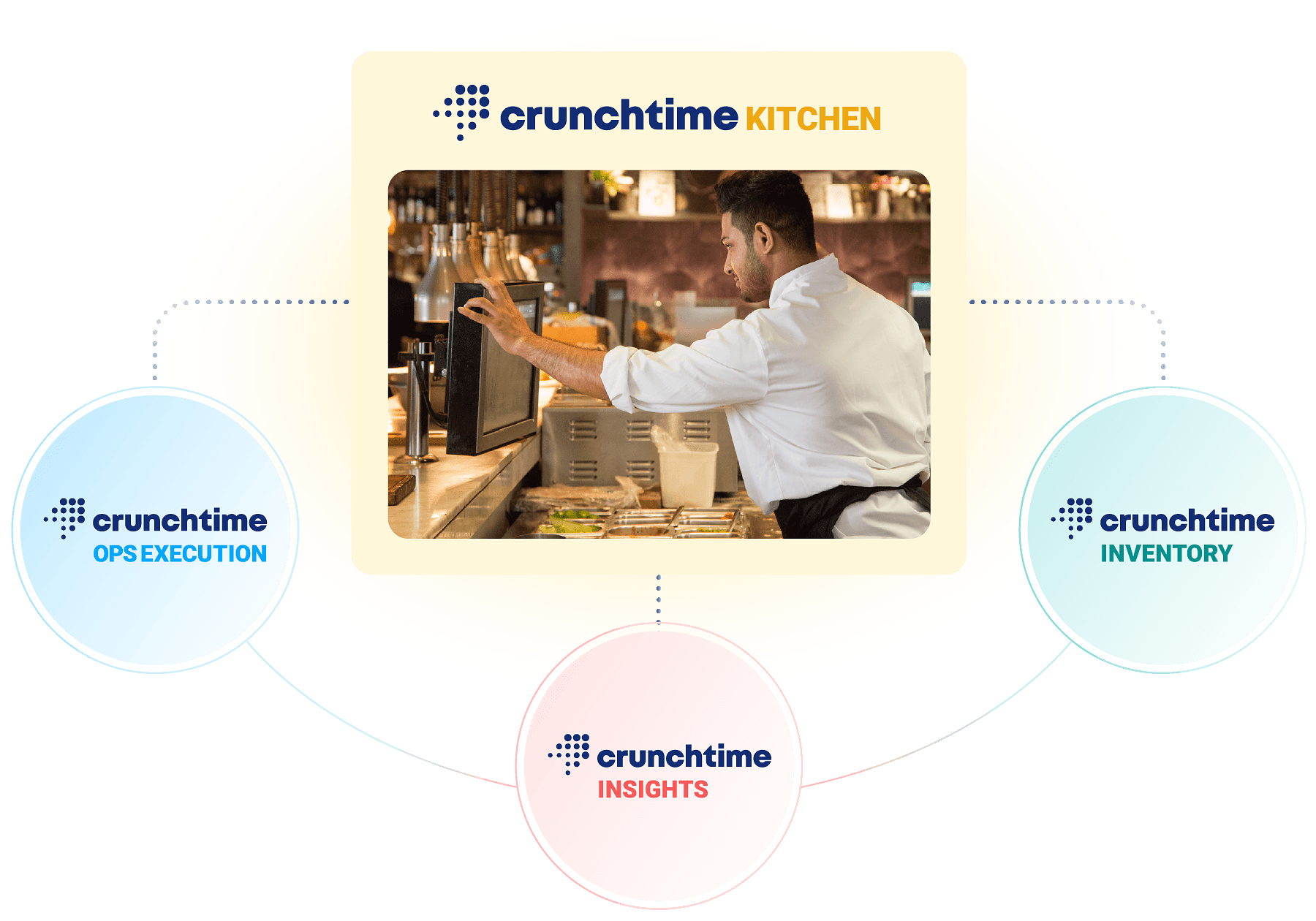
Multi-unit restaurant operators now have a single operational command center on the kitchen display system. Crunchtime, the Boston-based restaurant operations management software provider trusted by 850+ brands across 150,000+ locations worldwide, launched what it calls the industry's first connected operations management suite on September 16, unifying its Kitchen, Ops Execution, and Inventory products on the KDS screen. The announcement delivers on integration promises made when Crunchtime merged with QSR Automations in 2025.
The practical upshot for operators: line teams no longer need to toggle between devices or applications mid-shift. Task checklists, AI-generated prep recommendations, and waste logging all surface directly on the KDS — the same screen already running incoming orders. Waste entries logged on the KDS automatically update Crunchtime Inventory, reducing the data gaps that quietly erode food cost accuracy at scale.
What's Actually Connected
Three workflow changes define the launch. First, tasks built in Crunchtime Ops Execution can appear on KDS screens alongside order queues and be completed without a separate login. Second, AI forecasting from Crunchtime Inventory pushes prep recommendations to the line, targeting the over- and under-prepping that drives unnecessary food cost variance. Third, waste logging happens in-line rather than at a back-office terminal, making compliance more likely and inventory data more reliable.
The intelligence layer extends beyond the kitchen. By connecting Crunchtime Kitchen to Crunchtime Insights, speed-of-service metrics, ticket times, cook-time variance, and reservation data are now consolidated alongside inventory, labor, and POS data. For above-store leaders managing dozens or hundreds of units, that unified view replaces the manual reconciliation of multiple dashboards — a common friction point in multi-unit oversight.
Why This Signals a Broader Shift
For operators evaluating back-of-house tech stacks, this launch illustrates a consolidation trend that has been reshaping the foodservice technology vendor landscape. The fragmented best-of-breed approach — separate vendors for scheduling, inventory, task management, and KDS — is increasingly difficult to justify when integration overhead consumes labor hours and creates data blind spots. Crunchtime's suite now competes directly with platforms like Toast, Lightspeed, and Oracle MICROS on the breadth of native cross-product connectivity.
Bryan Herr, SVP of Product at Crunchtime, framed the core problem clearly: operational friction in multi-unit environments typically originates from software that forces teams onto multiple disparate devices throughout a shift. Consolidating execution onto the KDS — where front-line staff already spend their time — removes that context-switching cost. CEO John Raguin positioned the unified data layer as a shift in decision-making itself, enabling GMs and above-store leaders to act on a single source of truth rather than lagging, siloed reports.
For operators currently mid-cycle on a tech-stack review, the Crunchtime announcement is a useful benchmark. Vendors pitching individual point solutions should be pressed on native integration depth, not just API availability. The standard is moving toward consolidated intelligence, and procurement decisions made today will carry that expectation forward.
Crunchtime will demo the connected suite at FS/TEC in Grapevine, TX (Booth #404) and the Hospitality Tech Expo in London (Stand #HT1200).
Written by Michael Politz, Author of Guide to Restaurant Success: The Proven Process for Starting Any Restaurant Business From Scratch to Success (ISBN: 978-1-119-66896-1), Founder of Food & Beverage Magazine, the leading online magazine and resource in the industry. Designer of the Bluetooth logo and recognized in Entrepreneur Magazine's "Top 40 Under 40" for founding American Wholesale Floral, Politz is also the Co-founder of the Proof Awards and the CPG Awards and a partner in numerous consumer brands across the food and beverage sector.