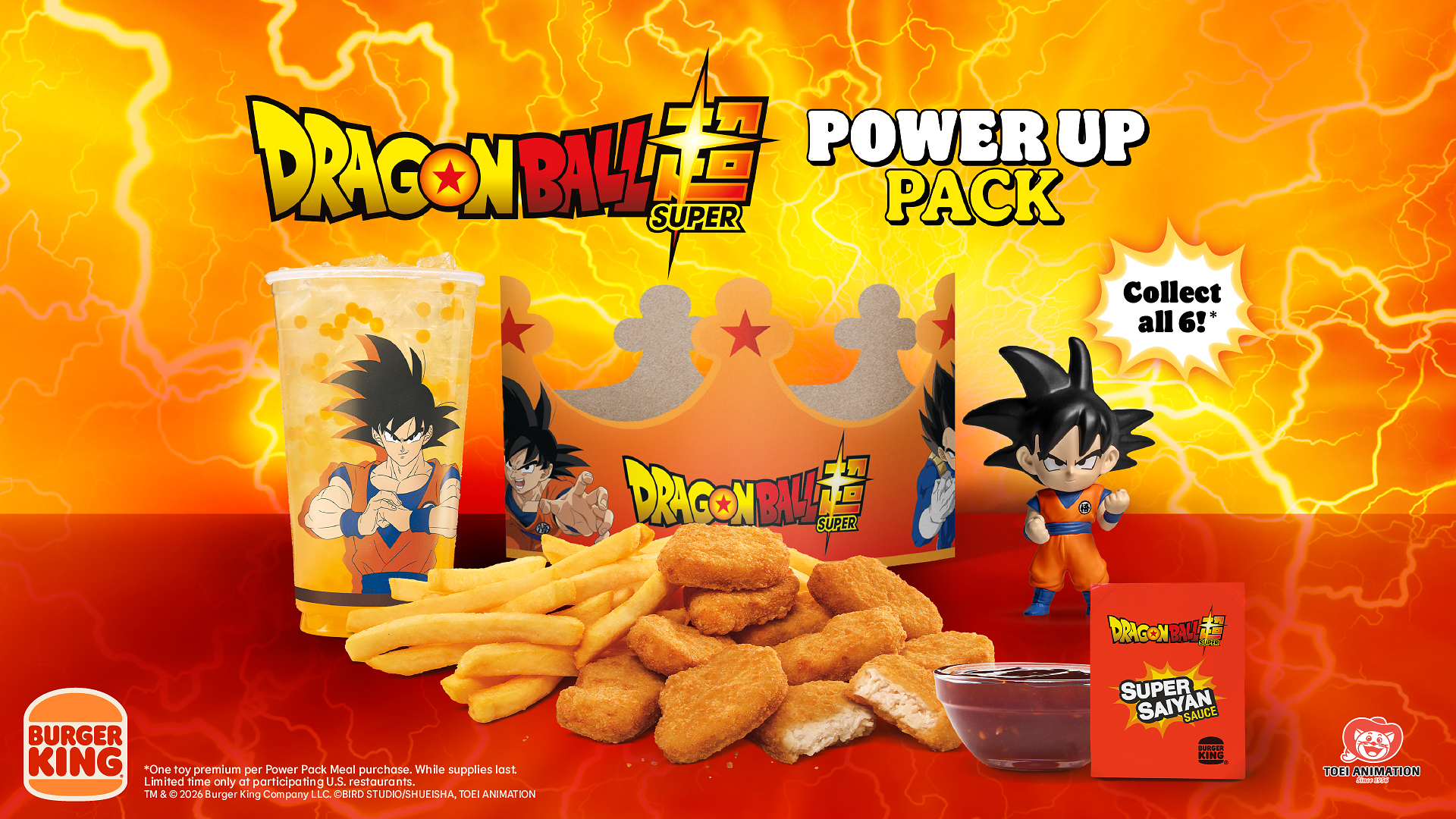
Burger King is rolling out a Dragon Ball Super limited-time menu across participating U.S. restaurants beginning September 1, partnering with Toei Animation to bundle new sauces, a novelty beverage, and collectible figurines into a single value pack. The activation covers dine-in, drive-thru, BK.com, and the BK App, maximizing order-channel coverage for franchisees who need every touch point working during a short promotional window.
The hero SKU is the "Dragon Ball Super Power Up Pack": 10-piece chicken nuggets served with a new Super Saiyan Sauce — described as a sweet, savory teriyaki-style profile — alongside a Mango Peach Lemonade loaded with mango-flavored popping boba, a medium fry, and one of six exclusive character figurines (Goku, Super Saiyan God Super Saiyan Goku, Vegeta, Super Saiyan God Super Saiyan Vegeta, Piccolo, and Beerus). A Dragon Ball Super King Jr. Meal mirrors the bundle for younger guests, with a figurine included and entrée options spanning hamburger, cheeseburger, or 4- or 6-piece nuggets.
Why This Play Works
Anime IP licensing has matured into a reliable QSR traffic driver. The Dragon Ball franchise — first introduced in the mid-1980s and revived with Dragon Ball Super in 2015 — commands a multigenerational fan base that skews young adult, exactly the demographic QSR chains are competing hardest to retain against fast-casual alternatives. Collectible figurines serve dual purposes: they generate earned media through unboxing content on short-form video platforms, and they create repeat-visit urgency when guests chase a complete set of six characters. That mechanic is well-documented in brand launch strategy and increasingly shows up in operator planning conversations around traffic-driving promotions.
Joel Yashinsky, Chief Marketing Officer of Burger King U.S. & Canada, framed the collaboration as an experience layer on top of the food itself — a signal that BK's marketing team is deliberately building moments that extend beyond the transaction. For the 19,000-plus locations across more than 120 countries in the Burger King system, most of them independently franchised, that framing matters: experience-driven LTOs tend to generate social amplification that a franchisee cannot buy with local ad spend alone.
What Operators Should Watch
The sauce innovation here is worth noting separately. Adding a named, character-tied dipping sauce to an existing nugget SKU is a low-cost menu extension — no new equipment, no major prep change — that creates a perceived novelty bump on the menu board. Operators in independent and regional QSR who have not explored proprietary sauce programs should benchmark this approach. The popping boba lemonade similarly grafts a trending ingredient format (boba, tapioca pearls) onto a standard fountain-adjacent beverage without requiring a full bubble tea buildout, which is the kind of menu innovation intelligence that translates across concepts.
From a procurement standpoint, short-window LTOs tied to IP releases demand tight supply-chain coordination — particularly for collectible premiums, which have historically been a point of friction when inventory runs short mid-promotion. Operators evaluating similar activations should build supplier lead-time buffers and set realistic "while supplies last" guest communication protocols upfront to avoid negative social blowback.
Written by Michael Politz, Author of Guide to Restaurant Success: The Proven Process for Starting Any Restaurant Business From Scratch to Success (ISBN: 978-1-119-66896-1), Founder of Food & Beverage Magazine, the leading online magazine and resource in the industry. Designer of the Bluetooth logo and recognized in Entrepreneur Magazine's "Top 40 Under 40" for founding American Wholesale Floral, Politz is also the Co-founder of the Proof Awards and the CPG Awards and a partner in numerous consumer brands across the food and beverage sector.