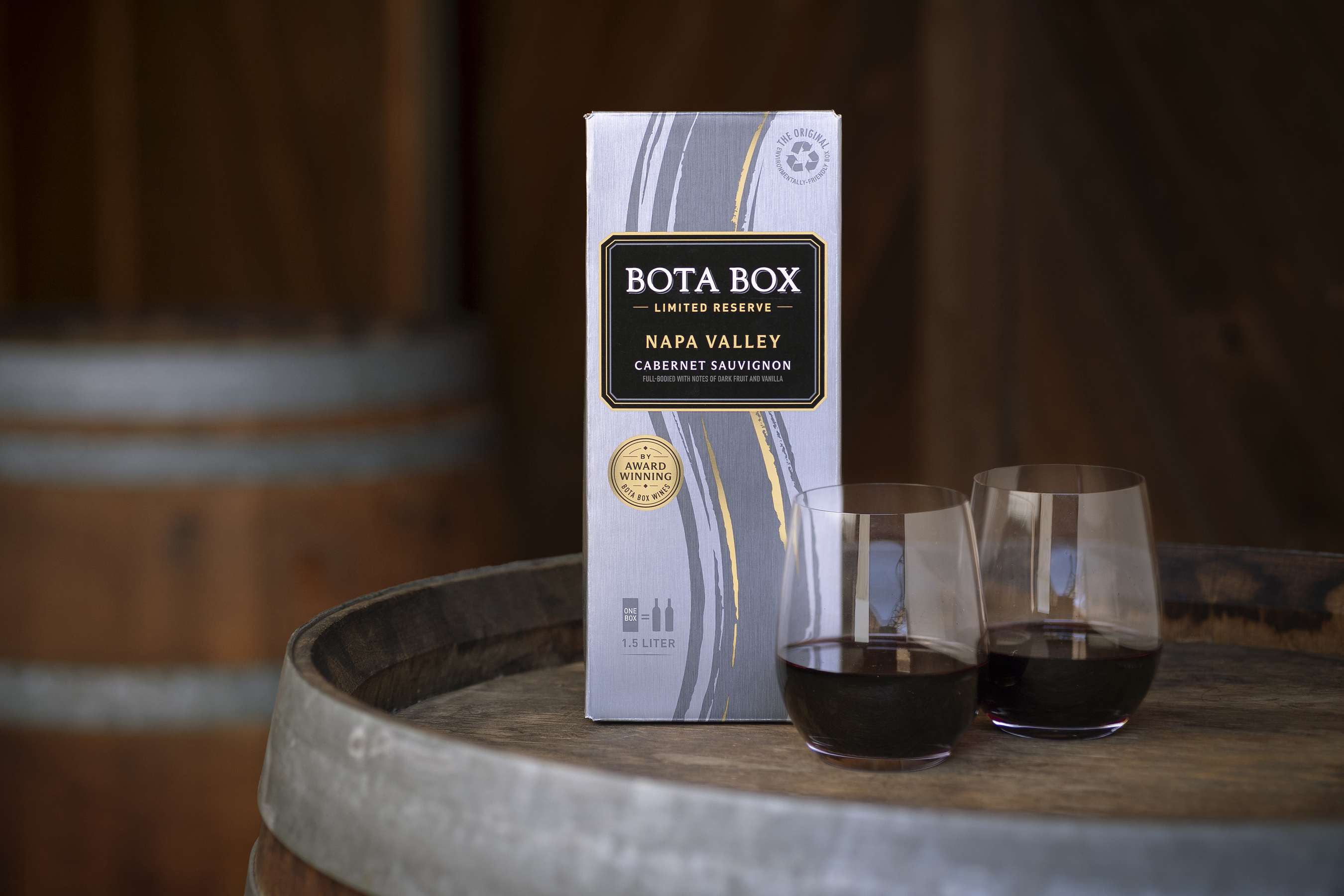
Bota Box is extending its premium boxed-wine playbook into Napa Valley appellation territory, releasing a Limited Reserve Napa Valley Cabernet Sauvignon in a 1.5-liter bag-in-box format with a $20 suggested retail price. The SKU, available while supply lasts at select Kroger locations and independent retailers, effectively prices a Napa Valley Cab at $10 per 750-milliliter equivalent — territory that has historically been difficult to occupy credibly in the glass-bottle channel.
The Format Argument
The case for bag-in-box at the premium tier has been building steadily. Bota Box has held the U.S. category-leader position in premium 3-liter boxed wine (Circana, Total MULO+ with Convenience, 52 weeks ending June 14, 2026), and this 1.5-liter format represents a deliberate step toward the single-occasion or small-household buyer who resists committing to a 3-liter carton. The stay-fresh-up-to-30-days technology inherent to bag-in-box also remains a genuine functional differentiator for operators and retailers managing open-bottle waste — a consideration that carries real cost implications for by-the-glass programs.
Winemaker Alicia Ysais built the blend from select Napa Valley vintage lots, targeting what she describes as a classic expression of the appellation: cherry, blackberry, spice, and cedar with firm structure. The wine is positioned as ready to drink on release, which removes the education barrier that can slow premium boxed-wine trials at retail.
What Buyers Should Watch
For retail buyers and on-premise procurement teams, the $20 price point on a double-bottle format is a direct challenge to the $14–$18 glass-bottle Cabernet shelf set that dominates mid-tier grocery wine sections. Andrew Blok, vice president of marketing at Bota Box, noted strong retailer uptake ahead of launch — a signal that category managers are treating the SKU as an incremental placement rather than a cannibal of existing bottle inventory.
The limited-run structure is also worth noting from a brand launch and distribution strategy standpoint. Scarcity mechanics at the retail level — Kroger chainwide plus curated independents — let Bota Box test velocity data and consumer response before any potential broader rollout. That playbook mirrors how several spirits and RTD brands have used regional or channel-limited drops to build demand signals ahead of scale decisions.
From a sustainability angle, bag-in-box carries a measurably lighter carbon footprint versus the equivalent volume shipped in glass, which is increasingly a procurement scoring criterion for hospitality groups with published ESG targets. Operators sourcing wine for banquet programs or hotel minibars may find the format worth revisiting as sustainability reporting requirements tighten.
For operators evaluating their beverage program pricing and value architecture, the Bota Box Limited Reserve illustrates how appellation credibility — Napa Valley is still one of the most consumer-recognized wine geographies in the U.S. — can be leveraged to elevate the perceived ceiling on alternative packaging formats. The relevant question for buyers is not whether boxed wine belongs on the premium shelf, but whether the category is moving fast enough to warrant dedicated shelf space and by-the-glass menu placement ahead of the mainstream adoption curve.
Written by Michael Politz, Author of Guide to Restaurant Success: The Proven Process for Starting Any Restaurant Business From Scratch to Success (ISBN: 978-1-119-66896-1), Founder of Food & Beverage Magazine, the leading online magazine and resource in the industry. Designer of the Bluetooth logo and recognized in Entrepreneur Magazine's "Top 40 Under 40" for founding American Wholesale Floral, Politz is also the Co-founder of the Proof Awards and the CPG Awards and a partner in numerous consumer brands across the food and beverage sector.