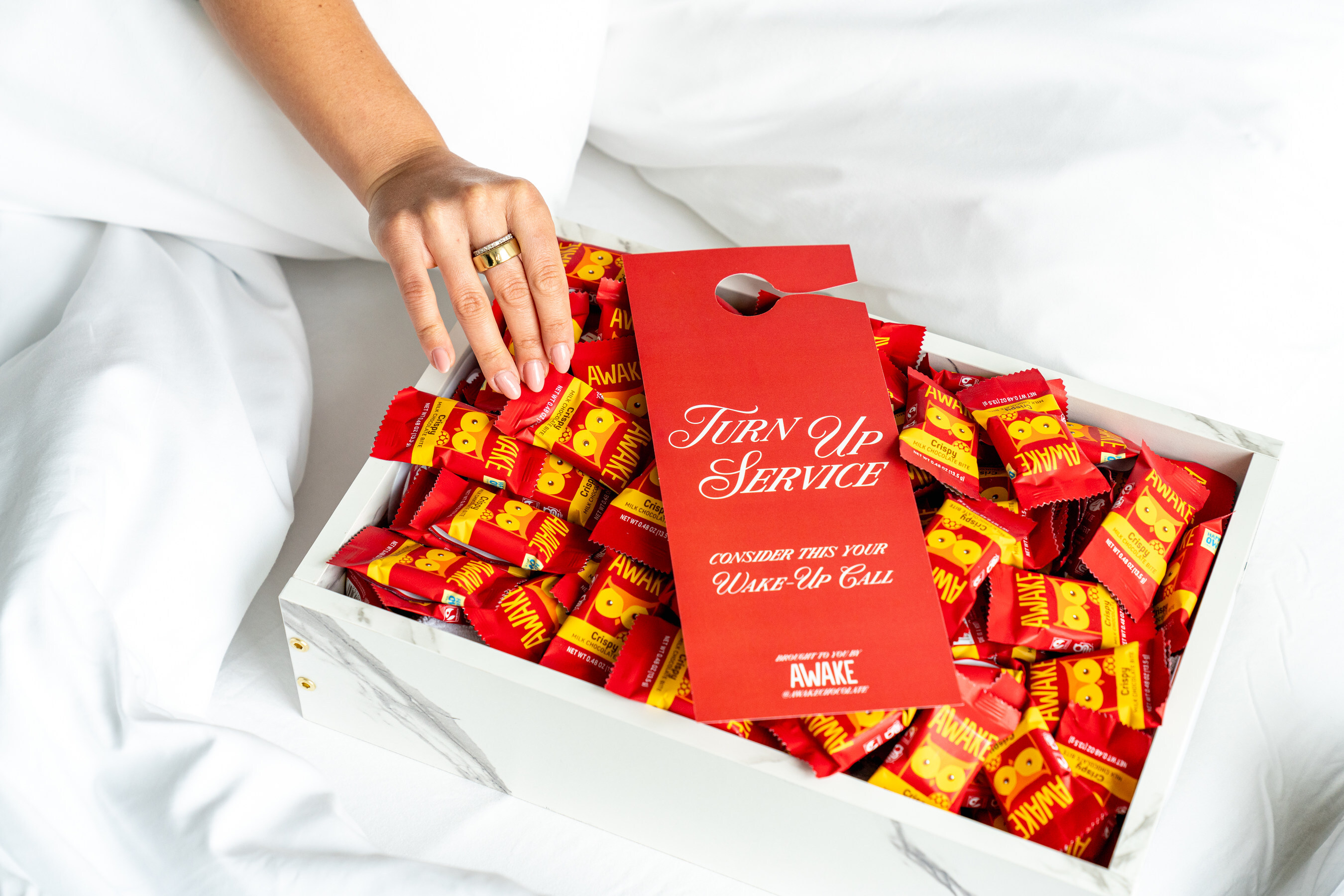
AWAKE Chocolate is trading the pillow mint for a caffeine hit. The brand announced a partnership with Walker Hotels — a collection of design-forward luxury properties in New York City — to launch what it's calling "Turn Up Service," a morning amenity cart delivering caffeinated chocolate to guests during the long days of early summer. The activation coincides with the debut of AWAKE's new Crispy Milk Chocolate Bites, making the hotel floor a de facto sampling channel before the SKU reaches wider retail.
For operators watching how emerging food and beverage brands earn shelf space and trial, this move is instructive. Rather than launching through a traditional retail push or a digital-acquisition funnel, AWAKE is embedding the product into a ritualized hospitality moment — the morning wake-up — where guest receptivity is high and brand recall tends to stick. Walker Hotels' positioning as design-led and experience-forward makes them a credible stage; guests are already primed for curated touches. The play mirrors what premium snack and beverage brands have done in airline first-class and boutique fitness studios: use a controlled, high-trust environment to compress the trial-to-repurchase cycle.
For hotel operators specifically, this is a reminder that the amenity space is undermonetized from a brand-partnership standpoint. Turn-down service has been a largely static ritual for decades. Reframing the morning equivalent — a "Turn Up" cart — as a branded energy ritual creates a new touchpoint that costs the property relatively little while adding a perceived experiential layer guests may actually photograph and share. That kind of organic social lift is meaningful for a boutique hotel competing against larger flags on amenity depth. Operators evaluating beverage and snack supplier partnerships should note that the activation format — a mobile cart, a named service moment, a seasonal window — is replicable without significant capital outlay.
From a brand-launch intelligence perspective, AWAKE is executing a classic seeding-before-scaling sequence: place the new product in a premium context, generate imagery and press, then use that credentialed awareness to open retail conversations. Buyers at grocery and specialty chains respond to proof-of-placement in premium hospitality the same way they respond to a festival activation or a celebrity endorsement — it signals that real consumers have already encountered and accepted the product at a price-premium moment. Emerging brands pursuing retail-ready launch strategies should treat hotel and boutique hospitality partnerships as legitimate pre-retail validation, not just marketing stunts.
The broader signal here is directional: hotel amenity programs are quietly becoming a viable distribution and discovery channel for food and beverage brands willing to build the relationship. For operators on the hotel side, the question is whether your amenity program has a formal partnership framework in place — or whether you're leaving both revenue and guest-experience equity on the table.
Written by Michael Politz, Author of Guide to Restaurant Success: The Proven Process for Starting Any Restaurant Business From Scratch to Success (ISBN: 978-1-119-66896-1), Founder of Food & Beverage Magazine, the leading online magazine and resource in the industry. Designer of the Bluetooth logo and recognized in Entrepreneur Magazine's "Top 40 Under 40" for founding American Wholesale Floral, Politz is also the Co-founder of the Proof Awards and the CPG Awards and a partner in numerous consumer brands across the food and beverage sector.