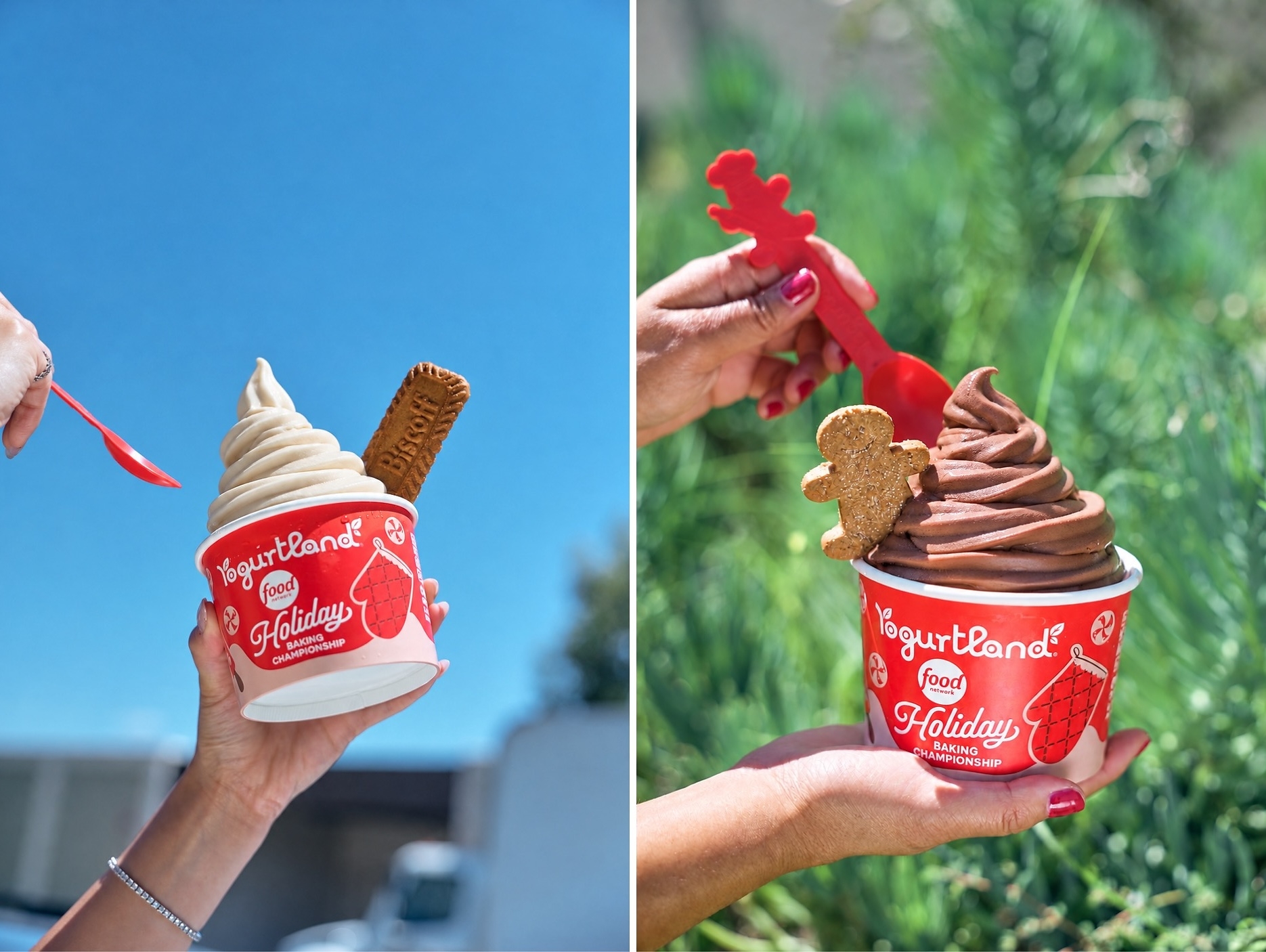
Yogurtland is launching two limited-time frozen yogurt flavors for the winter season: Holiday Baking Championship Peppermint Brownie Bliss, developed in partnership with Food Network's Holiday Baking Championship, and Cookie Butter Made with Biscoff® Cookies. Both flavors are available now through December 31 at participating locations across Yogurtland's 220-plus U.S. and international footprint, paired with two seasonal toppings — Holiday Baking Buddies and Biscoff® Cookies. For multi-unit dessert operators, the move is worth tracking less for the flavors themselves and more for the media-partnership mechanics behind them.
The IP Play
The Food Network co-branding is the signal here. Tying a frozen yogurt LTO to a linear TV property — one with Monday prime-time episodes and a dedicated holiday audience — is a distribution and awareness play that goes beyond social media sampling. It puts Yogurtland's seasonal menu in front of a self-selected audience that is already primed for holiday indulgence, without requiring the brand to build that emotional context from scratch. For operators evaluating how to spend limited marketing budgets during Q4, co-branded media IP arrangements like this one can compress the creative lift while borrowing an established content calendar. The tradeoff is coordination complexity and the need to align promotional windows with a broadcast partner's schedule.
What Operators Should Watch
Licensed-IP LTOs have become a reliable mechanism across the QSR and fast-casual dessert segment for driving incremental visits during high-competition seasonal windows. Biscoff, owned by Lotus Bakeries, has emerged as one of the most cross-category ingredient brands in foodservice — appearing in everything from airline service trays to independent café menus — giving Yogurtland's cookie butter SKU a built-in familiarity advantage at the point of sale. Sam Kwon, Head of Project Services & eCommerce at Yogurtland, framed the launches around guest experience, noting that the seasonal additions are designed to make "every visit a little more special this holiday season." That language is deliberate: in self-serve formats, where the operator controls ambiance but the guest controls the bowl, LTO flavors are one of the few direct levers for influencing average ticket and return frequency.
For procurement and marketing teams at multi-unit frozen dessert or specialty beverage concepts, the practical intelligence here is twofold. First, media co-branding with entertainment IP is no longer exclusive to national QSR chains with nine-figure budgets — mid-size specialty chains are executing these deals. Second, seasonal topping additions (Yogurtland is also releasing two LTO toppings alongside the flavors) are a low-cost way to extend LTO relevance and increase attach rates without reformulating core product. Operators considering their own Q1 planning cycles should be looking at whether ingredient brand partnerships — with names that already carry consumer trust — can substitute for some portion of paid media spend on new menu introductions.
Takeaways for Operators
The December 31 close date creates a hard urgency window, which is standard for holiday LTOs but worth noting: any franchise or multi-location operator benchmarking this approach needs roughly 90 to 120 days of lead time for ingredient sourcing, staff training, and POS updates to execute cleanly.
Written by Michael Politz, Author of Guide to Restaurant Success: The Proven Process for Starting Any Restaurant Business From Scratch to Success (ISBN: 978-1-119-66896-1), Founder of Food & Beverage Magazine, the leading online magazine and resource in the industry. Designer of the Bluetooth logo and recognized in Entrepreneur Magazine's "Top 40 Under 40" for founding American Wholesale Floral, Politz is also the Co-founder of the Proof Awards and the CPG Awards and a partner in numerous consumer brands across the food and beverage sector.