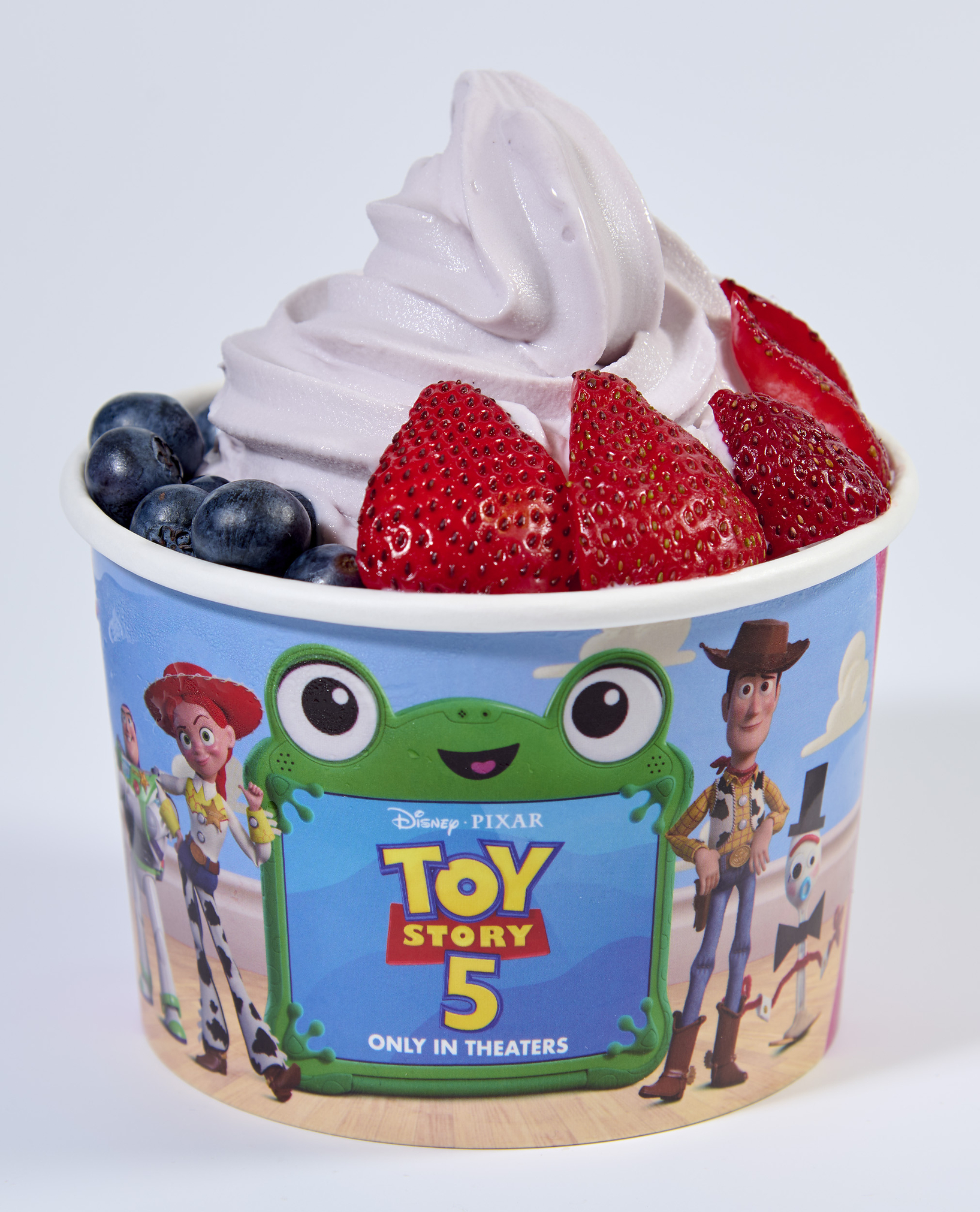
Yogurtland is rolling out a nationwide collaboration with Disney and Pixar's Toy Story 5 — in theaters June 19 — anchored by three limited-time frozen yogurt flavors, collectible in-store giveaways, and exclusive digital content, all live as of June 8. For operators watching how self-serve and fast-casual concepts compete for attention in a crowded summer calendar, the move is worth studying closely.
Licensed IP activations have become a reliable short-cycle traffic lever for dessert and QSR concepts, particularly when the studio partner carries a built-in family audience. Disney and Pixar properties consistently index above other entertainment IPs for household recall and visit intent among guests with children — a demographic that over-indexes for frozen yogurt occasions. Yogurtland is pairing the cultural moment with collectible physical merchandise, a tactic that extends dwell time, encourages repeat visits, and generates organic social content without requiring a paid-media heavy lift.
The intelligence signal here is three-layered. First, studios are actively seeking F&B co-marketing partners for tentpole releases, and the window to negotiate those agreements has compressed — operators and multi-unit franchise groups that want to access IP deals need either a direct brand-licensing relationship or a franchisor with existing studio relationships. Second, the digital content component of this activation suggests Yogurtland is building owned-channel assets — email, app, social — around the partnership rather than relying solely on in-store traffic. That is the right call: IP collaborations that live only on a table tent rarely generate measurable ROI. Third, limited collectible merchandise tied to a film release creates an urgency mechanic that discounting cannot replicate and that holds margin far better than a straight price promotion. Operators running loyalty programs should be watching how Yogurtland gates collectible access — whether through purchase thresholds or app engagement — because that structure determines whether the activation builds long-term customer data or just a one-week spike.
For multi-unit operators and emerging brands considering IP or entertainment partnerships, the Yogurtland-Disney framework is a workable reference. The core structure — limited flavor SKUs, physical collectible, digital content drop, hard theatrical release date as a built-in deadline — is replicable at smaller scale with regional or independent entertainment properties. The theatrical release date functions as a free media moment: entertainment press, parent bloggers, and family-content creators are already writing about Toy Story 5, and any brand with a visible in-store tie-in absorbs some of that ambient coverage. That earned-media efficiency is what makes studio partnerships disproportionately valuable relative to their licensing cost, provided the operator activates correctly across owned channels. See how brands are structuring entertainment IP activations for seasonal traffic and how LTO menu strategy intersects with loyalty program design for additional context on building repeatable frameworks around limited-time moments.
Written by Michael Politz, Author of Guide to Restaurant Success: The Proven Process for Starting Any Restaurant Business From Scratch to Success (ISBN: 978-1-119-66896-1), Founder of Food & Beverage Magazine, the leading online magazine and resource in the industry. Designer of the Bluetooth logo and recognized in Entrepreneur Magazine's "Top 40 Under 40" for founding American Wholesale Floral, Politz is also the Co-founder of the Proof Awards and the CPG Awards and a partner in numerous consumer brands across the food and beverage sector.