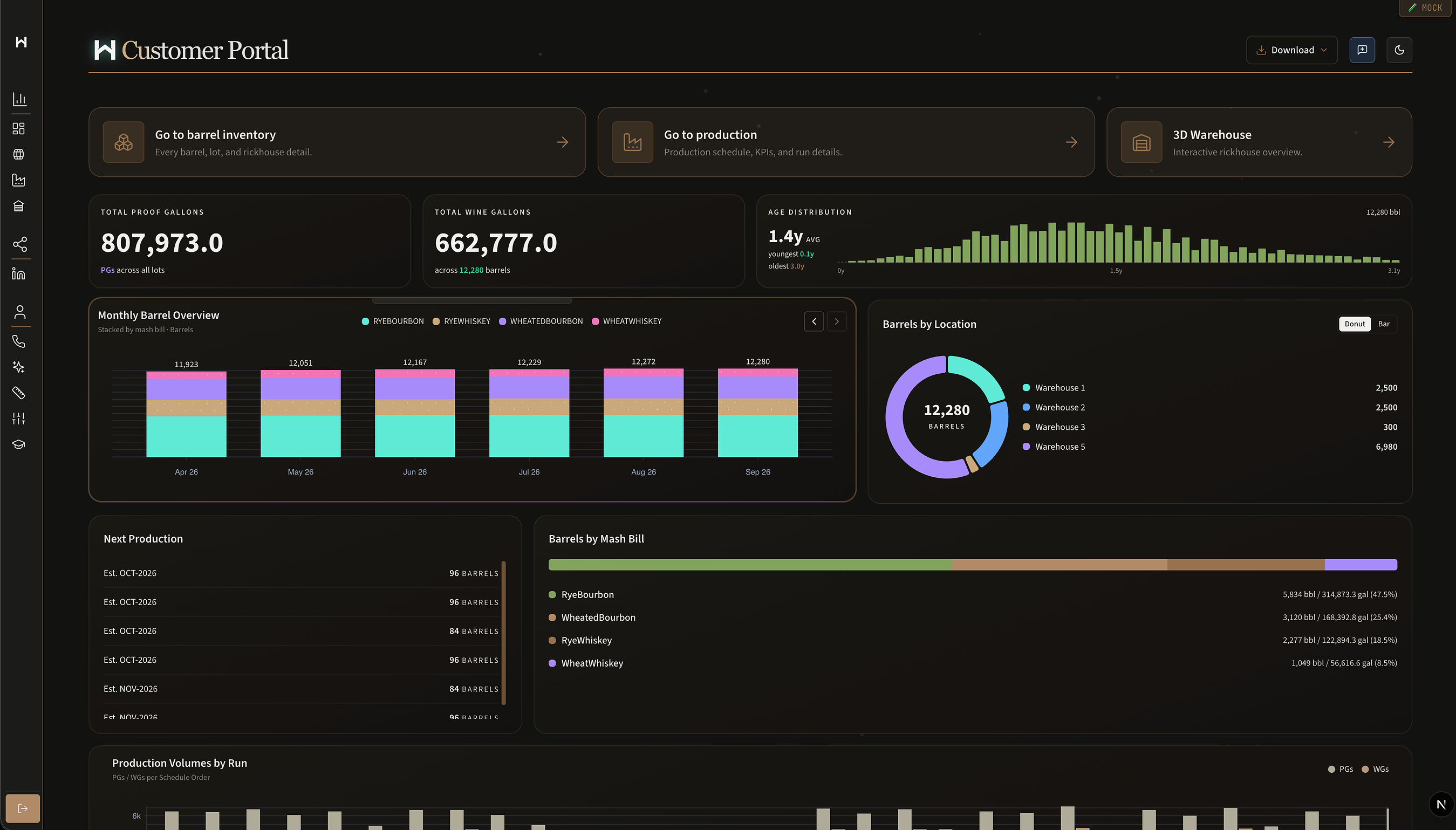
Custom distillery Whiskey House of Kentucky has rolled out Customer Portal 2.0, a ground-up rebuild of its proprietary client platform that gives spirits brand owners a photorealistic 3D walkthrough of the rickhouse where their barrels are aging — along with drill-down production data, flexible volume units, and secure CSV exports — all without picking up a phone.
The move is notable because contract distilling has historically operated on trust, spreadsheets, and quarterly check-ins. Brands placing barrels with a third-party producer typically wait for emailed reports and accept inventory summaries with a days-long lag. Customer Portal 2.0 eliminates that gap entirely: the system connects directly to Whiskey House's warehouse and production infrastructure with no middleware layer, meaning the data a brand sees in its dashboard reflects actual floor state, not a stale nightly export.
What the Platform Delivers
The centerpiece is a 3D warehouse viewer that lets customers open a true-to-life model of their rickhouse, filter by lot or schedule order, highlight matching barrels, and pull full production detail — entry proof, average wine gallons per barrel, cooperage spec, age, and location — by clicking a single barrel. A customizable card-based dashboard surfaces the KPIs each customer cares about most, with one-click branded data downloads. Volume units (liters of pure alcohol, wine gallons, or proof gallons) are selectable per account, with automatic server-side conversion across every table and export. A context-aware help layer walks new users straight into the 3D warehouse on first sign-in.
Security architecture received equal attention. Per-customer data protection is enforced at every request, accounts are routed independently, and a fail-closed security layer sits between the portal and the production floor. Whiskey House can migrate or upgrade individual accounts with zero downtime — a practical detail that matters when a brand's inventory represents years of capital tied up in aging spirit.
Intelligence Signal for Spirits Operators
For brand owners evaluating contract distilling partners, portal capability is becoming a procurement criterion, not a differentiator. As spirits brands grow more sophisticated about traceability — driven partly by retail buyers and importers demanding chain-of-custody documentation — the ability to pull auditable, timestamped production records on demand reduces friction at every stage from regulatory compliance to brand storytelling.
This investment also signals where the competitive floor is moving in custom spirits production. Operators sourcing a white-label or private-label bourbon program should now be asking prospective distillery partners about real-time inventory access, data export formats, and security architecture the same way a food manufacturer would vet a co-packer's ERP integration. A platform like Customer Portal 2.0 also generates the kind of granular, barrel-level provenance data that powers increasingly common "barrel journey" consumer narratives — content that commands shelf and menu placement at on-premise accounts.
For hospitality operators running private-label spirits programs — a growing strategy among hotel F&B groups and high-volume bar operators — this type of transparency infrastructure directly supports brand launch and retail readiness by ensuring the production documentation buyers and compliance teams require is always export-ready.
Whiskey House's positioning — no house brands, campus closed to the public, no conflicts of interest with its clients — remains the structural argument for why brands trust it with proprietary liquid. The portal upgrade reinforces that argument with a technical proof point rather than a marketing claim. Operators evaluating beverage program procurement and supplier intelligence should treat this as a benchmark for what a modern contract production relationship can look like.
Written by Michael Politz, Author of Guide to Restaurant Success: The Proven Process for Starting Any Restaurant Business From Scratch to Success (ISBN: 978-1-119-66896-1), Founder of Food & Beverage Magazine, the leading online magazine and resource in the industry. Designer of the Bluetooth logo and recognized in Entrepreneur Magazine's "Top 40 Under 40" for founding American Wholesale Floral, Politz is also the Co-founder of the Proof Awards and the CPG Awards and a partner in numerous consumer brands across the food and beverage sector.