The Offer Structure
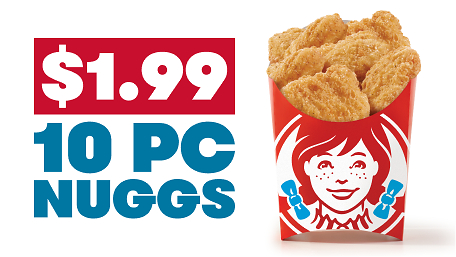
Wendy's is running a $1.99 10-piece Classic or Spicy Nugget offer — with any purchase — exclusively through its mobile app from August 24 through September 27. The mechanic refreshes daily, meaning the discount resets every 24 hours and gives the chain a legitimate behavioral reason for customers to open the app repeatedly over a five-week window. That daily-refresh design is the more interesting detail for operators and growth strategists than the price point itself.
Why the App Gate Matters
The app-exclusivity is doing real work here beyond margin management. Every redemption generates a logged transaction tied to an authenticated user — purchase time, add-ons, location, frequency. For a system operating more than 7,000 restaurants worldwide, that first-party behavioral data is increasingly the asset, not the discounted nugget. QSR chains across the competitive set have been redirecting value messaging away from printed coupons and passive loyalty cards toward app-gated offers precisely because the data capture justifies the discount economics. Chains that have moved aggressively in this direction — including McDonald's with its MyMcDonald's Rewards architecture and Taco Bell's app-exclusive drops — have reported measurable lifts in average ticket when loyalty members transact versus non-members.
For franchisee operators watching margin pressure from labor and food costs, the calculus is worth examining: a deeply discounted LTO that drives app downloads and repeat daily opens can outperform a higher-margin, lower-frequency promotion if the lifetime visit rate improves. The discount is the customer acquisition cost for the loyalty channel, not simply a margin sacrifice.
Signals for the Broader Operator Landscape
The daily-refresh mechanic is a pattern worth benchmarking. Operators running their own digital loyalty programs — or evaluating third-party platforms — should note that Wendy's is essentially using a high-demand SKU (nuggets consistently rank among its most-ordered items) as the hook for a frequency-driving engagement loop. The promotional calendar isn't structured around a single redeem-and-done event; it's structured around daily behavioral conditioning.
For food and beverage brands and suppliers considering how to support QSR promotional programs, this also signals where retail media and co-op spend are heading: toward digitally attributable, app-mediated placements rather than broad daypart broadcast. Operators on platforms like Toast, Olo, or proprietary ordering stacks should be mapping their own equivalent mechanics — what high-velocity item can anchor a daily-refresh engagement layer, and does the current tech stack support it?
From an AI and personalization standpoint, chains of scale are increasingly using these high-volume offer windows to train recommendation models — learning which users respond to value triggers versus which respond to new-item messaging, then segmenting future push notifications accordingly. The $1.99 nugget deal is, in that framing, also a data-labeling event at scale.
Written by Michael Politz, Author of Guide to Restaurant Success: The Proven Process for Starting Any Restaurant Business From Scratch to Success (ISBN: 978-1-119-66896-1), Founder of Food & Beverage Magazine, the leading online magazine and resource in the industry. Designer of the Bluetooth logo and recognized in Entrepreneur Magazine's "Top 40 Under 40" for founding American Wholesale Floral, Politz is also the Co-founder of the Proof Awards and the CPG Awards and a partner in numerous consumer brands across the food and beverage sector.