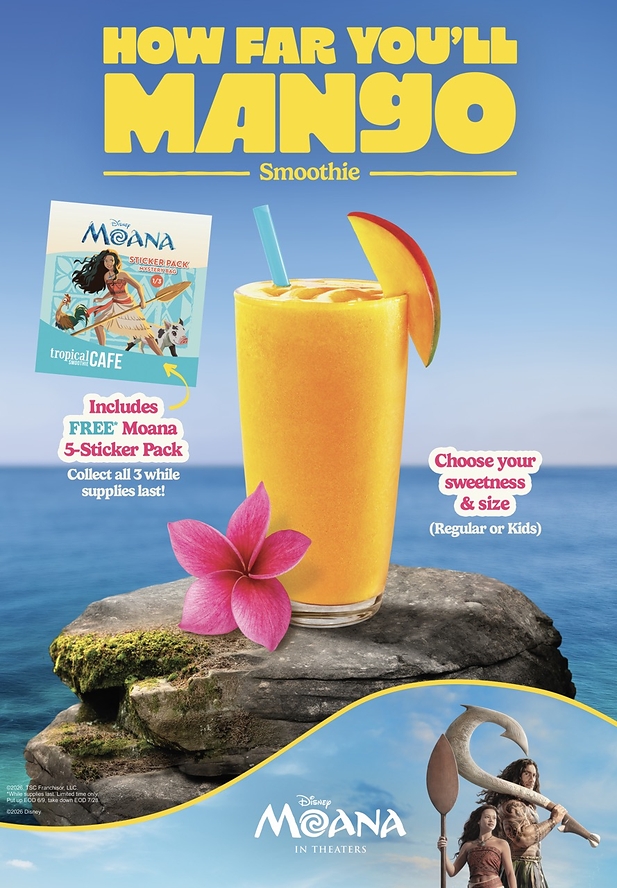
Tropical Smoothie Cafe is running a limited-time smoothie — the 'How Far You'll Mango Smoothie,' blending mango, pineapple, and guava — timed to the July 10 theatrical release of Disney's live-action Moana. The LTO runs through July 28, 2026, and is paired with collectible sticker packs designed to extend the in-store occasion. For franchise operators, the move is worth watching less as a novelty and more as a case study in how mid-size QSR chains are engineering short windows of incremental traffic around studio IP calendars.
Studio co-promotions have historically belonged to the major fast-food chains — McDonald's Happy Meal tie-ins are the canonical example — but the mechanics have filtered down market. Brands in the 1,000-to-1,500-unit range are increasingly bidding for regional or category-exclusive IP windows, particularly with Disney, which manages a dense licensing pipeline across theatrical, streaming, and theme-park release cycles. The collectible sticker mechanic here mirrors what convenience and fast-casual operators have used to increase visit frequency within a promotion window, a tactic that performs well when the IP has strong household penetration with families.
From a brand-launch and promotional-calendar standpoint, the structure of this campaign carries repeatable intelligence for operators and agency teams. The LTO is narrow — roughly seven weeks — which limits ingredient exposure and operational lift while maximizing launch-day media value. The smoothie itself is built from existing core ingredients (mango, pineapple, guava), meaning franchisees absorb minimal supply-chain disruption. That ingredient overlap is a deliberate operational choice, not an accident, and it's the kind of constraint discipline that keeps LTO attach rates high across a franchise system. Operators evaluating their own promotional calendars should note: the most executable LTOs are engineered backward from what's already on the truck.
The collectible sticker packs add a secondary engagement layer that doesn't require a digital infrastructure investment, which matters for franchisee operators who may not have loyalty-app saturation. Physical collectibles tied to IP with built-in fan communities — particularly children's entertainment — reliably drive repeat visits within a compressed window. Brands considering similar programs should evaluate whether their POS and staff-training cycles can support a clean handoff; the operational failure mode for collectible campaigns is usually inventory inconsistency across locations, not consumer disinterest.
For vendors, agencies, and brand consultants tracking how mid-market franchise chains allocate promotional spend, this signals continued investment in licensed-IP activations as a complement to owned digital channels. The broader implication: if your growth or brand strategy depends on LTO velocity, aligning your calendar to studio release windows — even as a secondary partner — is a legitimate traffic play worth modeling.
Written by Michael Politz, Author of Guide to Restaurant Success: The Proven Process for Starting Any Restaurant Business From Scratch to Success (ISBN: 978-1-119-66896-1), Founder of Food & Beverage Magazine, the leading online magazine and resource in the industry. Designer of the Bluetooth logo and recognized in Entrepreneur Magazine's "Top 40 Under 40" for founding American Wholesale Floral, Politz is also the Co-founder of the Proof Awards and the CPG Awards and a partner in numerous consumer brands across the food and beverage sector.