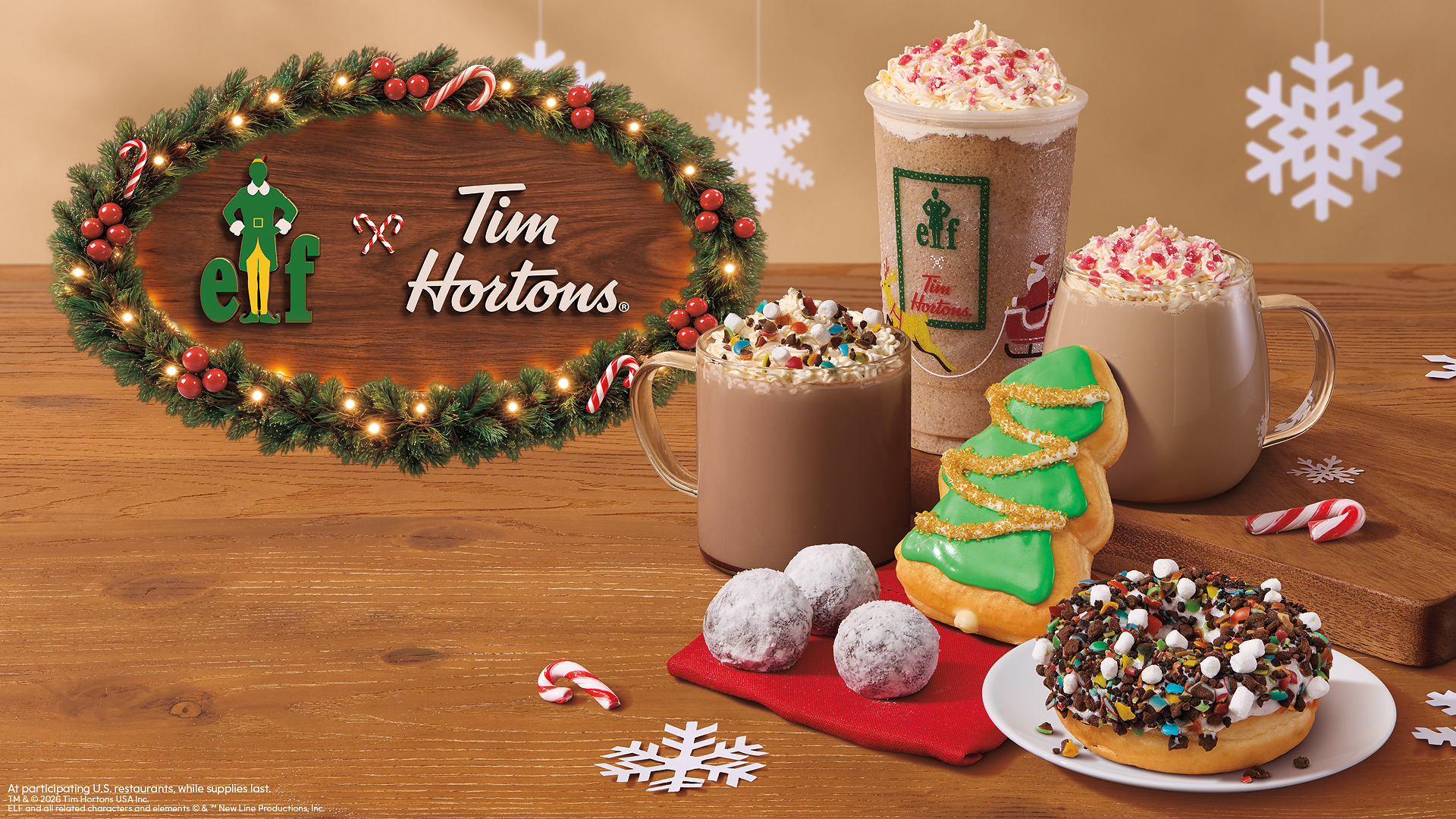
Tim Hortons is deploying a licensed IP strategy for the U.S. holiday season, rolling out a co-branded menu and packaging program built around Warner Bros.' ELF across participating domestic locations. The campaign — developed with Warner Bros. Consumer Products — introduces six new menu items and limited-edition packaging, all anchored to the film's characters and flavor cues.
The Menu Build
The product lineup spans both food and beverage, designed to maximize attachment at the counter. On the beverage side, the Candy Cane Forest ELF Latte (hot and iced), the Candy Cane Forest ELF Iced Capp, and the ELF Hot Chocolate — topped with spaghetti-shaped whipped cream and chocolate cookie crumble, a direct nod to Buddy the Elf's famously chaotic palate — carry the campaign's most visible storytelling. Food items include the ELF Chaos Donut (vanilla icing, crushed candy, chocolate, mini marshmallows), ELF Snowball Timbits (chocolate cake donut holes in powdered sugar), and the Holiday Cheer Donut, a tree-shaped yeast donut with green icing and gold sugar garnish. The packaging carries Buddy the Elf branding throughout, giving the LTO a cohesive retail identity rather than a loose seasonal refresh.
What the IP Play Signals
For QSR operators watching category trends, the Tim Hortons move is a data point in a broader shift: entertainment IP licensing is increasingly functioning as a media spend substitute. Rather than buying share of voice against crowded holiday ad inventory, brands are embedding a recognizable cultural property directly into the product and packaging — letting the IP do the awareness work in-store and on social. Katerina Glyptis, President of Tim Hortons U.S., framed it as a loyalty and experience play: "We've created a festive menu inspired by some of the movie's most memorable moments and flavors, giving guests a new way to enjoy Tims during the holidays."
That framing matters for operators and brand teams evaluating limited-time offer strategy and seasonal menu development. IP-led LTOs tend to generate organic social lift that a straight promotional menu rarely produces, particularly when the licensed property has strong generational nostalgia. ELF, released in 2003, now functions as a perennial holiday cultural fixture — the kind of IP that carries recognition across age cohorts without requiring a new theatrical release to stay relevant.
For foodservice suppliers, co-manufacturers, and packaging vendors, campaigns of this complexity signal meaningful lead time requirements. Flavor development (peppermint syrups, specialty toppings), die-cut packaging, and licensed artwork approval cycles typically run six to nine months ahead of a November launch. Operators considering their own brand launch or seasonal campaign planning should map those timelines accordingly.
Tim Hortons operates more than 6,000 systemwide restaurants across Canada, the United States, and international markets, giving any U.S.-specific campaign meaningful scale even at the "participating locations" qualifier. For vendors and agency partners, that footprint means the production and distribution demands behind a campaign like this are substantial — and worth benchmarking against when scoping similar activations for regional or emerging chains.
Written by Michael Politz, Author of Guide to Restaurant Success: The Proven Process for Starting Any Restaurant Business From Scratch to Success (ISBN: 978-1-119-66896-1), Founder of Food & Beverage Magazine, the leading online magazine and resource in the industry. Designer of the Bluetooth logo and recognized in Entrepreneur Magazine's "Top 40 Under 40" for founding American Wholesale Floral, Politz is also the Co-founder of the Proof Awards and the CPG Awards and a partner in numerous consumer brands across the food and beverage sector.