
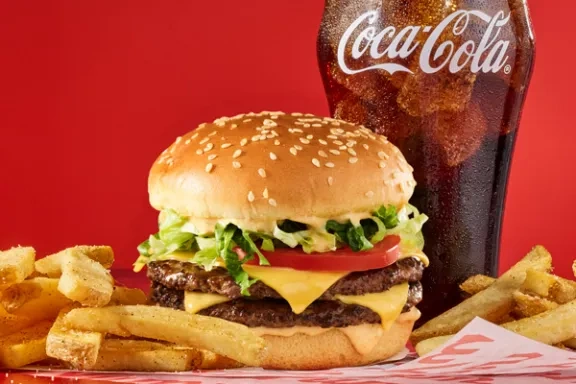
Red Robin Gourmet Burgers (www.redrobin.com) closed Q3 fiscal 2026 having completed the heaviest lift of its turnaround: selling 108 company-owned restaurants to three franchisee groups in a single quarter for approximately $89.4 million in aggregate cash consideration, then using those proceeds to refinance its entire credit facility on materially better terms. For operators, suppliers, and casual dining investors watching the sector, the move marks a meaningful shift in how a mid-scale burger chain can restructure its way back to relevance without closing its way there.
The Refranchising Math
The three Q3 transactions — 30 units to Evergreen Dining LLC, 61 to Op Burgers LLC, and 17 to Kuber Oregon/Kuber Washington LLC — were followed post-quarter by six additional restaurants transferred to Op Burgers for roughly $4.8 million, bringing the fiscal 2026 refranchising total to 114 locations. The company simultaneously closed a new $115.0 million credit facility consisting of a $90.0 million term loan and a $25.0 million revolving line, maturing October 2031 — replacing a more expensive prior facility and reducing long-term debt on the balance sheet from $164.7 million at year-end fiscal 2025 to $91.9 million as of October 4, 2026. Total liquidity stood at approximately $29.5 million at quarter-close, a tight but functional runway as transition costs work through the P&L.
The restructuring carries real-time friction. Q3 total revenues fell to $232.1 million from $265.1 million in the prior-year period, almost entirely reflecting the smaller company-owned restaurant base. Operating losses widened to $15.7 million for the quarter, weighed down by $4.2 million in losses on refranchise transactions and $3.7 million in debt extinguishment costs — both non-cash or one-time in nature. Adjusted EBITDA of $7.3 million was essentially flat versus $7.6 million in Q3 fiscal 2025, a reasonable result given the volume of transition activity.
Where the Operating Story Gets Interesting
Strip out the restructuring noise and the unit-level performance is directionally constructive. Comparable restaurant revenue rose 3.9% in Q3, reversing a 1.3% decline in the same period last year. The composition matters: average guest check was up 5.6%, driven in part by lapping the one-year anniversary of the Big Yummm value platform launched in July 2025, while traffic declined 1.7%. That traffic softness is the real watch item — check-led comps can sustain a quarter or two, but traffic recovery is what moves the needle on long-term franchise value and royalty revenue. Restaurant-level operating profit margin reached 10.8%, a 90-basis-point improvement year-over-year, reflecting pricing discipline, labor efficiencies, and cost savings that management has been executing since CEO Dave Pace took the role in April 2025.
For Q4 fiscal 2026, the company is guiding to comparable restaurant revenue growth of approximately 2.75%, restaurant-level operating profit margin of approximately 10.0%, and adjusted EBITDA of approximately $6.0 million — the latter burdened by roughly $1.5 million in general liability transition costs tied to recently refranchised locations. Management has flagged that overhead has not yet been right-sized for the new, higher-franchise-mix footprint, suggesting further G&A rationalization is in the pipeline. That cost optimization, once realized, should improve the earnings profile of the franchised system — which is exactly the signal franchisee buyers and their lenders will be watching as the brand rebuilds royalty credibility. Operators and vendors with existing Red Robin supplier relationships should expect procurement volumes to shift toward franchisee-controlled buying programs as the company-operated base shrinks, a dynamic worth tracking for anyone in the casual dining supply chain.
The broader lesson for multi-unit casual dining operators is structural: refranchising as a balance-sheet repair tool, rather than a growth mechanism, is increasingly common among chains carrying legacy debt loads and bloated fixed-cost bases. Red Robin's execution — three clean transactions, a concurrent refinancing, and a positive comp swing — represents a reasonably disciplined version of that playbook. Whether traffic can recover alongside the cleaner balance sheet will determine if the brand's franchise system can command the royalty premiums the new capital structure needs to justify.
Written by Michael Politz, Author of Guide to Restaurant Success: The Proven Process for Starting Any Restaurant Business From Scratch to Success (ISBN: 978-1-119-66896-1), Founder of Food & Beverage Magazine, the leading online magazine and resource in the industry. Designer of the Bluetooth logo and recognized in Entrepreneur Magazine's "Top 40 Under 40" for founding American Wholesale Floral, Politz is also the Co-founder of the Proof Awards and the CPG Awards and a partner in numerous consumer brands across the food and beverage sector.
