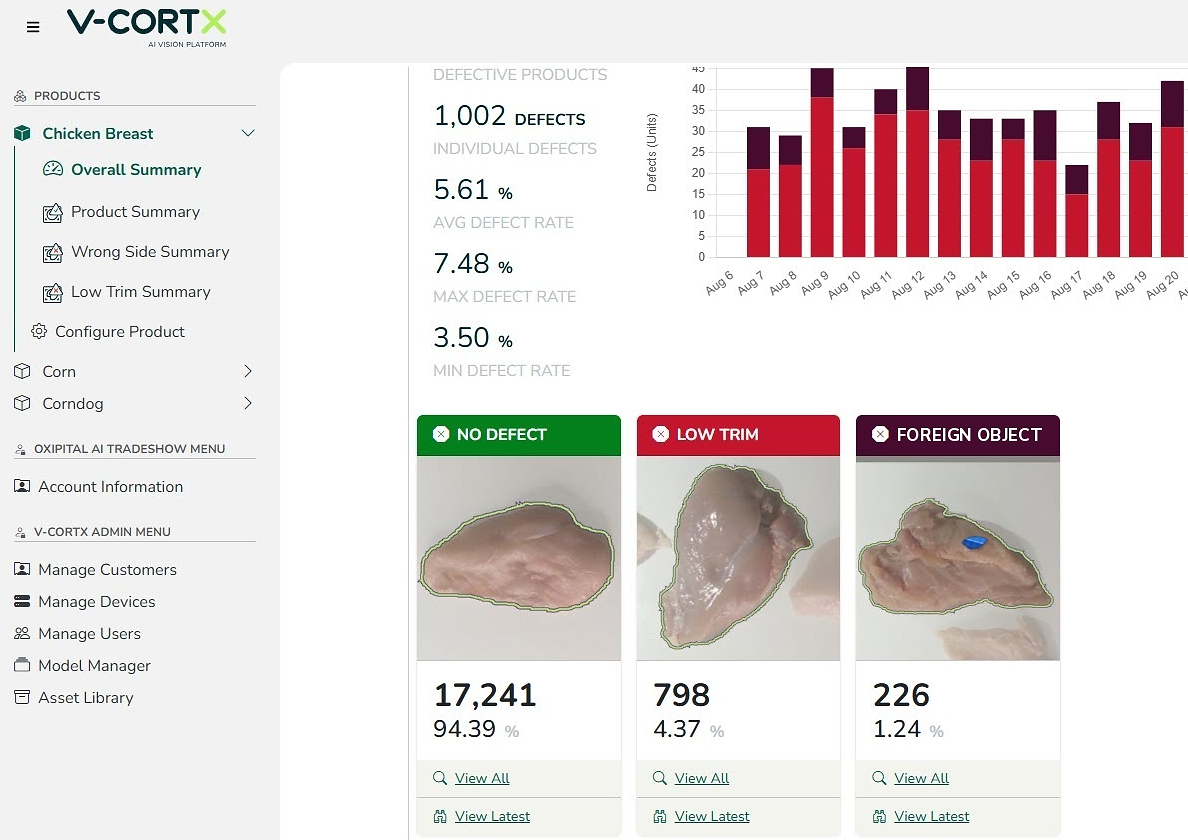
Food manufacturers dealing with recall exposure and FSQA documentation burdens now have a production-ready AI option: Oxipital AI has launched Foreign Material Detection, a new capability within its unified vision and intelligence platform that identifies contaminants in real time on high-speed production lines. The system is already running at major food producers — not in pilot, but in production — and is available on the OX and VX hardware platforms that many food and beverage manufacturers already have deployed for quality inspection and robotics.
The timing matters. Foreign material contamination remains one of the leading causes of FDA-regulated recalls, and the cost of a single recall event — accounting for remediation, brand damage, and regulatory follow-up — routinely runs into the tens of millions of dollars. Procurement and operations teams evaluating inspection technology are under pressure to consolidate vendors and close detection gaps without adding integration complexity.
How the System Works
Rather than relying on contamination events to build training data, Oxipital AI uses synthetic data generation to model the visual signatures of the foreign materials most commonly implicated in food safety incidents: hard and soft plastics, wood chips, bone fragments, metal shards, cardboard, and full or partial PPE. Those signatures are trained across varied lighting conditions, product types, and line speeds, so models arrive production-ready on day one rather than requiring weeks of on-site calibration.
Detection accuracy is rated at up to 99.0% in production environments — with the published caveat that vision-based inspection only captures material visible to the camera at operating line speed. Equally important for throughput economics, the system is tuned to keep false positives low. Unnecessary stoppages carry real cost: wasted product, crew disruption, and line downtime. Oxipital AI's models are built to distinguish genuine foreign material from natural product variation, so the line continues running when no threat is present.
When a confirmed contaminant is detected, the V-CORTX platform integrates with existing line control systems to trigger automated responses calibrated to severity. A minor anomaly can slow the line; a high-severity event stops it entirely, without waiting for a human to intervene. The system also classifies the type of contaminant — not just its presence — giving quality assurance and engineering teams the data needed to trace introduction points, whether a worn line component, a supplier issue, or a changeover gap.
What This Signals for Operators
For food and beverage manufacturers evaluating AI procurement, the Oxipital AI launch illustrates a consolidation trend worth tracking. Mark Chiappetta, CEO of Oxipital AI, summarized the customer feedback driving the decision: operators wanted fewer vendors, fewer integration headaches, and more confidence in detection coverage across quality, robotics, and food safety on a single platform. That demand for platform consolidation aligns with what procurement teams across food manufacturing are telling technology vendors: point solutions that don't talk to each other are losing ground to unified systems with shared hardware and shared analytics layers.
The V-CORTX analytics dashboard logs every foreign material event with timestamp, classification, imagery, dimensional data, and throughput impact — a continuous, searchable audit trail that directly supports FSQA documentation and root cause analysis. For plant managers who've been managing inspection records manually or across disconnected systems, that audit infrastructure alone reduces compliance overhead in a meaningful way.
Operators considering an AI vision RFP, or currently benchmarking inspection platforms against X-ray or traditional machine vision alternatives, should treat Oxipital AI's live deployment status as a meaningful differentiator. The difference between a vendor showing lab results and one running on active production lines at major food producers is a legitimate procurement signal. For more on how food manufacturers are structuring AI vendor evaluations, see our coverage of AI procurement frameworks for foodservice operators and food safety technology trends shaping operator decisions.
Written by Michael Politz, Author of Guide to Restaurant Success: The Proven Process for Starting Any Restaurant Business From Scratch to Success (ISBN: 978-1-119-66896-1), Founder of Food & Beverage Magazine, the leading online magazine and resource in the industry. Designer of the Bluetooth logo and recognized in Entrepreneur Magazine's "Top 40 Under 40" for founding American Wholesale Floral, Politz is also the Co-founder of the Proof Awards and the CPG Awards and a partner in numerous consumer brands across the food and beverage sector.