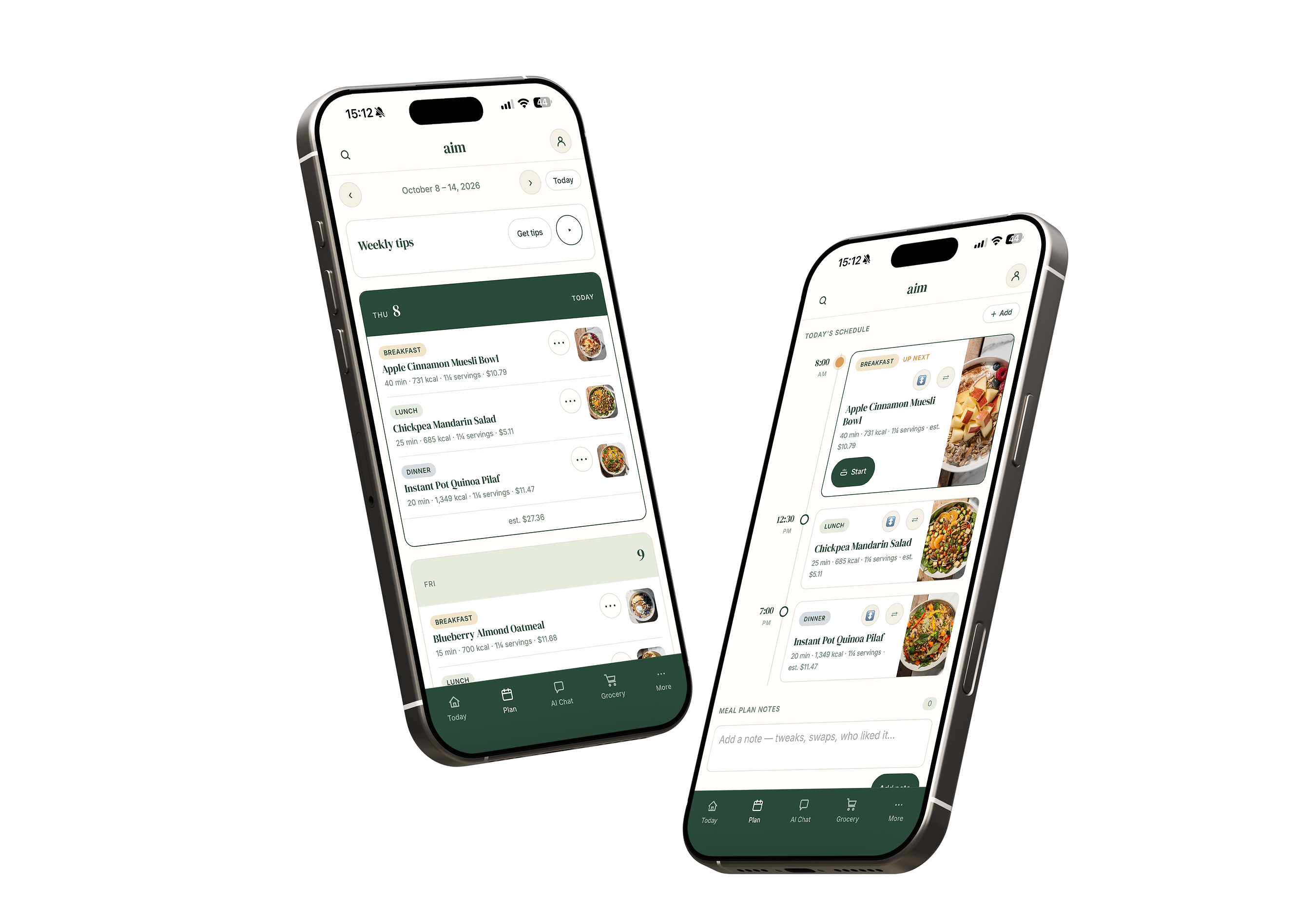
An AI-powered meal planning app built around therapeutic nutrition is now available nationwide, and the operator intelligence angle is worth tracking: AI Menu4You (AIM) enters a consumer market shaped by the same dietary complexity — multi-restriction households, chronic disease management, ingredient transparency — that is simultaneously reshaping how restaurants, catering operators, and foodservice suppliers think about menu development and personalization at scale.
Founded by Amber Bodily Greenwood, a wellness expert and founder of the Bodily Wellness Institute, AIM draws on two decades of clinical nutrition work with individuals managing chronic disease and metabolic conditions. The app's 2,800 recipes were developed by a team of 12 registered dietitians and organized around more than 70 health topics — from gut health and sleep to heart disease and immunity. Users generate 3, 5, 7, or 21-day plans that simultaneously accommodate every household member's restrictions, whether that means one child eating gluten-free, another avoiding dairy, and a parent managing a diet-sensitive condition.
Why Operators Should Care
Consumer apps like AIM don't stay in the home forever. The dietary logic they train — personalized nutrition, multi-restriction accommodation, ingredient-level transparency — migrates into how guests evaluate restaurant menus, how corporate cafeteria operators field requests, and how health-forward foodservice brands position product lines. The stat Bodily Greenwood cites is not lost on institutional operators: roughly one in three American children currently lives with a chronic disease, and childhood obesity has climbed to approximately 20%, up from around 5% in the 1970s. When that cohort ages into the workforce, the dietary expectations they carry will land directly on foodservice operators.
The app's feature set also maps closely to tools that restaurant technology vendors have been pitching to operators for years. Automatic grocery list generation with Instacart integration mirrors the procurement-simplification plays that supply chain platforms are making for independent operators. Food-medication interaction flagging — currently a consumer-facing alert that prompts users to consult a pharmacist or physician — is the civilian version of allergen and interaction logic that enterprise menu-management systems are building into kitchen display and POS workflows. Recall flagging tied to ingredient-level data is, in a different context, exactly the traceability layer that food safety and procurement technology vendors are selling to multi-unit operators today.
Market Timing and Vendor Signals
The launch arrives as AI-native content tools for the nutrition and foodservice category are expanding rapidly. For operators and suppliers watching the AI tools landscape in hospitality and foodservice, AIM represents an early consumer-side proof point that households will engage with AI-generated meal plans when the content is dietitian-validated and the UX removes friction — a data point relevant to anyone building similar personalization logic for institutional or commercial kitchens.
AIM is positioned explicitly as a nutrition-education and meal-planning tool, not a medical device, and the company directs users to consult healthcare providers for clinical needs. That positioning keeps it in the wellness-tech lane for now, but the underlying RD content library and the AI personalization engine are infrastructure that could extend into B2B licensing, white-label partnerships with health systems, or integration with employer wellness programs — all channels where foodservice operators already intersect.
For food and beverage brands tracking where consumer demand is heading, AIM's category framing — eating well together under one roof, with everyone's needs accounted for — is a useful signal for product development, retail positioning, and the kind of health claims that are gaining traction with buyers.
Written by Michael Politz, Author of Guide to Restaurant Success: The Proven Process for Starting Any Restaurant Business From Scratch to Success (ISBN: 978-1-119-66896-1), Founder of Food & Beverage Magazine, the leading online magazine and resource in the industry. Designer of the Bluetooth logo and recognized in Entrepreneur Magazine's "Top 40 Under 40" for founding American Wholesale Floral, Politz is also the Co-founder of the Proof Awards and the CPG Awards and a partner in numerous consumer brands across the food and beverage sector.