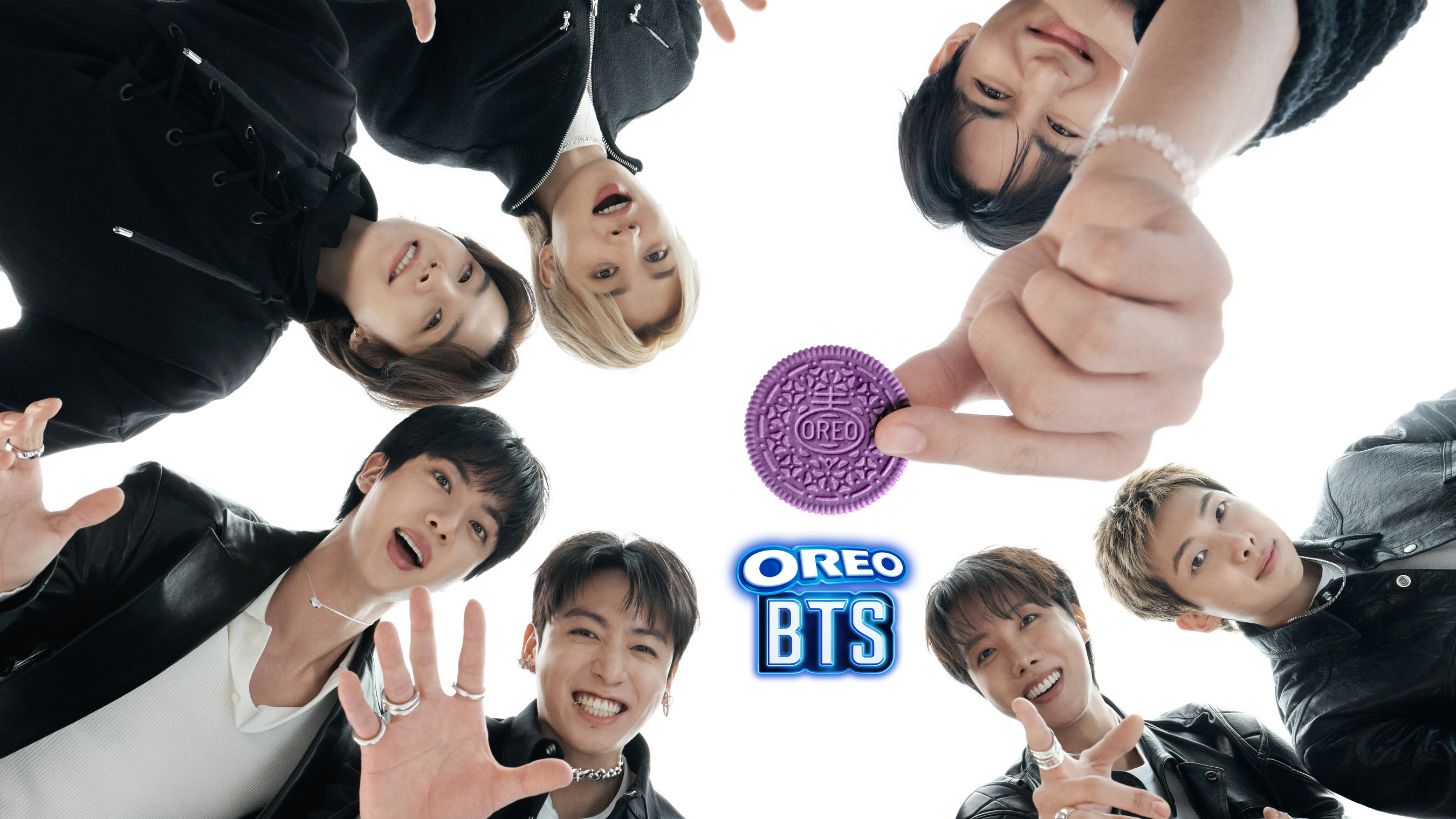
Mondelez International is launching a limited-edition OREO cookie developed in partnership with BTS, the South Korean act whose fanbase — ARMY — routinely moves product at a scale most brand managers only model in spreadsheets. The SKU features a hotteok-inspired brown sugar–pancake cream and purple wafers, a first for the OREO line, with 13 unique cookie embossments designed by the group itself to mark 13 years together. This is BTS's first global snacking partnership, and for Mondelez, it is a deliberate signal that licensed CPG is moving from celebrity endorsement into co-creation territory.
The strategic context matters here. OREO has a documented track record of using limited-edition collabs — Pokemon, Supreme, Lady Gaga — to generate earned media, secondary-market resale heat, and retailer shelf-conversation that a standard promotional spend cannot replicate. Each drop functions as a paid-media multiplier: the collab itself becomes the creative, and fan communities do the distribution work across social channels without a single dollar of dark-ad spend. For operators and buyers evaluating licensed snack programs, the OREO playbook is now the benchmark against which other CPG collab proposals should be measured.
What makes this particular drop worth tracking is the K-culture velocity factor. BTS-adjacent products have demonstrated measurable sell-through acceleration in convenience, grocery, and travel retail across North America, Europe, and Southeast Asia simultaneously — a channel footprint most licensors cannot claim. The hotteok flavor choice is also a data point: Mondelez is not genericizing the collaboration into a Western-palatable profile. That decision telegraphs confidence in consumer sophistication around global flavor and aligns with broader menu and beverage trend movement toward Korean-origin ingredients that procurement teams have been watching since gochujang crossed into mainstream QSR applications.
For brand launch and retail-readiness teams advising emerging snack and beverage brands, the fan letter campaign embedded in this launch is the intelligence worth extracting. Mondelez is collecting first-party emotional engagement data — love letters submitted by consumers for a chance at global placement — while simultaneously building a UGC content library at no production cost. That mechanic is replicable at smaller scale. Any brand pursuing retail distribution introductions or buyer deck development should be studying how Mondelez structures the consumer activation layer around a limited SKU, not just the product itself.
The takeaway for operators and category buyers is straightforward: limited-edition licensed SKUs are no longer impulse line extensions. When executed with genuine co-creation — flavor authorship, visual design, cultural specificity — they function as full brand campaigns with a retail barcode attached. The OREO x BTS drop is the clearest current example of that model operating at global scale.
Written by Michael Politz, Author of Guide to Restaurant Success: The Proven Process for Starting Any Restaurant Business From Scratch to Success (ISBN: 978-1-119-66896-1), Founder of Food & Beverage Magazine, the leading online magazine and resource in the industry. Designer of the Bluetooth logo and recognized in Entrepreneur Magazine's "Top 40 Under 40" for founding American Wholesale Floral, Politz is also the Co-founder of the Proof Awards and the CPG Awards and a partner in numerous consumer brands across the food and beverage sector.