Napa Cellars is turning holiday hosting anxiety into a brand platform. The Oakville-based winery — established in 1976 and focused on everyday Napa Valley accessibility — launched a Friendsgiving Registry that lets hosts assign dishes and wine responsibilities to guests before they ever step through the door. The move is a direct response to data the brand collected through its own 2026 Friendsgiving Trends Report, which identified managing rising food costs as the single biggest challenge for this year's holiday hosts.
What the Data Shows
The survey numbers are worth operators paying attention to. A full 65% of respondents said they were actively looking to lower their personal financial responsibility when hosting. That aligns with a broader consumer behavior shift visible across foodservice and retail: group dinners and potluck-style gatherings are growing as a hedge against per-head cost pressure. The report also flagged that fewer than 10% of respondents plan to spend extra on décor, while 79.6% said they would spend more on food — a clear signal that food quality remains the last category guests are willing to cut, even when budgets tighten.
The timing data carries additional weight for beverage and catering operators. A 67.2% majority prefer a daytime Friendsgiving, split between brunch-style gatherings (35.6%) and late-afternoon sip-and-graze formats (31.6%). That shifts wine selection away from the typical dinner-pour toward lighter, more versatile bottles. When asked how they choose wine, respondents ranked food versatility first at 48.4%, followed by value in the $20–$35 range at 31.2% — a price window that maps directly onto Napa Cellars' accessible portfolio positioning.
Three Menus, One Platform
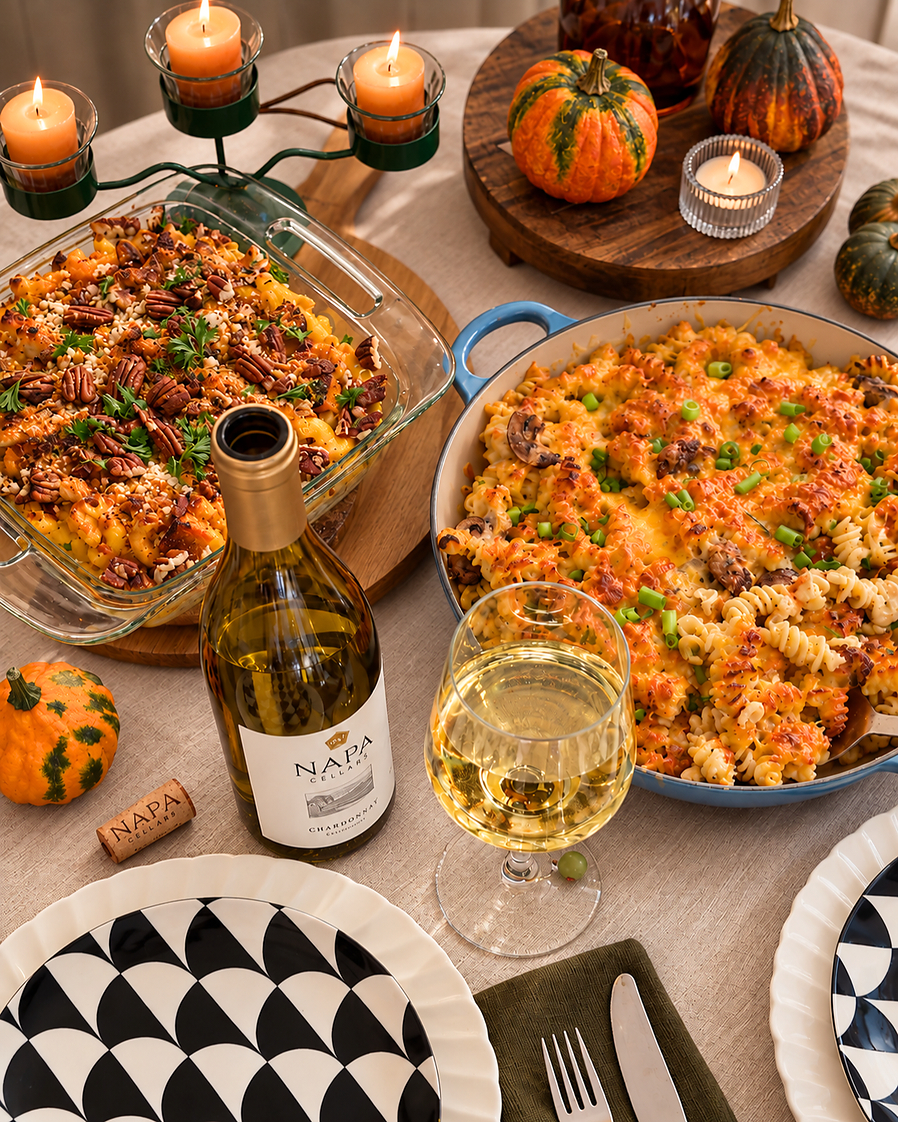
The registry itself is structured around three chef-curated menus developed by Chef James Houghton, director of culinary for Napa Cellars, and hosting expert Kelli Calkins. The host selects a menu, claims the main course and wine pairing, then shares a link so guests can claim sides, salads, appetizers, or desserts — each with a suggested bottle to bring. The distributed model is designed so no single guest shoulders an outsized cost and no dish arrives duplicated.
The three menu formats map directly onto the survey's dominant preference clusters. "Pass the Mac" centers on elevated mac and cheese — the survey's top-ranked must-have side at 40% — and builds out a six-dish tasting bar format suited to casual entertaining. The "Y2K Throwback Thanksgiving" menu serves the almost 50% who still want traditional holiday staples, anchored by roast turkey and paired with Napa Cellars Cabernet Sauvignon. "Brunch-Giving" is designed for the leading daytime preference, built around shareable small plates like Sweet Corn Blini with Crème Fraîche and paired with Napa Cellars Sauvignon Blanc. All three menus are scaled for 20 adults in buffet-style quantities.
What This Signals for Operators
For beverage directors, event managers, and hospitality operators planning November programming, the registry model offers a replicable framework. The underlying mechanic — survey your audience, identify the friction point, then build a structured product that solves it — is applicable well beyond wine. Catering operations, hotel F&B departments, and restaurant private dining coordinators could deploy similar shared-cost structures for holiday buyouts or group dining packages where guest contribution is encouraged but typically uncoordinated.
The wine pairing layer is also instructive for beverage program operators. Consumers in the $20–$35 tier are not defaulting to the cheapest bottle; they are defaulting to the most versatile one. Menus and beverage lists that lead with food-pairing rationale — rather than price point or prestige — are better positioned to convert at this segment. Operators building holiday wine lists or curated bottle selections for retail or on-premise gifting should weight the brief accordingly.
For brands and suppliers watching the brand launch and campaign landscape, Napa Cellars' use of proprietary survey data as a campaign foundation is worth noting. The Trends Report gives the registry platform editorial credibility and media legs beyond a standard product push — a tactic increasingly common among food and beverage brands that want press coverage without a traditional news hook.
Written by Michael Politz, Author of Guide to Restaurant Success: The Proven Process for Starting Any Restaurant Business From Scratch to Success (ISBN: 978-1-119-66896-1), Founder of Food & Beverage Magazine, the leading online magazine and resource in the industry. Designer of the Bluetooth logo and recognized in Entrepreneur Magazine's "Top 40 Under 40" for founding American Wholesale Floral, Politz is also the Co-founder of the Proof Awards and the CPG Awards and a partner in numerous consumer brands across the food and beverage sector.