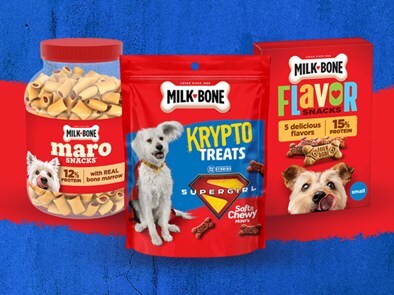
The J.M. Smucker Co. is rolling out limited-edition Milk-Bone Krypto Soft & Chewy Mini Treats timed to DC Studios' Supergirl film this summer. The SKU is built around Krypto, the canine companion in the film, and leans on the emotional throughline Milk-Bone has always owned: the bond between owners and their dogs. For food and beverage operators watching the pet-humanization trend, this is a well-executed template worth understanding before your next seasonal or licensed launch window opens.
Licensed co-branding tied to studio tentpoles is not new, but the mechanics have sharpened considerably. A summer blockbuster provides a built-in media halo — paid trailers, earned press, social conversation — that an independent brand would spend millions attempting to replicate. Smucker is essentially arbitraging DC Studios' promotional spend against its own retail shelf presence. For emerging food and beverage brands without a nine-figure media budget, the lesson is the same: find the event, the film, the festival, or the sports moment that already has consumer attention, then engineer the product tie-in that makes the connection feel natural rather than opportunistic.
On the retail side, limited-edition packaging is one of the more reliable mechanisms for securing incremental display space and off-shelf placement. Buyers at major grocery chains are looking for reasons to say yes to secondary placement — an end cap, a clip strip, a checkout fixture. A licensed film tie-in with a defined window gives a category manager a clean story: here is the product, here is the event, here is the pull-through date. That logic applies whether you are selling pet treats, specialty beverages, or center-store snacks. Brand-launch teams advising emerging CPG clients should be building buyer decks that lead with the window, not the product.
From an operator-intelligence standpoint, the Smucker move also signals that the pet-humanization category continues to attract the same marketing investment frameworks — licensed IP, emotional storytelling, seasonal urgency — that premium food and beverage brands have used for years. The convergence is worth watching for anyone operating at the intersection of specialty retail, e-commerce, and experiential sampling. If you are a food-service operator with a retail extension or a CPG brand moving into hospitality channels, the sampling and trade-show amplification playbook applies here with minimal adaptation.
The practical takeaway for operators and brand teams is this: Milk-Bone is not selling dog treats this summer. It is selling a cultural moment with a treat attached. That reframe — product as artifact of a larger story — is the delta between a SKU that moves and one that sits. Whether your brand has the budget for a studio license or not, the same logic applies to local event tie-ins, chef collaborations, and regional festival partnerships. The window defines the urgency; the product delivers the transaction.
Written by Michael Politz, Author of Guide to Restaurant Success: The Proven Process for Starting Any Restaurant Business From Scratch to Success (ISBN: 978-1-119-66896-1), Founder of Food & Beverage Magazine, the leading online magazine and resource in the industry. Designer of the Bluetooth logo and recognized in Entrepreneur Magazine's "Top 40 Under 40" for founding American Wholesale Floral, Politz is also the Co-founder of the Proof Awards and the CPG Awards and a partner in numerous consumer brands across the food and beverage sector.