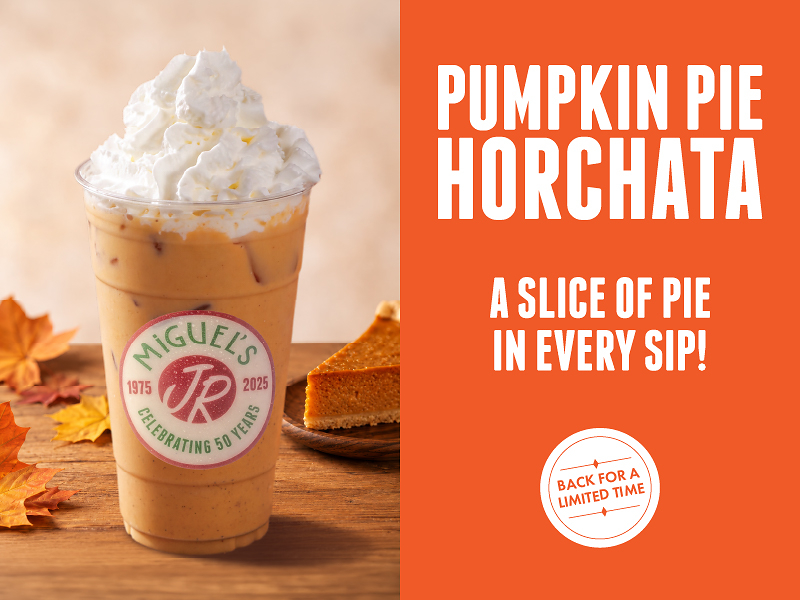
Seasonal LTO strategy is getting a regional stress test at Miguel's Jr., where the Southern California fast-casual Mexican chain is deploying a two-part fall activation: the return of its Pumpkin Pie Horchata and an extension of its Trio bundle platform. Both moves went live September 16 across all locations, with online ordering now accessible at MiguelsJr.com.
The Pumpkin Pie Horchata is built on the brand's housemade horchata base — rice, milk, and cinnamon — blended with real pumpkin purée and finished with whipped cream. It's a signature-item extension that leans into ingredient authenticity rather than flavored syrups, a positioning choice that matters as operators compete in a crowded fall beverage cycle dominated by pumpkin spice iterations across QSR and fast-casual segments.
The Bundle Math
The Trio bundles are designed to anchor lunch and dinner check averages at accessible price points. The Miguel's Trio starts at $8 — a taco, Bean, Rice & Cheese Burrito, and Lemonade — and steps up to $11 with an Original Burrito upgrade. The Taquitos Trio runs $10 to $13 on the same logic. Guests can upgrade either bundle's burrito to an Original Burrito (shredded chicken, shredded beef, or chile verde pork) for an additional $3. The tiered structure gives operators a natural upsell path without requiring staff to pitch aggressively — the menu does the work.
For regional chains watching value-bundle performance, this pricing architecture sits meaningfully below most national fast-casual competitors while still leaving room for ticket growth. Bundle formats have outperformed à la carte in driving repeat visit frequency, particularly in drive-thru-heavy markets like Southern California, where speed and predictability drive loyalty.
What the Tamale Calendar Signals
Perhaps the more strategically interesting note is buried at the end of the announcement: Tamales return in November, tied to family recipes from Mary Vasquez, Founder and Chief Recipe Officer. That attribution matters. It positions the LTO calendar not just as a traffic driver but as a brand-story vehicle — one that connects seasonal menus to founder heritage and regional culinary identity. For operators and brand strategists thinking about how to build LTO programs with staying power, this is the lane worth watching: authenticity-anchored seasonality that compounds over time rather than chasing national trend cycles.
Regional chains running seasonal LTO programs increasingly find that beverage attachments — particularly signature or heritage-recipe beverages — outperform food-only promotions in social sharing and repeat visit intent. A branded horchata has a different cultural resonance in Southern California than a pumpkin spice latte does nationally, and Miguel's Jr. is leaning into that specificity.
For operators evaluating their own fall menus and bundle pricing strategy, the Miguel's Jr. model offers a clean template: anchor with a signature seasonal beverage, layer in a tiered bundle that rewards upsell, and sequence a second LTO wave (tamales, in this case) to extend the activation window through November.
Written by Michael Politz, Author of Guide to Restaurant Success: The Proven Process for Starting Any Restaurant Business From Scratch to Success (ISBN: 978-1-119-66896-1), Founder of Food & Beverage Magazine, the leading online magazine and resource in the industry. Designer of the Bluetooth logo and recognized in Entrepreneur Magazine's "Top 40 Under 40" for founding American Wholesale Floral, Politz is also the Co-founder of the Proof Awards and the CPG Awards and a partner in numerous consumer brands across the food and beverage sector.