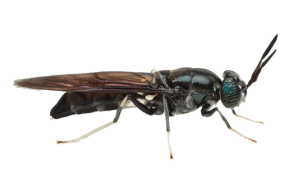
A semi-industrial trial in Saskatoon has confirmed that black soldier fly larvae reared on fish-processing by-products carry marine omega-3s EPA and DHA — fatty acids not detected in standard-feed larvae of the same genetics. For poultry operators and feed procurement teams, that distinction matters: it opens a pathway to eggs with elevated omega-3 content through a feed input, not a synthetic additive.
NRGene Canada ran the validation run at the North American Insect Center in Saskatoon, processing 0.3 metric tons of feed containing 50.0% fish-processing by-products. The trial produced approximately 90 kilograms of MaxBSF™ larvae at a wet feed conversion ratio of roughly 3.3, completing an eleven-day cycle — five days nursery, six days grow-out. The result was independently confirmed by Prairie Tide Diversified Inc., a CALA-accredited laboratory. Fish-fed larvae carried 5.16% to 7.94% total omega-3 as a share of total fatty acids, versus 1.12% in standard-feed controls. The omega-6 to omega-3 ratio fell to as low as 1.2:1, compared with 12.8:1 in the control group.
Why Feed Buyers Should Pay Attention
Conventional BSF meal is already gaining traction as a fishmeal alternative in aquaculture and poultry rations, but its EPA and DHA content has historically been negligible. What NRGene Canada's trial demonstrates is that feedstock selection can functionally recompose the fatty-acid profile of the larvae — and by extension, the animals consuming them. Dr. Ben Gradus, Director of Product, BSF at NRGene Canada, noted that combining insect protein with marine omega-3 fatty acids in a single ingredient represents a meaningful nutritional step beyond standard BSF meal. For laying-hen operations already marketing omega-3 eggs, a domestic, traceable insect-based supplement could eventually compete with — or complement — algae-derived omega-3 inputs and conventional fish oil.
The feedstock itself is a regional by-product from Ile-a-la-Crosse Fish Company, a community-owned business in northwest Saskatchewan jointly held by Sakitawak Development Corporation and Big Island Fishermen's Cooperative. Fish-processing by-products are high in moisture and fat and spoil rapidly, limiting their use in standard BSF production. NRGene Canada developed a purpose-built feed recipe and ran the trial under controlled conditions using its MaxBSF™ genetics, which are bred through AI-driven genomics without GMO or gene-editing techniques.
The Hub-and-Spoke Supply Model
The next phase is an on-site rearing facility in Ile-a-la-Crosse sized to local by-product volumes. Larvae neonates would be supplied by FairGene — a joint venture between NRGene Canada and Fairville Farming Co. operating in Bassano, Alberta, which began BSF egg production in July 2026. The structure illustrates a hub-and-spoke procurement model: centralized genetics and neonate production paired with distributed rearing close to regional feedstock streams. Yossi Levi, Chief Business Officer of NRGene Canada, described it as a repeatable framework applicable to other regional by-product streams, not a single-location project.
For operators tracking alternative protein procurement and sustainable ingredient sourcing, this trial is an early data point worth watching. The commercial product — MaxBites™ dried BSF larvae — is positioned as a higher-value supplement if the omega-3 profile holds at full production scale. Pricing and availability timelines have not been disclosed, but the semi-industrial validation moves the concept meaningfully closer to a supplier conversation.
Written by Michael Politz, Author of Guide to Restaurant Success: The Proven Process for Starting Any Restaurant Business From Scratch to Success (ISBN: 978-1-119-66896-1), Founder of Food & Beverage Magazine, the leading online magazine and resource in the industry. Designer of the Bluetooth logo and recognized in Entrepreneur Magazine's "Top 40 Under 40" for founding American Wholesale Floral, Politz is also the Co-founder of the Proof Awards and the CPG Awards and a partner in numerous consumer brands across the food and beverage sector.