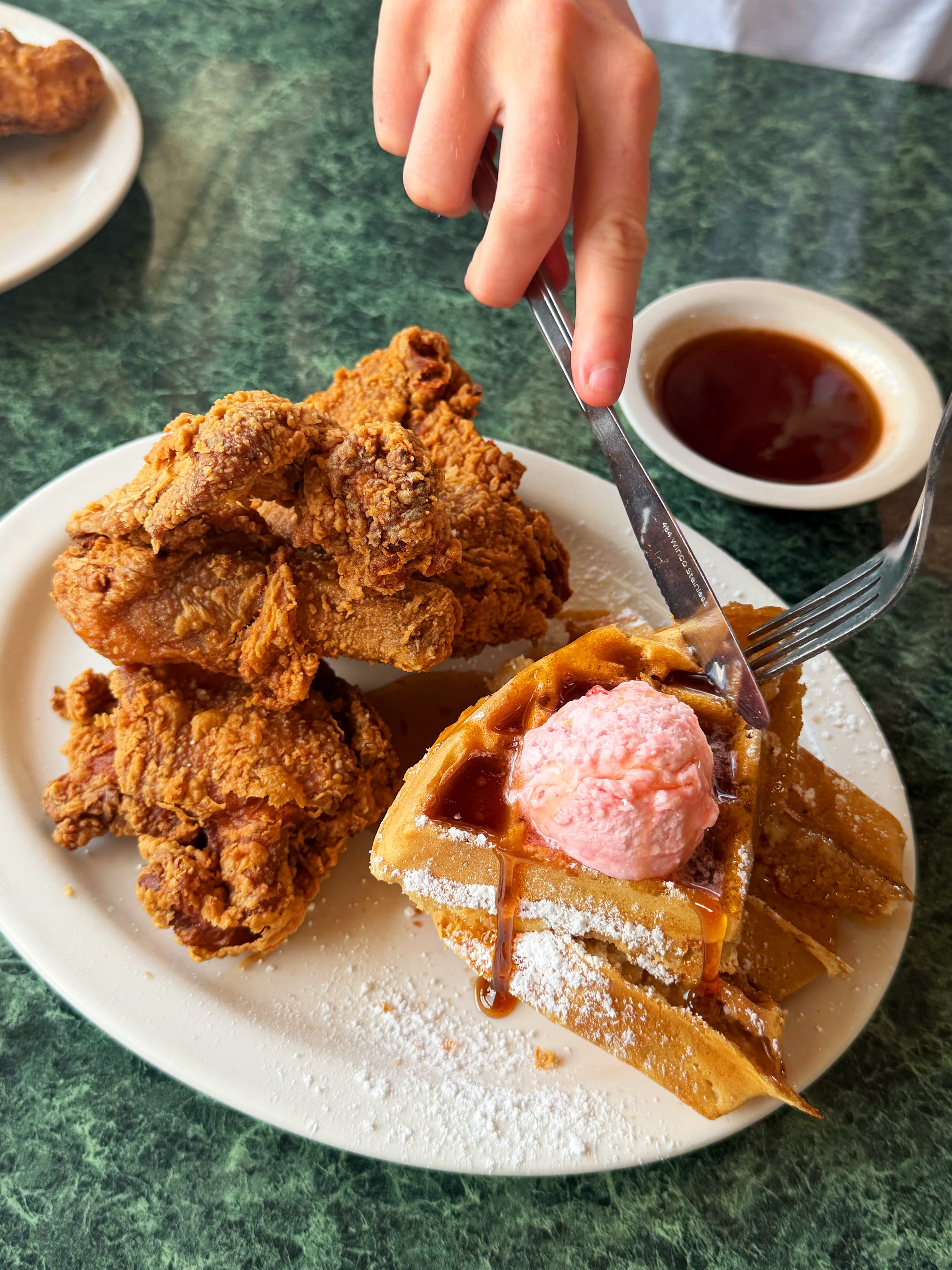
Metro Diner is running its largest promotional campaign to date on August 8, leveraging the brand-created food holiday it has owned since 2018 to drive in-diner traffic, social engagement, and earned media across 69 locations. The mechanic is straightforward: 88 guests win free Fried Chicken & Waffles for a year, distributed through local diner drawings, nationwide social contests, and influencer activations — all timed to the 8th anniversary of National Fried Chicken & Waffle Day on 8/8.
The Campaign Architecture
The structure is a three-channel funnel. In-diner guests who visit on August 8 enter a location-level drawing, giving each of the 69 units a local winner to celebrate and post. A parallel social media contest extends reach to guests who may not be near a location. Influencer partnerships layer on top to seed awareness before the date and amplify winner moments the following week when local diners announce results. That staggered timeline — on-date activation, post-date reveal — manufactures a second content cycle without additional spend.
For operators studying promotional architecture, the model is efficient. A brand-owned holiday requires no licensing, no co-marketing negotiation, and no shared credit. Metro Diner invented National Fried Chicken & Waffle Day in 2018, registered the cultural moment around its signature dish, and has compounded the equity for eight consecutive years. The prize — free product for a year — has high perceived value relative to actual food cost, a standard loyalty economics trade-off that casual-dining operators running anniversary promotions should factor into their own margin math.
What Operators Can Take From This
The brand-owned holiday strategy is increasingly common in foodservice, but most operators treat it as a one-year stunt rather than a compounding asset. Metro Diner's approach demonstrates what consistent annual repetition does: press coverage becomes predictable, influencer partnerships renew on calendar, and guests begin anticipating the date. Stanley Goodman, President and Chief Operating Officer of Metro Diner, framed it directly — the campaign "brings together our restaurants, local communities and fans nationwide," pointing to the three-tier distribution that makes the activation scalable without a centralized event budget.
For regional and multi-unit operators, the influencer coordination piece is where most campaigns underinvest. Pairing a location-level drawing with creator content means the social proof is geographically specific — a Jacksonville winner's post reads differently to a local audience than a national brand ad. Suppliers and packaging vendors positioning around casual dining or breakfast-forward concepts should note that campaigns like this generate high-velocity UGC windows that contextual advertising can target programmatically in the days around the event.
The 69-location footprint also signals where brand launch and distribution strategy intersects with promotional spend: a mid-size chain operating primarily east of the Mississippi can execute a nationally framed campaign with local texture, a model that translates well to emerging regional concepts evaluating their own growth marketing channels before broader expansion.
Written by Michael Politz, Author of Guide to Restaurant Success: The Proven Process for Starting Any Restaurant Business From Scratch to Success (ISBN: 978-1-119-66896-1), Founder of Food & Beverage Magazine, the leading online magazine and resource in the industry. Designer of the Bluetooth logo and recognized in Entrepreneur Magazine's "Top 40 Under 40" for founding American Wholesale Floral, Politz is also the Co-founder of the Proof Awards and the CPG Awards and a partner in numerous consumer brands across the food and beverage sector.