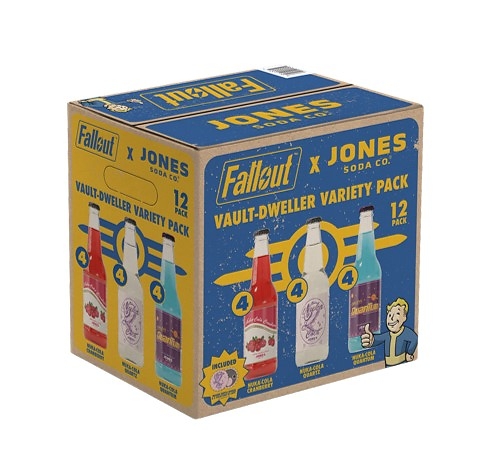
Jones Soda Co. is shipping its fourth Fallout-branded club-retail collection in late September, debuting two flavors — Nuka-Cola Quartz and Nuka-Cola Cranberry — that have existed only in game lore until now. The drop lands ahead of Fallout Day on October 23, 2026, and is available exclusively at participating club retail locations across the United States and Canada.
The "Vault-Dweller Variety" 12-pack contains four glass bottles each of Nuka-Cola Quartz, Nuka-Cola Cranberry, and the returning Nuka-Cola Quantum — the blue-glowing fan favorite that anchored earlier Jones x Fallout releases. The package also includes a custom Quartz-themed bottle opener and collectible caps, housed in a display-ready collector bag. Every element is engineered to trigger the treasure-hunt impulse that drives club-channel purchasing behavior.
Why Club Retail Matters
For beverage operators and brand strategists watching channel strategy, the continued commitment to club exclusivity is the real signal here. Jones Soda Co. CEO Scott Harvey framed it plainly: "This collection represents exactly what we love about these partnerships — taking something fans have imagined for years and creating a way for them to experience it in the real world." The club format rewards that positioning with high basket values, built-in member urgency, and a shopper who actively hunts for limited releases.
IP-licensed beverage collaborations have become a reliable brand-launch mechanism for craft soda and specialty beverage companies competing against legacy soft-drink giants. Gaming and entertainment properties carry pre-built, passionate audiences that reduce the cost of awareness — a meaningful advantage for a brand like Jones that distributes across retail, e-commerce, and strategic partnerships without the media spend of a Tier 1 CPG.
What Operators Should Watch
The structural playbook here — recurring seasonal IP drops anchored to a fandom calendar event, exclusive to a single channel, presented as collectibles — is worth studying for any supplier or brand considering entertainment licensing as a growth vehicle. Each successive release builds on prior fan data and refines the collectible value proposition, compounding loyalty rather than starting from zero. Food & Beverage Magazine has tracked several similar limited-edition beverage strategies gaining traction in both club and specialty grocery.
For procurement teams at club retailers, this kind of collab pack also solves a floor-space problem: it generates incremental revenue in non-endemic categories (collectibles, gaming merchandise) while moving beverage units. That dual-category appeal strengthens the buyer conversation and gives category managers a reason to allocate premium endcap or seasonal display space.
Brands pitching club buyers in the beverage aisle should note the format details: glass bottles, collectible hardware, and branded display packaging all signal a higher price-per-unit justification and a gift-purchase use case that extends the selling window beyond the core fan base. See how other craft beverage brands are structuring operator-intelligence around limited-edition launch windows to inform your own channel timing.
Written by Michael Politz, Author of Guide to Restaurant Success: The Proven Process for Starting Any Restaurant Business From Scratch to Success (ISBN: 978-1-119-66896-1), Founder of Food & Beverage Magazine, the leading online magazine and resource in the industry. Designer of the Bluetooth logo and recognized in Entrepreneur Magazine's "Top 40 Under 40" for founding American Wholesale Floral, Politz is also the Co-founder of the Proof Awards and the CPG Awards and a partner in numerous consumer brands across the food and beverage sector.