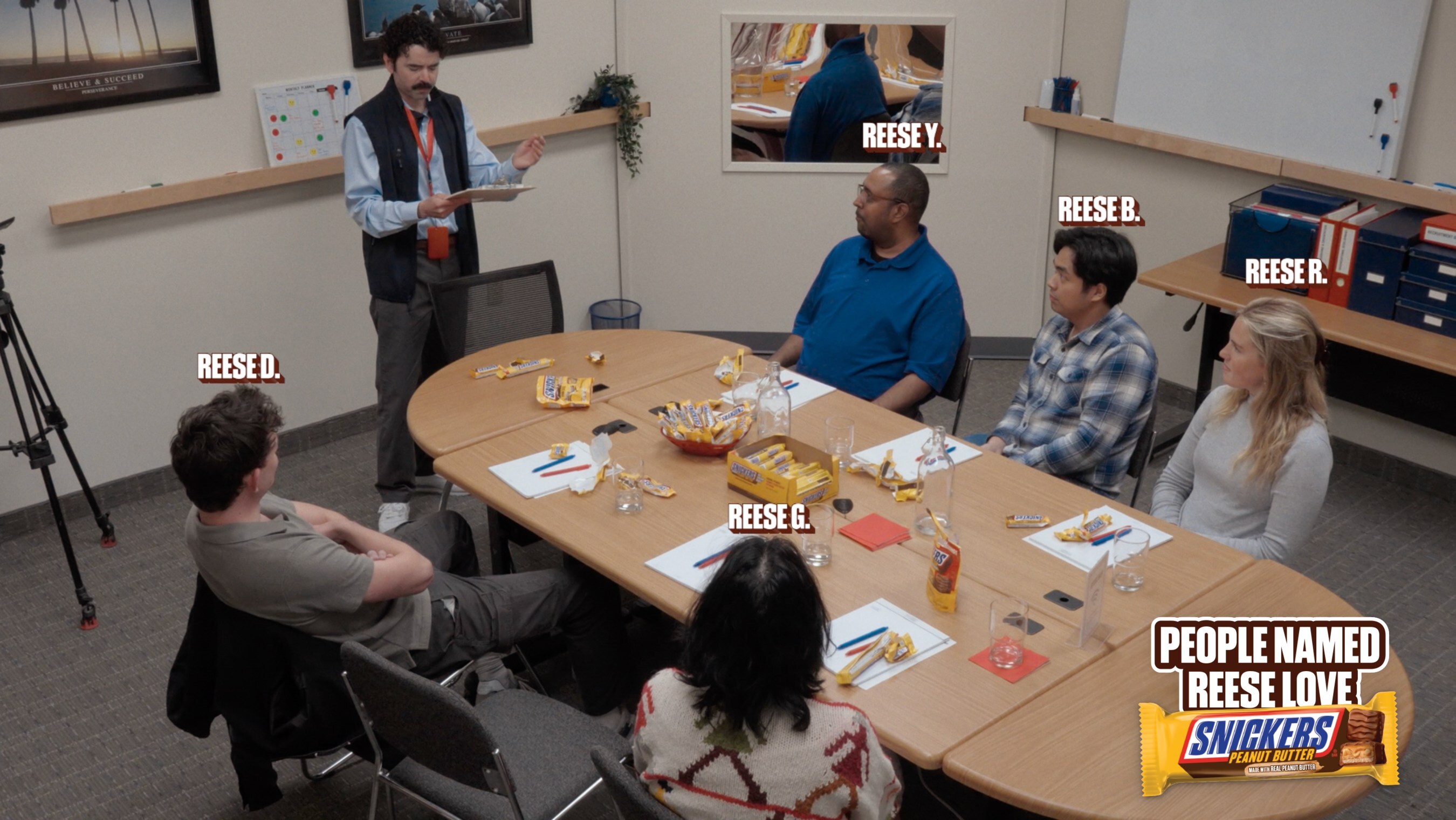
Mars, Incorporated is running a competitor-adjacent provocation campaign for SNICKERS Peanut Butter, enlisting comedian Eric André to direct a focus group made up entirely of real people named Reese — every spelling variation counts. The activation, anchored at SNICKERS.com/peanutbutterpledge, asks those consumers to publicly declare loyalty to the new bar in exchange for a chance at rewards. For food and beverage operators watching how established brands move product in a crowded confection aisle, the mechanics here are worth a close read.
The product itself — creamy peanut butter, crunchy peanuts, caramel, and nougat in two milk chocolate squares — positions directly against the peanut butter category's dominant association with a competing brand name. Rather than running a straightforward sampling or trade-promotion push, Mars chose a name-targeted earned-media play that generates social content, press pickup, and first-party data through the pledge form. That is a meaningful departure from the typical FSI and in-store display stack that still dominates confection launches at retail.
For brand launch teams and retail buyers, this campaign illustrates a specific format worth benchmarking: use a cultural provocation to lower the cost of trial conversion. André's involvement moves the focus-group footage out of the test-kitchen aesthetic and into shareable content territory. The pledge mechanism, meanwhile, creates an owned-data capture point that most one-time sampling campaigns never build. Brands working with brokers and retail buyers on new SKU introductions can draw a direct line between this kind of pre-sell buzz and improved buyer-deck conversations — a topic covered in depth in our Brand Launch Department coverage of retail-ready activation strategy.
From an operator-intelligence standpoint, the campaign reflects a broader trend: mid-to-large CPG players are allocating meaningful budget to stunt-driven digital activations that generate content assets reusable across paid, owned, and earned channels simultaneously. That compresses the cost-per-impression on what would otherwise be a pure paid-media awareness buy. Foodservice operators and hotel F&B buyers negotiating co-marketing agreements with supplier brands should be asking whether those partners have this kind of activation infrastructure — because the brands that do will deliver more shelf and menu velocity. See also our Growth Department breakdown of co-branded CPG digital campaigns in foodservice.
The takeaway for operators is practical: Mars is demonstrating that a product with a strong multi-texture story — creamy, crunchy, caramel, chocolate — benefits more from experiential proof than from attribute-led advertising. If you are a food-and-beverage buyer evaluating new confection or snack SKUs for retail, hotel amenity programs, or foodservice applications, look for supplier partners who can hand you a content-and-trial activation package alongside the product pitch, not just a sell sheet.
Written by Michael Politz, Author of Guide to Restaurant Success: The Proven Process for Starting Any Restaurant Business From Scratch to Success (ISBN: 978-1-119-66896-1), Founder of Food & Beverage Magazine, the leading online magazine and resource in the industry. Designer of the Bluetooth logo and recognized in Entrepreneur Magazine's "Top 40 Under 40" for founding American Wholesale Floral, Politz is also the Co-founder of the Proof Awards and the CPG Awards and a partner in numerous consumer brands across the food and beverage sector.