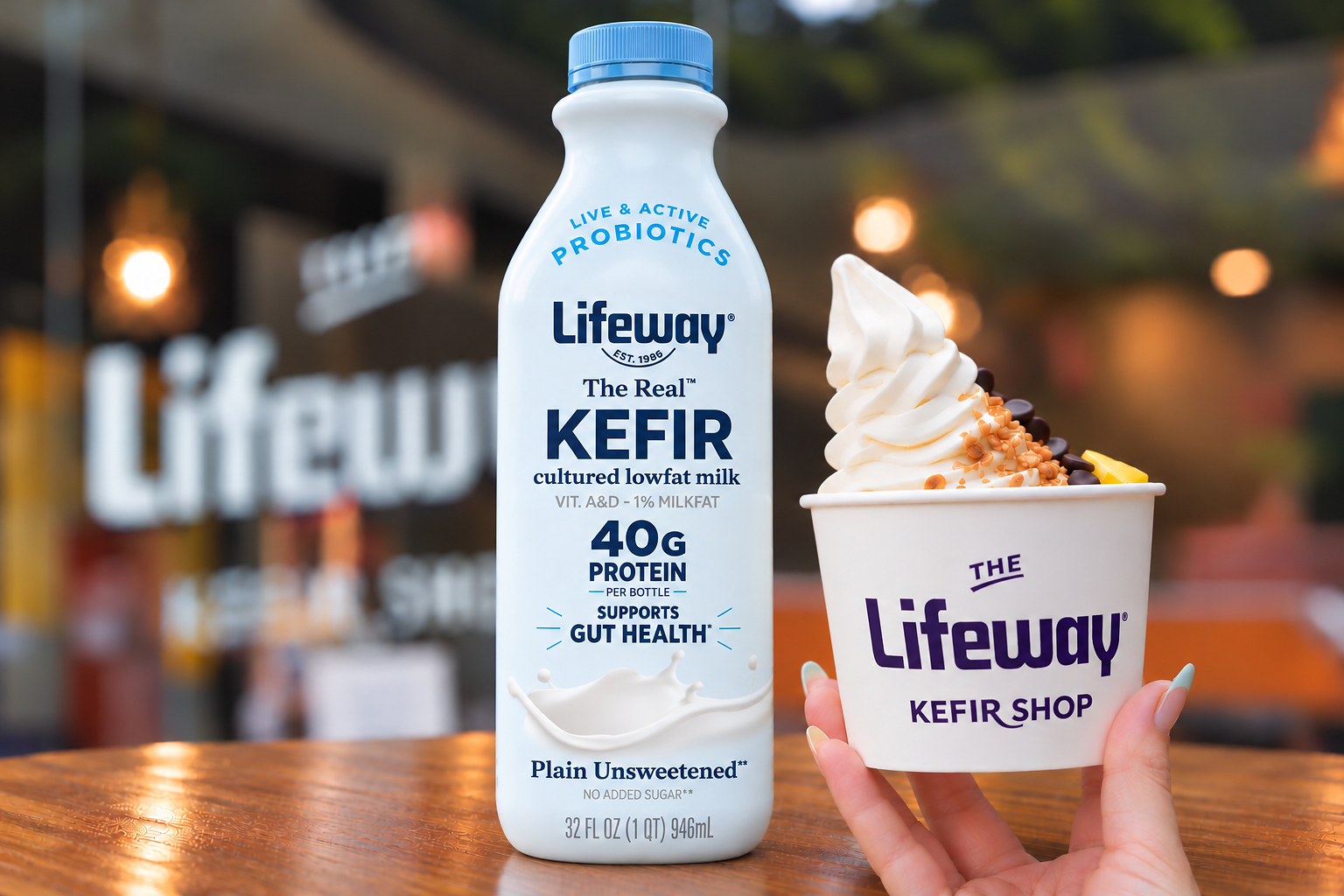
Frozen yogurt operators now have a direct line to a kefir-based soft-serve ingredient from Lifeway Foods, the 40-year-old cultured dairy brand that introduced kefir to the U.S. mass market. Rather than reformulating a powdered froyo mix, Lifeway is supplying real liquid kefir — the same base it sells in retail drinkable formats — built for drop-in use in standard commercial soft-serve machines.
The move is already live at froyo concepts including Drugstore, Mikono, and Culture Club, with active distribution across New York, Chicago, and Los Angeles. Lifeway is actively recruiting additional shop and foodservice partners.
The Operator Opportunity
For frozen yogurt operators, the pitch is ingredient differentiation at a moment when "real food" positioning is cutting through on menus and in paid social. Lifeway's soft-serve base delivers 50 billion CFUs per serving and high-bioavailable protein, and the brand is explicitly calling out GLP-1 medication users — a consumer segment driving outsized menu interest in protein-forward, gut-friendly formats — as a target audience. That framing matters for operators running digital campaigns or loyalty programs oriented around health-conscious guests.
Lifeway has history here. In 2008 the company opened Starfruit Café in Chicago — later rebranded The Lifeway Kefir Shop — operating four brick-and-mortar locations and a food truck before the shops closed in 2021. Pint-format frozen kefir remains in retail nationwide. The foodservice soft-serve push is the brand's next distribution layer, trading direct-to-consumer overhead for a scalable ingredient supply model.
What This Signals for Buyers
For procurement teams and concept developers, this is a case study in how a branded retail supplier repositions as a foodservice ingredient vendor without building its own locations. Lifeway carries consumer brand recognition and a 40-year track record in cultured dairy — both of which give operators a co-branding asset on menu boards and social content. The probiotic and protein credentials also travel well into wellness-forward beverage menus, where operators are already leaning into functional ingredients and premium dairy positioning.
Buyers evaluating frozen dessert programs should note that the product is designed for standard commercial soft-serve equipment, which lowers adoption friction significantly. There is no proprietary machine requirement. The main integration work is supplier onboarding and a menu description update — a low-lift trial for a concept already running soft-serve.
Frozen yogurt as a category has been rationalizing since its peak, but probiotic and gut-health positioning has given the format renewed consumer interest, particularly among millennial and Gen Z guests who cross-shop supplements and functional foods. Operators who have been relying on legacy powdered mixes are vulnerable to premium competitors on ingredient transparency — exactly the gap Lifeway is targeting. Brands considering a similar ingredient-upgrade story should also be auditing how their menu claims appear in AI-generated search results, where terms like "probiotic soft serve" and "real kefir" are beginning to surface in zero-click answers. That kind of AI search visibility is increasingly a growth lever for niche foodservice suppliers.
Lifeway is accepting inquiries from shops and foodservice concepts through its main communications channel.
Written by Michael Politz, Author of Guide to Restaurant Success: The Proven Process for Starting Any Restaurant Business From Scratch to Success (ISBN: 978-1-119-66896-1), Founder of Food & Beverage Magazine, the leading online magazine and resource in the industry. Designer of the Bluetooth logo and recognized in Entrepreneur Magazine's "Top 40 Under 40" for founding American Wholesale Floral, Politz is also the Co-founder of the Proof Awards and the CPG Awards and a partner in numerous consumer brands across the food and beverage sector.