
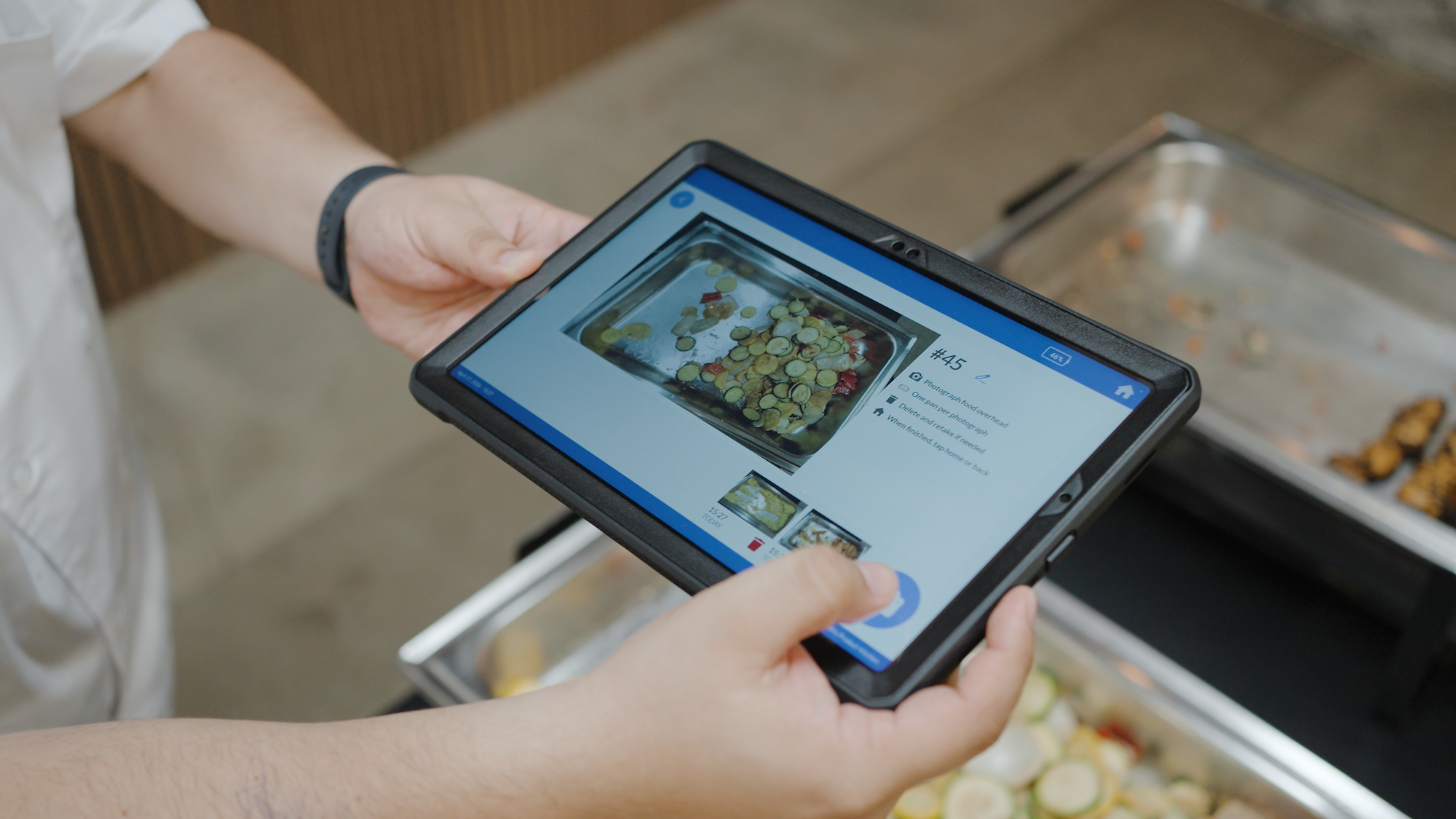
LeanPath has launched Snap AI, a mobile food waste tracker that uses computer vision to identify food type and estimate weight from a single photograph — no scale, no fixed terminal, no data entry required. The announcement matters to any operator running off-site catering, stadium concessions, hotel banquet services, or remote event production, because those environments have historically generated zero waste data. The food left on a hotel ballroom buffet or a catered corporate lunch has never made it into a waste ledger. Now it can.
The structural problem Snap AI addresses is straightforward: conventional food waste platforms — including LeanPath's own hardware suite — are designed for the back-of-house environment. Scales and terminals anchor to prep stations. When the operation moves to a venue, a tent, or a rooftop, the tracking stays behind. Industry estimates have long acknowledged that off-premise catering represents a meaningful share of total foodservice waste volume, but that share has been effectively invisible to operators trying to hit sustainability benchmarks or tighten food cost.
For procurement and operations teams, this signals a broader shift in how AI is being embedded at the point of service rather than at the point of production. Computer vision for weight estimation is not a new concept in controlled lab settings, but deploying it reliably in variable lighting, on irregular surfaces, and across diverse food categories at an actual event is a materially harder problem. LeanPath is claiming that threshold has been crossed. Operators evaluating the tool should pressure-test accuracy rates across protein, produce, and prepared dishes before committing it to cost-reporting workflows — the data is only as useful as the confidence interval behind the image recognition. AI tools for food waste and kitchen intelligence are increasingly being evaluated in operator RFP cycles alongside POS and inventory platforms.
On the brand and sustainability reporting side, off-site waste data has a second-order value that operators shouldn't overlook. Corporate catering clients, hotel groups managing ESG disclosures, and university dining programs are under increasing pressure to produce third-party-verifiable waste metrics. A mobile tool that generates a timestamped, image-backed record at the point of service creates an audit trail that a manual tally sheet never could. That positions Snap AI less as an operational convenience and more as a compliance asset for operators selling to institutional buyers. Operators building retail or institutional buyer decks are increasingly required to include sustainability data as a proof point.
LeanPath has been in the food waste management category for over 20 years, which gives Snap AI a meaningful distribution and integration advantage over newer entrants. The question operators should ask is whether the mobile product feeds into the same reporting dashboard as the in-kitchen hardware — unified waste data across all channels is the actual goal, and a siloed mobile app that produces a separate report defeats the purpose.
Written by Michael Politz, Author of Guide to Restaurant Success: The Proven Process for Starting Any Restaurant Business From Scratch to Success (ISBN: 978-1-119-66896-1), Founder of Food & Beverage Magazine, the leading online magazine and resource in the industry. Designer of the Bluetooth logo and recognized in Entrepreneur Magazine's "Top 40 Under 40" for founding American Wholesale Floral, Politz is also the Co-founder of the Proof Awards and the CPG Awards and a partner in numerous consumer brands across the food and beverage sector.

