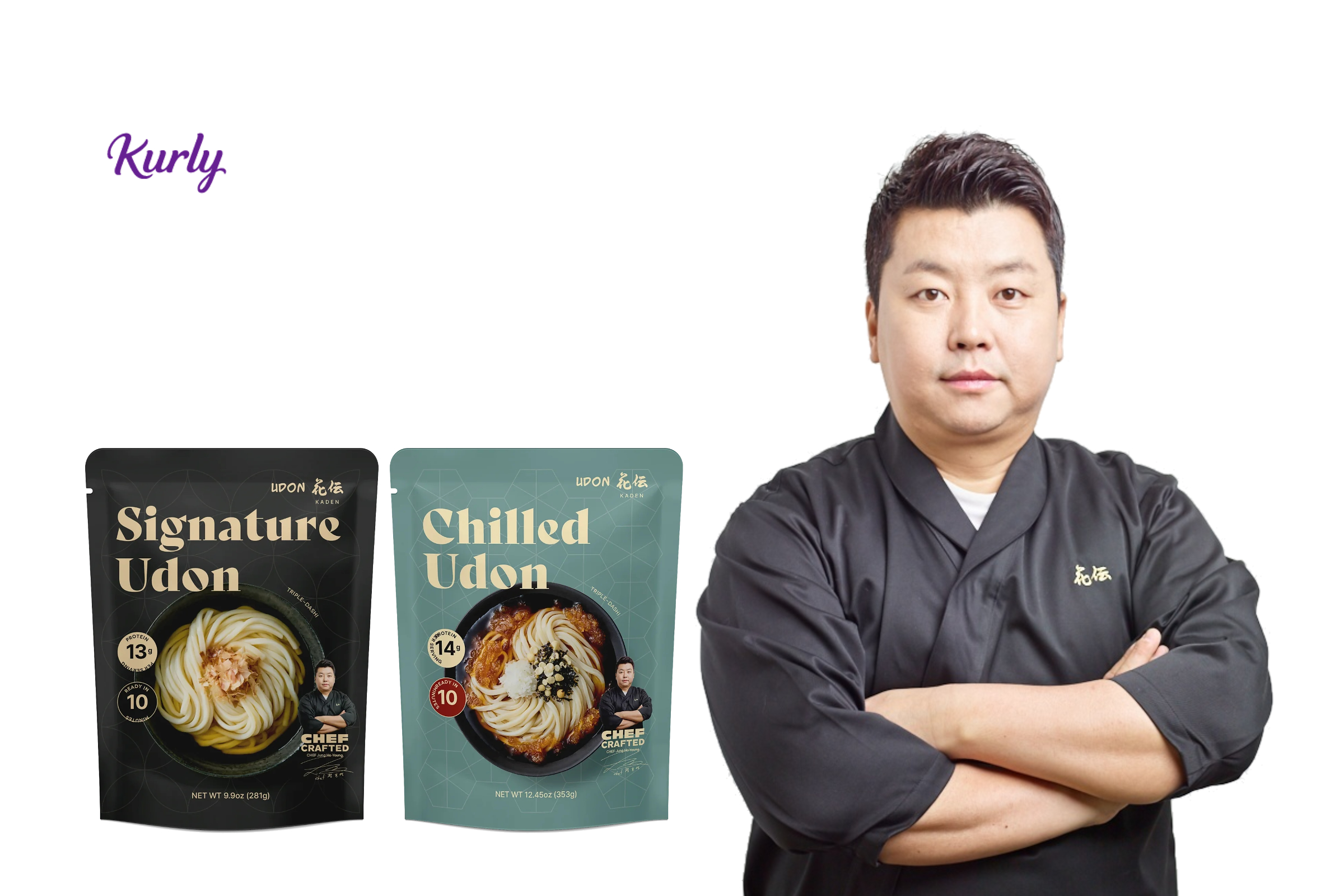
Chef Jung Ho Young's Seoul udon restaurant is now on American freezer shelves. Kurly, the premium Korean food company, has launched two frozen dishes from Udon Kaden — Signature Udon and Chilled Udon — at H Mart, Jagalchi, Mega Mart, and other retail partners, with online fulfillment through Kurlyglobal.com. The rollout marks Kurly's most prominent U.S. retail push to date and gives buyers a case study in how Korean platform operators are converting proven domestic SKUs into cross-border CPG plays.
The Product Logic
Both items translate Udon Kaden's restaurant identity directly into a frozen format. Signature Udon ships fresh-frozen noodles alongside a dashi broth built from kombu, anchovy, and smoked mackerel — a 10-minute cook requiring no culinary skill. Chilled Udon inverts the format: cold noodles, a concentrated dashi-rich sauce, and grated radish, designed for shoppers who want high-umami convenience without hot soup. The simplicity is deliberate. Kurly's model depends on a frozen meal reproducing a restaurant experience faithfully enough that the chef's name on the package carries commercial weight.
That weight is measurable. On Kurly's Korean marketplace, where the line launched first, Signature Udon (listed there as Original Udon) has accumulated nearly 20,000 customer reviews. The full Udon Kaden product page has passed 50,000 combined reviews — a volume of social proof most U.S. frozen-food SKUs never approach at launch. For retail buyers evaluating shelf risk, that data point matters more than any trade-show sample.
Jung's profile adds distribution leverage. He is recognizable to Korean and Korean-American audiences from Netflix's "Culinary Class Wars" Season 2 and the long-running food program "Chef & My Fridge." After training at the Tsuji Culinary Institute in Osaka, he opened the izakaya Kaden and then Udon Kaden, which now operates in Seoul's Yeonhui-dong neighborhood and on Jeju Island. That media footprint shortens the brand-education curve for retailers and reduces paid-awareness spend at launch.
A Repeatable Playbook
Kurly has been running this model in Korea since 2017, partnering directly with chefs and restaurants to convert signature menus into frozen meals. The early U.S. proof point is Mokran, the Chinese-cuisine brand of chef Lee Yeon Bok, which has sold more than 7 million units on the Korean platform. Kurly USA is now widening the lineup with Udon Kaden and Yun Seoul, from chef Kim Do Yun — signaling a pipeline strategy rather than one-off licensing.
To activate the launch, Chef Jung hosted in-store tastings at four California locations on August 22–23: H Mart Buena Park and H Mart Irvine NorthPark in Southern California, and Jagalchi in Daly City and Mega Mart in East Palo Alto in Northern California. The sampling tour follows a distribution footprint concentrated in Asian grocery — a deliberate channel choice that matches the target shopper and limits shelf-competition risk against entrenched mainstream frozen brands.
For operators and retail buyers watching the premium-frozen and global-import segments, Kurly's approach is worth tracking. The company is effectively functioning as a chef-licensing and distribution platform, using its Korean marketplace as a demand-validation engine before committing to U.S. retail SKU introductions. That intelligence loop — launch domestically, collect review data at scale, then export the winners — is a model that food and beverage brand launch teams and retail distribution consultants should be stress-testing against their own pipelines.
Written by Michael Politz, Author of Guide to Restaurant Success: The Proven Process for Starting Any Restaurant Business From Scratch to Success (ISBN: 978-1-119-66896-1), Founder of Food & Beverage Magazine, the leading online magazine and resource in the industry. Designer of the Bluetooth logo and recognized in Entrepreneur Magazine's "Top 40 Under 40" for founding American Wholesale Floral, Politz is also the Co-founder of the Proof Awards and the CPG Awards and a partner in numerous consumer brands across the food and beverage sector.