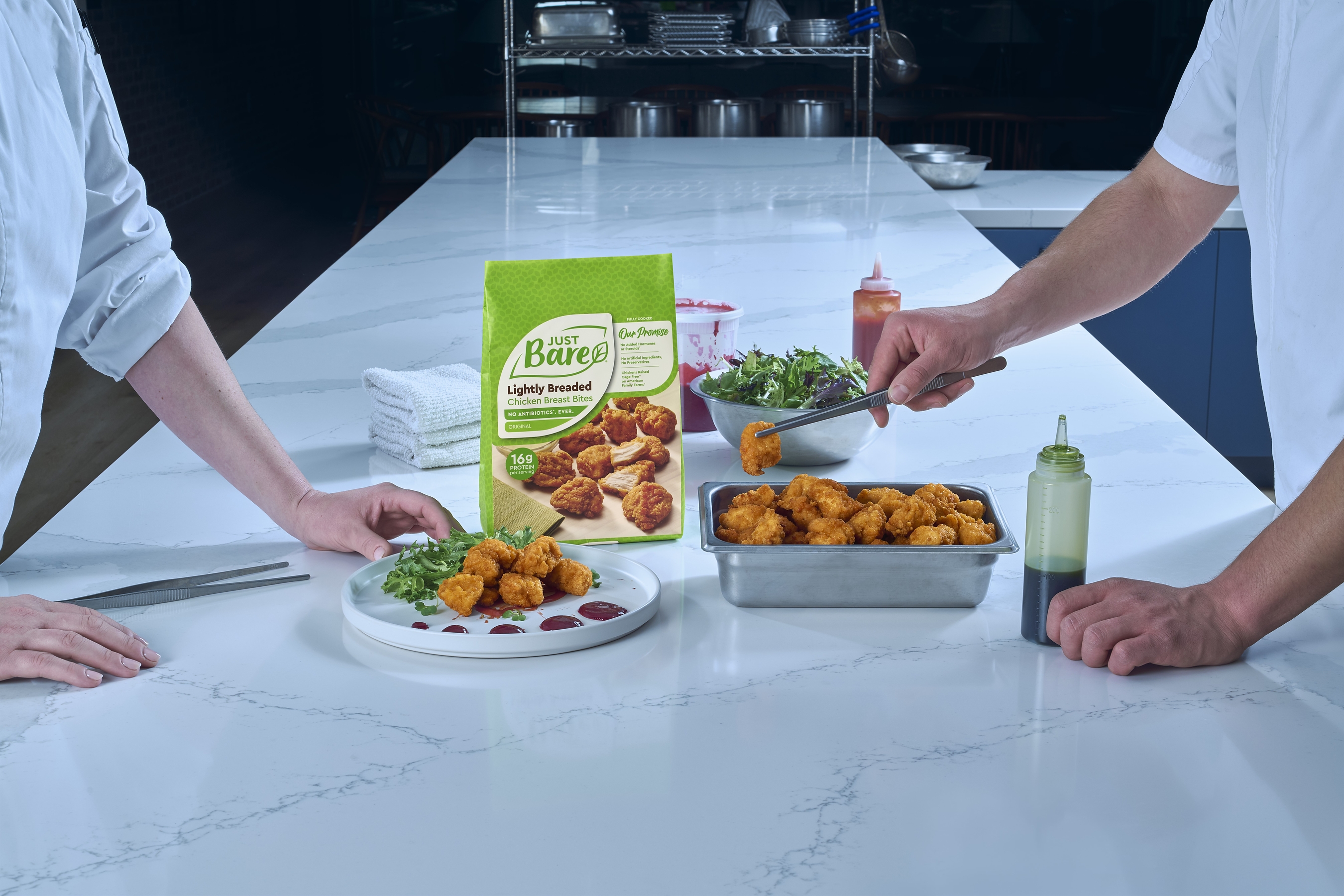
Just BARE, the natural chicken brand owned by Pilgrim's Pride, is running a one-day immersive dining pop-up in New York City on June 18 tied to FX's The Bear — the show's fifth and final season premieres June 25 on FX and Hulu. Chef Courtney Storer, the culinary mind behind the series, designed the menu. Reservations are open now. The event is a single-day, single-location activation, which keeps production costs controlled while maximizing earned media concentration in the days immediately before a major cultural moment.
This kind of timed brand-entertainment partnership is not new, but the mechanics here are worth unpacking for operators and brand marketers alike. Just BARE is a retail product competing in a crowded natural-protein set. Getting onto a table in a curated, character-driven dining environment — weeks before millions of viewers return to a show obsessed with culinary craft and kitchen culture — is a targeting play disguised as a food event. The audience self-selects: food-forward, quality-conscious, exactly the consumer a premium chicken brand needs at point-of-decision in the grocery aisle.
For brands considering similar moves, the procurement and partnership structure matters as much as the creative. Entertainment IP holders like FX are increasingly open to co-branded experiential integrations when the brand narrative aligns — The Bear is built on sourcing, technique, and ingredient integrity, which gives Just BARE a credible on-ramp that a commodity protein brand would not have. Brands exploring this lane should be building their brand launch and media kit infrastructure well in advance of any outreach to IP or network partners, because the pitch timeline compresses fast once a premiere date is locked.
From an operator-intelligence standpoint, the pop-up format is doing several jobs simultaneously: generating press placement, creating social content inventory, driving trial, and building retailer confidence by demonstrating that the brand commands cultural attention outside the store shelf. Emerging food brands pitching retail buyers in Q3 and Q4 2026 should note that experiential activations tied to media moments are increasingly appearing in buyer decks as proof of marketing investment — a signal that the brand can pull consumers, not just push product. That dynamic is worth tracking as food and beverage brand launch strategies continue to evolve.
The broader takeaway for operators and brand founders: entertainment co-branding is now a viable media channel for food brands with a credible story, but the window of relevance is narrow and the logistics are demanding. The brands executing this well are treating it as a paid-media extension with a PR multiplier, not a vanity project — and they are building the infrastructure to capture and redeploy the content long after the one-day event closes.
Written by Michael Politz, Author of Guide to Restaurant Success: The Proven Process for Starting Any Restaurant Business From Scratch to Success (ISBN: 978-1-119-66896-1), Founder of Food & Beverage Magazine, the leading online magazine and resource in the industry. Designer of the Bluetooth logo and recognized in Entrepreneur Magazine's "Top 40 Under 40" for founding American Wholesale Floral, Politz is also the Co-founder of the Proof Awards and the CPG Awards and a partner in numerous consumer brands across the food and beverage sector.