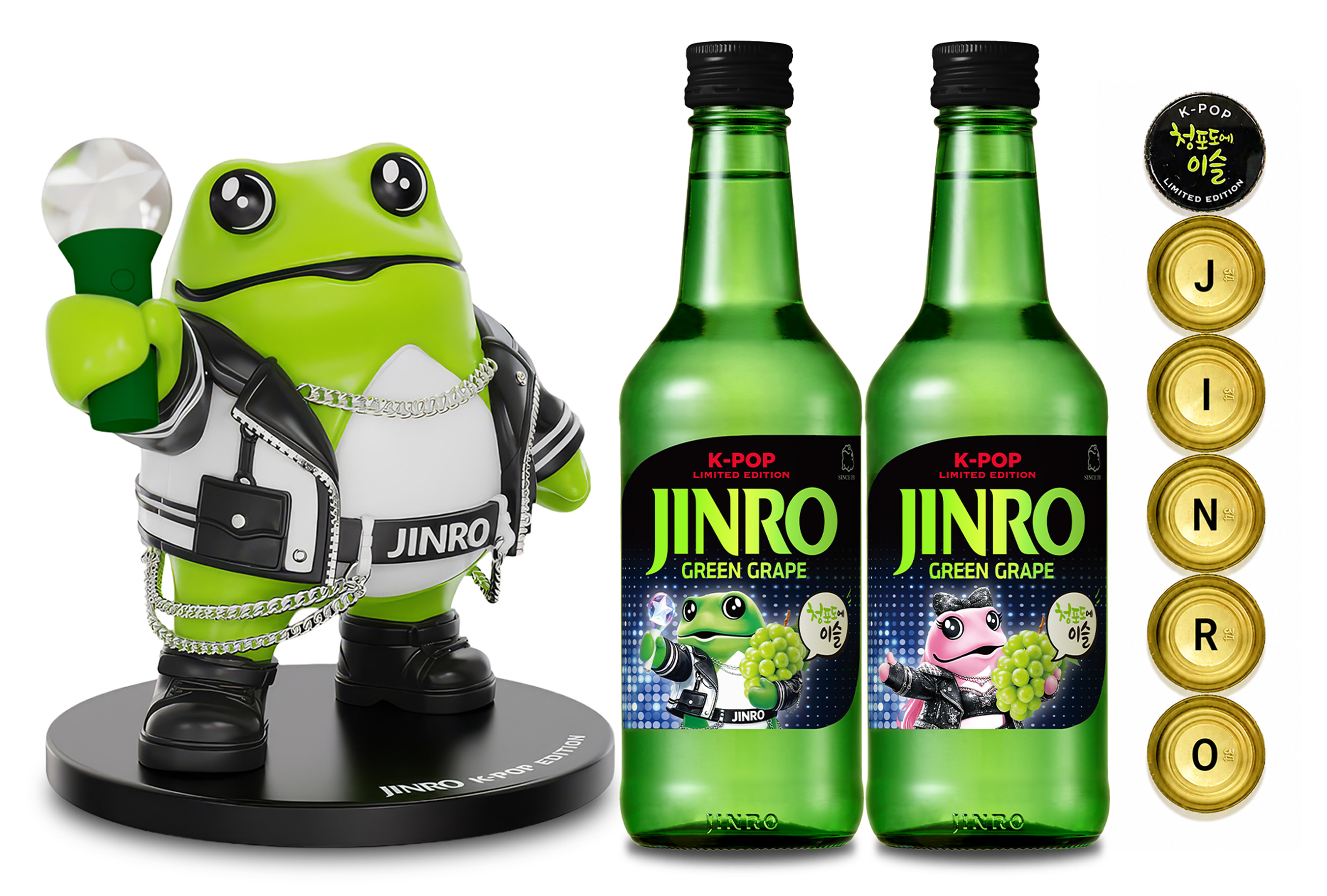
The world's best-selling spirits brand is deploying K-POP aesthetics as a shelf-differentiation and consumer-engagement tool. JINRO, the flagship soju label of HiteJinro, has launched a global limited-edition 'K-POP Star Toad' Green Grape expression — its top-performing fruit liqueur in international markets — designed to capitalize on sustained global appetite for Korean culture.
The limited-edition SKU holds the same 13% ABV and flavor profile as the standard Green Grape, so on-premise operators and retail buyers don't face a product-training burden. What changes is the packaging: JINRO's iconic Toad mascot is reimagined as a K-POP stage performer across two colorways, Green and Pink, explicitly positioned as collectibles rather than shelf staples. That framing matters for buyers — collectible packaging drives incremental velocity without requiring a permanent planogram shift.
The Consumer Activation Layer
Beyond packaging, JINRO is running a 'Message Challenge' mechanic: alphabet letters printed on the underside of bottle caps, inviting consumers to collect and arrange them into personalized phrases to share on social media. Two exclusive promotional items — a collectible figurine and a bottle-shaped microphone — accompany the launch as trade and consumer merchandise. For operators, that kind of built-in social loop can extend promotional lift well past the initial drop date and reduce the paid-media spend needed to sustain awareness.
Jung-ho Hwang, Head of Overseas Business at HiteJinro, framed the play directly: the goal is to use K-culture as a bridge to the global mainstream while reinforcing the Toad mascot as a recognizable brand property across markets. That dual objective — cultural relevance plus mascot equity-building — is increasingly the architecture behind spirits brand extensions aimed at Gen Z and millennial international consumers.
What This Signals for Buyers and Operators
For beverage directors and retail buyers assessing this SKU, the strategic read is straightforward: JINRO is using a limited-edition mechanism to test appetite in new geographies without introducing a permanent new SKU that requires ongoing replenishment commitments. That makes trial low-risk for on-premise accounts that want to merchandise around K-culture moments — restaurant weeks, K-pop events, or Asian heritage programming — without locking into long-term inventory.
For the broader spirits and beverage category, this release is a data point in a larger trend: culturally anchored limited editions are outperforming generic seasonal packaging because they give retail staff and servers a story to tell. Operators who've piloted K-spirits programming report that flavored soju — particularly fruit expressions under 15% ABV — punches above its weight in low-ABV cocktail menus and at the bar rail when positioned as an affordable premium pour.
On the brand-launch and distribution side, the cap-collect mechanic is worth watching as a low-cost loyalty driver that doesn't require an app or loyalty program infrastructure. Suppliers and brand managers should note that this type of analog engagement loop can generate user-created content at scale, effectively turning packaging into a media channel. For operators evaluating how to merchandise limited-edition spirits drops, that organic content layer reduces the promotional budget required to sustain a window event.
Written by Michael Politz, Author of Guide to Restaurant Success: The Proven Process for Starting Any Restaurant Business From Scratch to Success (ISBN: 978-1-119-66896-1), Founder of Food & Beverage Magazine, the leading online magazine and resource in the industry. Designer of the Bluetooth logo and recognized in Entrepreneur Magazine's "Top 40 Under 40" for founding American Wholesale Floral, Politz is also the Co-founder of the Proof Awards and the CPG Awards and a partner in numerous consumer brands across the food and beverage sector.