Jefferson's Bourbon has refreshed its entire portfolio with new packaging and two meaningful liquid updates — most notably, an 8-year minimum age statement and a proof increase to 96 on Jefferson's Reserve. For on-premise buyers and spirits program directors, this is the kind of substantive SKU evolution that warrants a menu review, not just a shelf reset.
What Changed in the Bottle
The Reserve expression is the headline. Ale Ochoa, Jefferson's Master Blender, describes the updated liquid as built from older, more mature barrels selected with intention: dark fruit and vanilla custard on entry, followed by baking spice, oak, and toasted almond through a long, spicy finish. The proof jump from its previous spec to 96 gives bartenders more to work with in stirred cocktails while still holding up as a neat pour. Separately, Jefferson's Very Small Batch Bourbon moves to 88 proof, a modest bump the brand says improves both flavor and cocktail versatility. For bar programs running a tiered bourbon selection, that proof increase on Very Small Batch puts it in a more useful spec range for high-volume mixed applications.
Packaging as a Navigation Tool
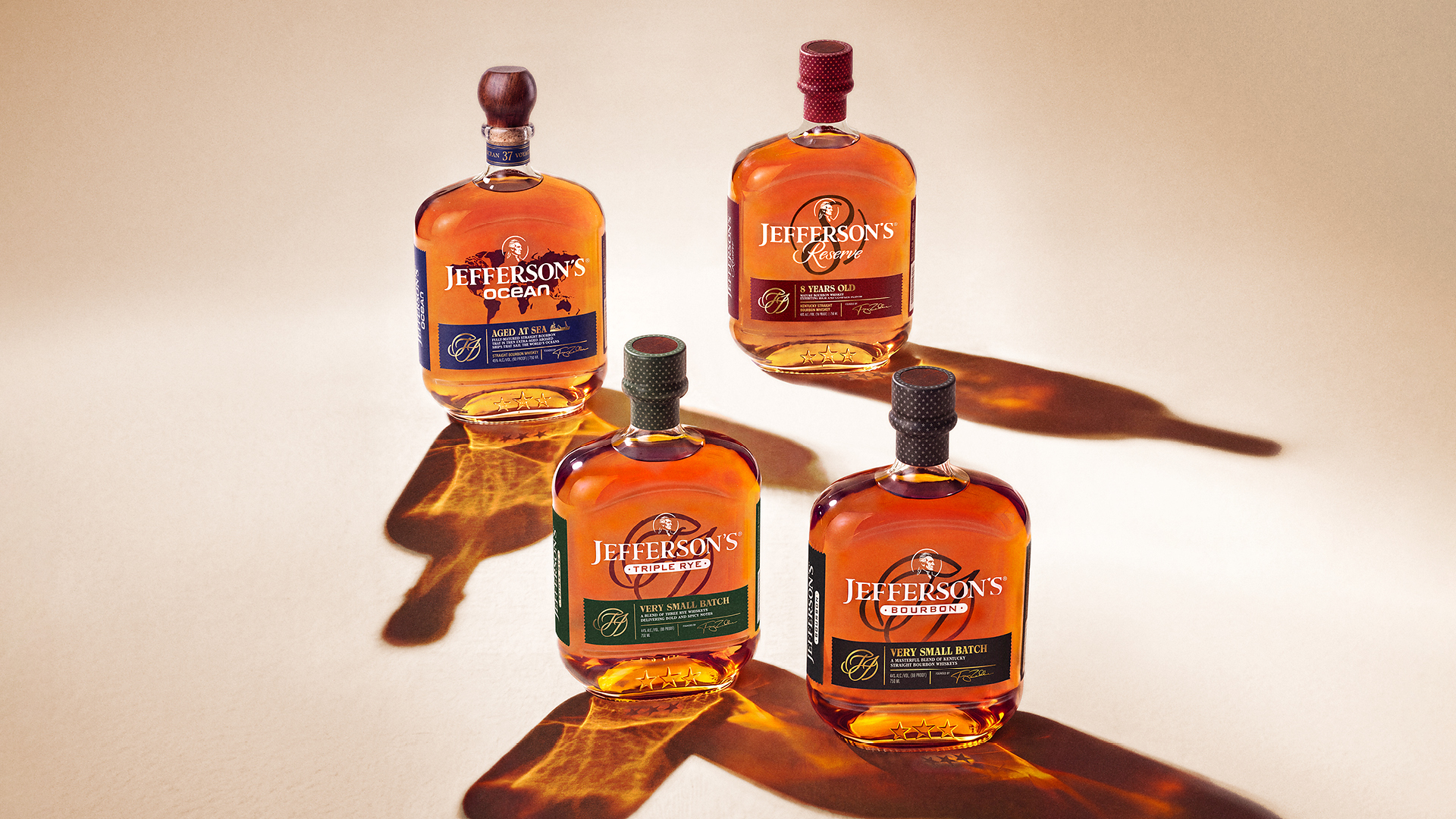
Beyond the liquid, the portfolio-wide packaging redesign is aimed squarely at shelf and back-bar legibility. The new bottles are built around a cleaner, more cohesive visual system — a practical move for any retail or on-premise account carrying multiple Jefferson's expressions. The four core SKUs (Very Small Batch, Triple-Rye, Reserve 8-Year, and Ocean Aged at Sea) now read as a family rather than a collection of one-offs, which simplifies staff training and customer-facing merchandising. The 750ml rollout is already moving through spirits shops, restaurants, and bars nationally; 375ml, 1L, and 1.75L formats are slated to follow later in 2026.
What This Signals for Bourbon Procurement
Age statements are returning to American whiskey as a credibility lever, particularly in the premium-and-above tier where on-premise guests are increasingly label-literate. Jefferson's move to lock in a minimum 8-year claim on Reserve aligns with a broader category shift: brands backed by large spirits groups — here, Pernod Ricard USA — are using verified age statements to justify price positioning in a bourbon market that has seen retail shelf prices under pressure. For procurement managers building a spirits program, an age-stated expression from an established brand typically carries lower buyer-education overhead than a non-age-stated premium offering at the same price point.
For operators managing bourbon selections across a multi-unit footprint, this is also a signal to audit current Jefferson's POS materials and menu copy — the old specs (proof, age) will need to be updated across digital menus, cocktail lists, and any printed collateral. Distributors will likely offer updated sell sheets and staff training materials as part of the relaunch support. Confirm availability of the new packaging before reprinting anything.
For deeper context on how proof changes and age statements are influencing bourbon program design, see our coverage in Operator Intelligence and the beverage trend breakdowns running through the Brand Launch Department.
Written by Michael Politz, Author of Guide to Restaurant Success: The Proven Process for Starting Any Restaurant Business From Scratch to Success (ISBN: 978-1-119-66896-1), Founder of Food & Beverage Magazine, the leading online magazine and resource in the industry. Designer of the Bluetooth logo and recognized in Entrepreneur Magazine's "Top 40 Under 40" for founding American Wholesale Floral, Politz is also the Co-founder of the Proof Awards and the CPG Awards and a partner in numerous consumer brands across the food and beverage sector.