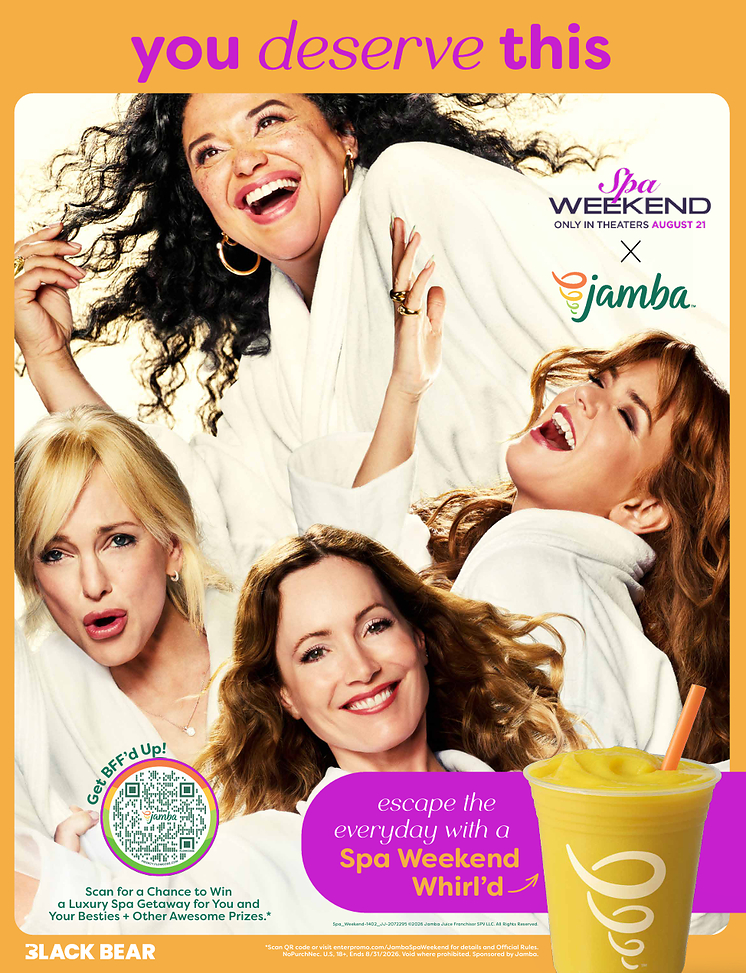
Entertainment co-branding is back as a legitimate LTO growth lever, and Jamba is running the playbook cleanly. The GoTo Foods smoothie chain launched the Spa Weekend Whirl'd smoothie on August 3 in conjunction with Spa Weekend, a comedy from Black Bear set to hit theaters August 21 — giving the campaign a natural media moment and a built-in audience already primed by film marketing.
The smoothie itself is a mango-peach-pineapple-ginger blend available at participating locations through August 31, 2026. Every purchase includes a co-branded reusable koozie, adding a physical brand touchpoint that extends beyond the transaction. Jamba is simultaneously running a sweepstakes for a three-person spa trip to Costa Rica, with five runner-up prize kits containing a bathrobe, slippers, a branded ice bath, and Jamba and Fandango gift cards.
The Co-Brand Mechanics
What operators should note here is the layering. Jamba isn't just slapping a movie logo on a cup. The campaign runs on at least four activation points: the LTO product, the in-hand merchandise, the sweepstakes driving digital entry and first-party data capture, and the loyalty loop — every piece of campaign messaging routes back to Jamba Rewards enrollment at jamba.com. Kate Morgan, Vice President of Marketing at Jamba, framed it directly: the partnership is designed to create shared-moment marketing, turning a smoothie purchase into a social occasion tied to a cultural release.
For a franchise system now operating over 750 locations across 36 U.S. states and 8 countries and territories, the risk profile on a 28-day LTO is low and the upside — incremental traffic from film audiences, press pickup ahead of the August 21 theatrical release, and sweepstakes-driven email acquisition — is measurable. GoTo Foods, the Atlanta-based parent behind Jamba, Cinnabon, Auntie Anne's, and five other brands, has enterprise-scale marketing infrastructure that makes this kind of coordinated campaign executable at speed.
What This Signals for Operators
Entertainment IP deals have historically skewed toward QSR giants, but mid-size and emerging fast-casual brands are increasingly finding access through independent studios and streaming-adjacent releases rather than Marvel-level franchises. Black Bear, the studio behind Spa Weekend, also distributes films independently in the U.S., U.K., and Canada — a leaner deal structure that likely made this partnership more accessible than a major-studio tie-in.
For operators evaluating similar moves, the mechanics worth benchmarking here are the merchandise-with-purchase koozie (low COGS, high perceived value, organic social amplification), the sweepstakes as a first-party data engine, and the film release date as a built-in PR window. Brands considering entertainment co-branding for a product launch should also assess whether their loyalty infrastructure can capture the entry-to-enrollment conversion — that's where the long-term return actually lives.
The broader trend is accelerating. As paid digital acquisition costs continue to climb across restaurant growth marketing channels, co-brand partnerships that deliver press coverage, social content, and in-store traffic simultaneously are earning a harder look from marketing teams managing tighter cost-per-visit targets.
Written by Michael Politz, Author of Guide to Restaurant Success: The Proven Process for Starting Any Restaurant Business From Scratch to Success (ISBN: 978-1-119-66896-1), Founder of Food & Beverage Magazine, the leading online magazine and resource in the industry. Designer of the Bluetooth logo and recognized in Entrepreneur Magazine's "Top 40 Under 40" for founding American Wholesale Floral, Politz is also the Co-founder of the Proof Awards and the CPG Awards and a partner in numerous consumer brands across the food and beverage sector.